




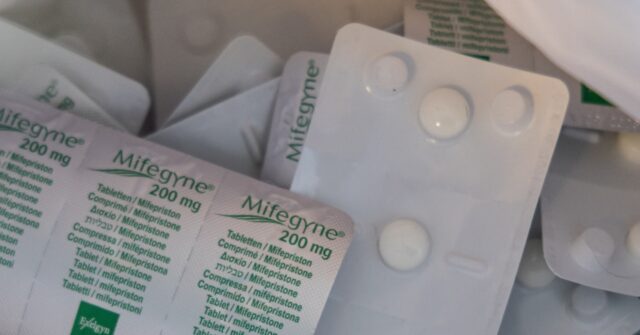
Sen. Josh Hawley (R-MO) announced on Wednesday that he plans to introduce legislation that would ban the drug mifepristone from being used for abortions.
Hawley announced the bill, called the “Safeguarding Women from Chemical Abortion Act,” at a press conference on Capitol Hill amid Republicans’ fight against the flood of abortion pills into red states enabled by the U.S. Food and Drug Administration’s (FDA) deregulation of the drug.
The bill would withdraw the FDA’s approval of mifepristone for abortion, make distributing and labeling mifepristone for pregnancy termination a violation of federal law, and empower women who believe they have been harmed by abortion drugs to sue the manufacturers for damages.
“The science is clear: the chemical abortion drug is inherently dangerous to women and prone to abuse. Yet major companies like Danco Laboratories are making billions off it,” Hawley said in a statement. “That’s why I am introducing new legislation to ban the use of mifepristone for abortion and empower women to sue its manufacturers. Congress must act now to protect the health and safety of women.”
Hawley referenced a recent study from the Ethics and Public Policy Center (EPPC) that found 10.93 percent of women who had mifepristone abortions experienced severe complications including sepsis, infection, hemorrhaging, or another serious adverse event within 45 days following the abortion. The percentage is significantly higher than the less than 0.5 percent in clinical trials reported on the FDA-approved drug label. The study is based on analysis of data from an all-payer insurance claims database that includes 865,727 prescribed mifepristone abortions from 2017 to 2023.
The study has led the FDA and HHS to conduct a safety review of the abortion pill, which the agencies said is ongoing. However, Republicans and pro-life groups have accused the agencies of slow-walking the review and enabling abortionists in Democrat-led states with shield laws to circumvent pro-life laws in red states.
In a medication abortion, mifepristone — also called by the brand name Mifeprex created by Danco Laboratories — blocks the action of progesterone, which the mother’s body produces to nourish the pregnancy. When progesterone is blocked, the lining of the mother’s uterus deteriorates, and blood and nourishment are cut off to the developing baby, who then dies inside the mother’s womb. The drug misoprostol (also called Cytotec) then causes contractions and bleeding to expel the baby from the mother’s uterus.
In 2023, medication abortions accounted for 63 percent of all abortions within the formal U.S. healthcare system — meaning an estimated 642,700 unborn babies died in medication abortions, according to the pro-abortion Guttmacher Institute. The percentage was up from an estimated 53 percent in 2020 and 39 percent in 2017. The report did not account for abortion pills obtained through underground national and international networks, including those that send pills to women in states with abortion restrictions.
Mifepristone was fast-tracked for approval in 2000 during the Clinton administration under a process that required unwanted pregnancy to be classified as a “serious or life-threatening illness.” Original safety regulations around the drug were then chipped away by the pro-abortion Obama and Biden administrations.
In 2021 under former President Joe Biden, the FDA removed the in-person dispensing requirement for abortion pills and allowed them to be sent via mail. That action, combined with shield laws in blue states, have allowed abortionists to mail abortion pills into red states with laws protecting the unborn.
The FDA also stopped requiring prescribers to report serious adverse events other than deaths in 2016.
Rep. Diana Harshbarger (R-TN), who is introducing companion legislation in the House, said that as a pharmacists, she believes “every drug approved in the United States must meet the highest standards of safety, transparency, and medical oversight.”
“Yet the FDA under previous administrations has steadily dismantled critical safety safeguards surrounding the abortion drug mifepristone — removing in-person dispensing requirements, allowing the drug to be shipped through the mail, and limiting adverse-event reporting so that most serious complications are no longer tracked,” Harshbarger said in a statement.
“Evidence now suggests that the real-world risks to women are far greater than the federal government has acknowledged. That’s why I’m proud to join Senator Hawley in introducing the Safeguarding Women from Chemical Abortion Act, to restore accountability and help ensure that women’s health — not politics — guides federal drug policy,” she continued.
RELATED: Online Map Tracks ‘Scumbags’ Who Coerce Pregnant Women into Taking Abortion Pills
At the press conference, Hawley had several women who say they have suffered serious health and emotional consequences from using mifepristone tell their stories.
One woman, a nursing student attending school in Maryland named Shanyce Thomas, said she suffered a serious infection after taking the abortion, resulting in her having a partial hysterectomy.
“I developed a severe infection behind my uterus that went undetected until it became life-threatening. My condition deteriorated so rapidly that I was rushed into the ICU,” she said. “I was [in a] medically induced coma for a month. During this time, I required several blood transfusions.”
The legislation is supported by several conservative and pro-life groups, including: Susan B. Anthony Pro-Life America, Family Research Council, Alliance Defending Freedom, Concerned Women for America, Live Action, Students for Life of America, Ethics and Public Policy Center, and the American Association of Pro-Life OBGYNs.
Katherine Hamilton is a political reporter for Breitbart News. You can follow her on X @thekat_hamilton.
Read the full article here


