


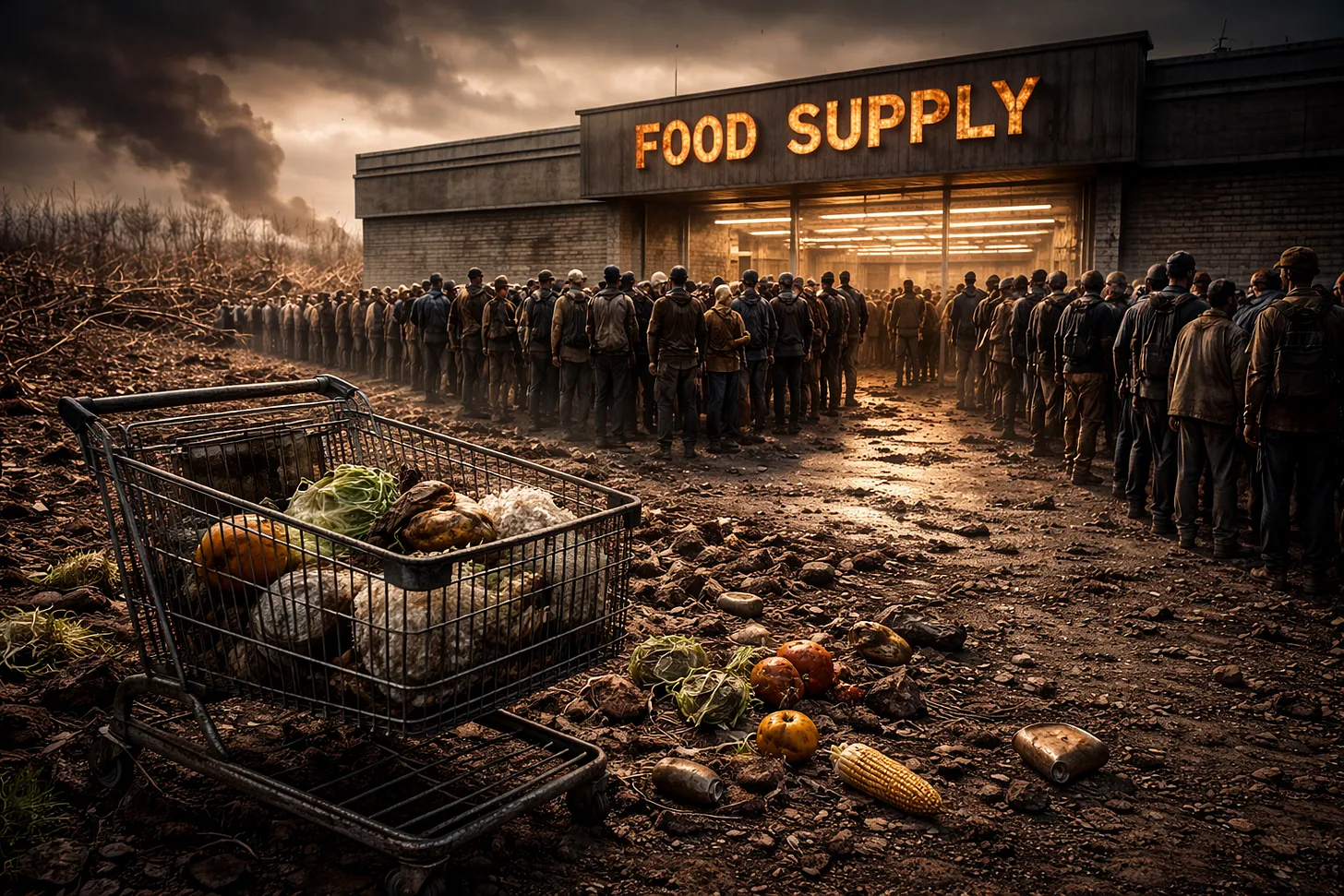
A Fragile System Built on Invisible Inputs
The modern global food system, often perceived as vast, resilient, and technologically advanced, rests on a surprisingly fragile foundation—fertilizers. These chemical inputs, largely invisible to the average consumer, sustain nearly half of global food production. Without them, the abundance of supermarkets, the predictability of harvests, and the stability of food prices would rapidly unravel.
Recent disruptions in fertilizer supply chains, intensified by geopolitical conflict, energy crises, and trade fragmentation, are exposing just how precarious this foundation truly is.
What makes the situation particularly alarming is not merely the shortage itself, but the interconnected web of dependencies it reveals. Fertilizers depend on natural gas. Global trade depends on chokepoints. Agricultural productivity depends on timing. When one element falters, the entire system begins to tremble.
And today, it is not just trembling—it is beginning to fracture.
EXCLUSIVE VIDEO: Inside Factory Farms – Hidden Camera Footage Reveals What Really Happens Behind Closed Doors!
The Anatomy of a Crisis: Why Fertilizers Matter More Than Ever
To understand the magnitude of the threat, one must first grasp the scale of dependence:
- Roughly 50% of global food production relies on synthetic nitrogen fertilizers
- Fertilizer costs account for up to 25% of total agricultural production expenses
- Global fertilizer prices surged 18% in 2025 alone, remaining above pre-pandemic levels
These are not marginal inputs—they are the backbone of industrial agriculture.
Yet, the supply of fertilizers is uniquely vulnerable due to:
- Energy dependence (especially natural gas for nitrogen fertilizers)
- Geopolitical concentration (key exporters clustered in unstable regions)
- Logistical chokepoints (notably the Strait of Hormuz)
Recent events have demonstrated how quickly these vulnerabilities can cascade into crisis.
A Perfect Storm: War, Energy, and Supply Chain Collapse
In 2026, escalating conflict in the Middle East has triggered one of the most severe disruptions to fertilizer markets in recent history. The Strait of Hormuz—through which a significant share of global fertilizer inputs passes—has become a bottleneck of global consequence.
- Urea prices have surged dramatically, in some cases rising over 47% since the conflict escalated
- Nearly 50% of global urea exports transit this chokepoint
- Tanker traffic has dropped by more than 90% in extreme scenarios, threatening systemic supply shocks
At the same time:
- Natural gas prices—essential for fertilizer production—have spiked
- Major exporters such as China and Russia have restricted exports
- Insurance and shipping risks have slowed global trade
The result is a cascading failure across agricultural systems worldwide.
Farmers, already operating on thin margins, are now faced with impossible choices:
- Apply less fertilizer and risk lower yields
- Switch crops to less input-intensive varieties
- Or, in extreme cases, abandon planting altogether
The Human Cost: Hunger, Inflation, and Global Inequality
The consequences of fertilizer shortages extend far beyond farms. They ripple through entire economies and societies, disproportionately affecting the most vulnerable.
Recent projections and warnings are stark:
- Up to 45 million additional people could face acute hunger due to rising costs and disruptions
- Developing nations, heavily reliant on imports, face the greatest risks
- Food prices are expected to surge globally, affecting staples like wheat, rice, and maize
In many regions, the crisis manifests in subtle but devastating ways:
- Farmers selling produce at 50% below normal prices due to logistical disruptions
- Reduced planting leading to future supply shortages
- Governments imposing export bans to protect domestic markets
These reactions, while understandable, often worsen the global situation by fragmenting already strained supply chains.
A Slow-Burning Catastrophe: What Happens If Nothing Changes
Perhaps the most unsettling aspect of the fertilizer crisis is its delayed impact. Unlike sudden disasters, this crisis unfolds gradually, quietly embedding itself into future harvest cycles.
If no significant action is taken, the world may face a multi-stage collapse:
1. Immediate Phase (0–12 months)
- Fertilizer prices spike
- Farmers reduce usage
- Crop yields decline modestly
2. Short-Term Phase (1–3 years)
- Global grain reserves begin to shrink
- Food prices surge significantly
- Import-dependent countries face shortages
3. Medium-Term Phase (3–7 years)
- Soil fertility degrades due to under-fertilization
- Agricultural productivity declines structurally
- Food insecurity becomes chronic in vulnerable regions
4. Long-Term Phase (7–15 years)
- Global food systems fragment into regional blocs
- Persistent famine risks emerge
- Political instability and migration pressures intensify
This is not speculative fiction—it is consistent with historical precedents. The fertilizer shortages of 2022, for example, contributed to significant spikes in global food prices and reduced yields in several African nations .
The Dark Undercurrent: Structural Fragility and Hidden Dependencies
Beyond the visible crisis lies a deeper, more unsettling reality: the global food system is structurally fragile.
A few key insights illustrate this:
- A small number of countries dominate fertilizer production and export
- Supply chains are optimized for efficiency, not resilience
- Critical inputs depend on politically unstable regions
This concentration creates what some analysts describe as a “single point of failure” system.
Even more concerning is the possibility—often dismissed but increasingly discussed—that such vulnerabilities could be leveraged strategically.
While not necessarily the result of coordinated intent, the alignment of:
- Trade restrictions
- Resource nationalism
- Strategic chokepoint disruptions
raises uncomfortable questions about whether global food supply could be influenced—or even weaponized—through control of fertilizer flows.
At the very least, the system is dangerously exposed.
Farm-Level Reality: The Crisis on the Ground
For farmers, the crisis is not theoretical—it is immediate and deeply personal.
Reports from multiple regions highlight:
- Fertilizer costs rising to over $166 per acre for some crops in 2026
- Some growers reporting they will run out of fertilizer within weeks
- Others considering not planting at all due to input costs
This creates a dangerous feedback loop:
- Higher costs → lower planting
- Lower planting → reduced supply
- Reduced supply → higher prices
And so the cycle accelerates.
Environmental and Systemic Consequences
Ironically, fertilizer shortages also pose environmental risks:
- Reduced fertilizer use can degrade soil over time
- Panic-driven overuse in some regions may increase pollution
- Lower yields may push expansion into fragile ecosystems
Furthermore, shifting crop choices—toward less fertilizer-intensive options—could disrupt global food balance, affecting everything from livestock feed to biofuel production.
Breaking Point: How Close Are We?
Despite the severity of the situation, the global system has not yet collapsed. Food reserves remain relatively stable, and markets have not fully entered panic mode.
However, experts warn that this stability is deceptive.
A prolonged disruption—particularly one lasting three months or more in critical trade routes—could trigger a systemic shock to global food supply .
In other words, the system is not broken—but it is dangerously close to breaking.
What Can Be Done: A Narrow Window for Action
Addressing the fertilizer crisis requires coordinated global action:
- Diversifying supply chains to reduce dependence on key regions
- Investing in alternative fertilizers (organic, bio-based)
- Improving efficiency through precision agriculture
- Building strategic reserves of key agricultural inputs
- Reducing trade restrictions during crises
Yet, these solutions require time, investment, and political will—three resources often in short supply during global crises.
Conclusion: A Crisis We May Not See Until It’s Too Late
The global fertilizer shortage is not a distant or abstract problem. It is a slow-moving, systemic threat that is already reshaping agriculture, economies, and food security.
Unlike sudden disasters, it does not announce itself with dramatic headlines—at least not yet. Instead, it unfolds quietly:
- A farmer uses less fertilizer
- A harvest comes in slightly lower
- Prices rise just enough to strain households
Until, eventually, the cumulative effect becomes impossible to ignore.
If decisive action is not taken, the world may soon face a reality where food is no longer abundant, affordable, or accessible for billions.
And by the time the full scale of the crisis is visible, the damage may already be irreversible.
The most unsettling question is not whether the system will fail—but whether we will recognize the warning signs in time to prevent it.
You’ll Understand Everything After Watching This VIDEO!
Read the full article here