




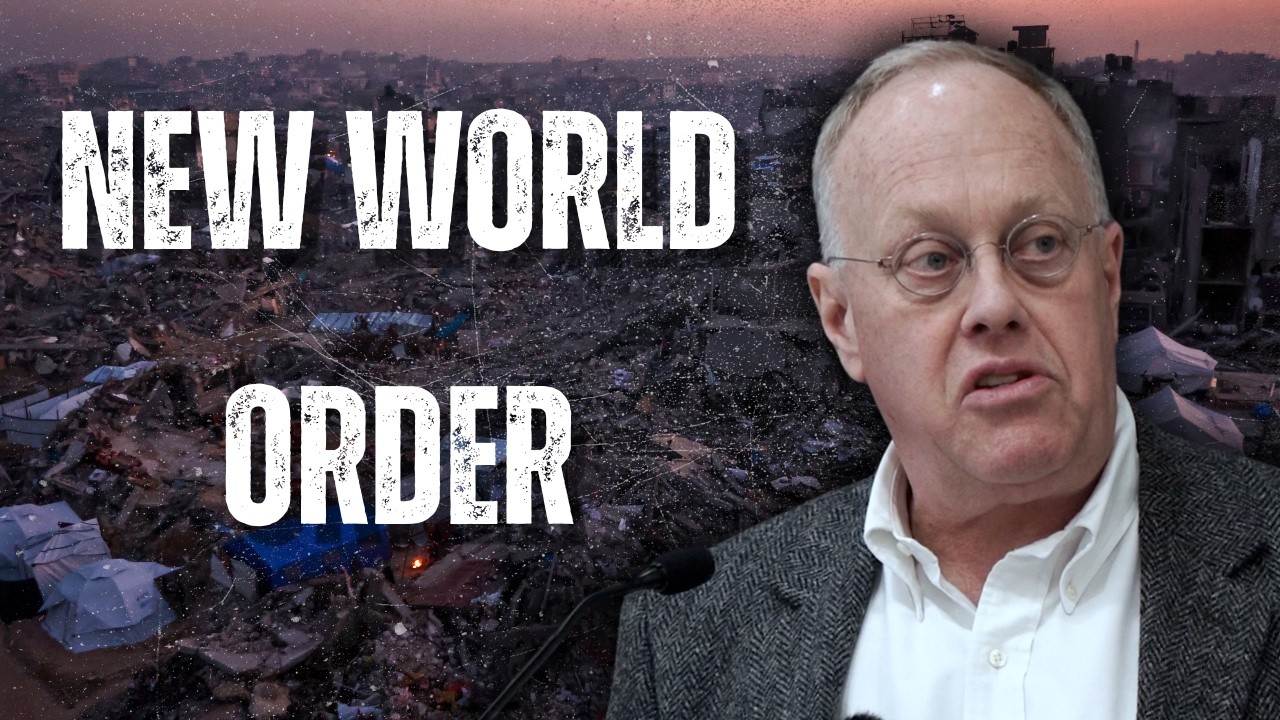
Chris Hedges’ recent speech at Princeton is not simply a commentary on the wars in Gaza, Lebanon, and Iran — it is a sweeping indictment of a global order collapsing into what he calls “technologically advanced barbarism.” Drawing on decades of reporting, historical analysis, and moral philosophy, Hedges argues that the atrocities unfolding today are not isolated events but the opening chapter of a far darker era.
Hedges begins with a blunt thesis: “The genocide in Gaza is the beginning.” The mass displacement of millions, the saturation bombing of civilian populations, and the open defiance of international law signal the death of the post‑World War II framework that once claimed to restrain state violence. Institutions like the United Nations and the International Court of Justice, he says, have been “neutered, transformed into useless appendages of another age.”
What replaces them is a world where “there are no rules for the strong, only for the weak.”


A World Unraveling
Hedges describes a geopolitical landscape in freefall:
- Over 6 million people displaced across Gaza, Lebanon, and Iran.
- A U.S. political class pushed into war with Iran by ideological zealots and lobby pressure.
- A global legal system openly ignored by the very nations that once claimed to uphold it.
The result is a moral vacuum where, as Hedges puts it, “the most psychopathic rulers of human history… have returned with a vengeance.”
The Weaponization of Memory
One of the most provocative sections of the speech examines how Holocaust memory has been distorted to shield state power rather than confront the universal dangers of genocide. Hedges argues that many institutions dedicated to Holocaust remembrance have failed to speak out against the mass killing of Palestinians, revealing a deeper crisis of moral authority.
This silence, he warns, has “imploded the moral authority of Holocaust scholars and Holocaust memorials.”
Genocide as a Western Tradition
Hedges traces a lineage from colonial extermination campaigns to Hiroshima and beyond, arguing that genocide is not an aberration but a recurring instrument of Western empire. Citing Langston Hughes, he reminds the audience that marginalized communities have long understood fascism not as theory but as lived experience.
“Genocide is not an anomaly. It is coded within our DNA.”
The Authoritarian Turn at Home
The repression of student protesters, the blacklisting of dissenting academics, and proposals to revoke broadcasting licenses for critics of U.S. foreign policy are, Hedges argues, the domestic echo of the violence abroad.
A “deadening silence” is descending — the silence that precedes authoritarian consolidation.
“We know where this ends.”
The Real Enemies
In one of the speech’s most striking lines, Hedges rejects the idea that America’s enemies are foreign populations:
“They are not in Palestine. They are not in Lebanon. They are not in Iran. They are here among us.”
These enemies, he says, are the political, corporate, and media elites who envision “a world of slaves and masters.”
A Final Warning
Hedges closes with a stark choice: obstruct or surrender. There are no internal mechanisms left for reform. The machinery of empire, perfected abroad, is turning inward.



Read the full article here


