


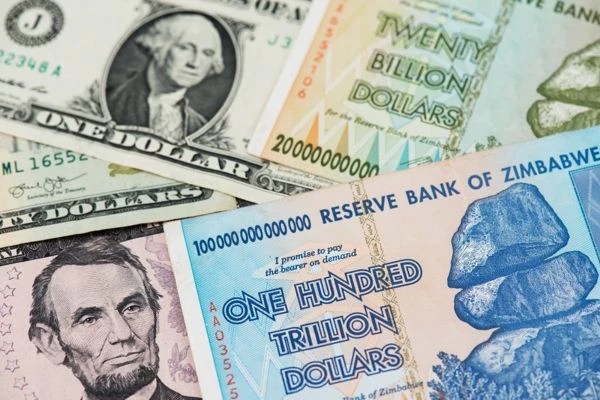
Inflation is an elusive term. In 1983, Webster’s New Universal Unabridged Dictionary defined Inflation as:
“An increase in the amount of currency in circulation, resulting in a relatively sharp and sudden fall in its value and rise in prices: it may be caused by an increase in the volume of paper money issued or of gold mined, or a relative increase in expenditures as when the supply of goods fails to meet the demand.”
However, Investopedia states:
“Inflation is an increase in the average price of goods and services over time.”
A quick check will reveal that Investopedia is not alone in their current definition. The definition has moved away, in large part, from the previous definition of the root cause to now describing a symptom.
But are we splitting hairs here? Does it really matter whether people understand the root cause? Yes, it does, if we wish to understand that inflation sometimes serves a political purpose. As stated by John Maynard Keynes in Economic Consequences of the Peace,
“By a continuing process of inflation, government can confiscate, secretly and unobserved, an important part of the wealth of their citizens.”
If we understand the 1983 Webster’s definition of inflation, it becomes clear that Keynes does not merely imply that governments can benefit from an inflationary situation, should it occur. Governments can actually create the situation through the issuance of currency.
Keynes wrote his book in 1919 and, to say it was a hit with legislators would be an understatement. For the better part of one hundred years, his concepts have been at the centre of the economic policies of governments the world over. (US President Richard Nixon famously stated publicly, when he took the US dollar off the gold standard in 1971, “We’re all Keynesians now.”)
Hyperinflation Defined
So, the reader may take his pick as to which definition of inflation sits best with him, but, fortunately, there is less confusion over the definition of hyperinflation. Hyperinflation is typically defined as:
Ruinously high increase (50 percent or more per month) in prices due to the near total collapse of a country’s monetary system, rendering its currency almost worthless as a medium of exchange.
Not much room for confusion there. Armed with a definition of this condition, we may examine the likelihood of being faced with hyperinflation in the near to not-too-distant future. Certainly, readers of this publication will be aware of the extreme monetary condition most First World countries are presently facing as a result of excessive debt, resulting in considerable inflation (by the1983 definition).
Governments, when queried about the possibility of hyperinflation, are inclined to toss off the possibility, saying, in effect, “We won’t let that happen.” However, the history of hyperinflation indicates otherwise. Whilst governments often do induce inflation (even dramatic inflation) consciously, it is safe to say that they are unlikely to create hyperinflation consciously. Quite the opposite, in fact. What generally occurs is that they keep inflating until, unintentionally, the dam breaks. Hyperinflation, typically, is like a hurricane – an unstoppable and destructive force that, once begun, takes on a life of its own.
A History of Hyperinflation
Here are a few interesting facts about hyperinflation that are not commonly known:
- Hyperinflation, historically, only occurs in connection with fiat currencies.
- The first case of hyperinflation, following the introduction of paper currency units, occurred from 1789 to 1796, during the French Revolution.
- All other cases of hyperinflation (over 27 of them, so far) have occurred since the publication of Keynes’ book and the adoption of his economic principles.
- Five occurrences took place in the 1920s.
- Four occurrences took place in the 1940s.
- Eighteen occurrences took place in the 1980s – 1990s.
The occurrences took place in capitalist, socialist and communist countries. In Asia, South America, Central America, Europe and Africa. They are therefore not dependent upon a particular form of government or social structure. They happen specifically as a result of a major creation of fiat currency units over a short time.
What of Europe and America?
So, is hyperinflation on the way for Europe and America? This may not be a certainty, but it is quite possible and may be described as “likely.”
At present, the US is not far from the inflationary level that has historically triggered hyperinflation. If we consider this, we may resolve to keep an eye on the situation, so that we are not taken by surprise. After all, hyperinflation is the economic equivalent of a hurricane and is just as devastating a situation to be caught in.
The question, however, is whether “keeping an eye on the situation” will do the trick. The trouble is, hyperinflation happens rather suddenly. In the 1920s, for example, inflation had been on the rise for some time in Weimar Germany when it suddenly took off, reaching 16,579,999%. In just a few months, the notes had become, literally, worth less than the paper they were printed on, prompting Germans to use them as kindling and wallpaper.
To those readers who may be uncertain as to whether they need to take precautionary measures to protect their wealth, they may wish to consider the above, particularly in the light that, if the hyperinflation hurricane hits, there is likely to be little, if any, warning. Whatever portion of your wealth is now in fiat currency, may well become worthless.
It should be said that many people who may presently be exposed to the upcoming hyperinflation will say, “But I don’t have any wealth to speak of. What I have in the bank is not enough to buy a new car.”
If this is your situation, you are not alone. There are literally tens (and possibly hundreds) of millions of people in the First World whose situation is similar. For those people, a good rule of thumb may be to maintain, say, three months’ expenses in cash, and move any amount over that into something that does not lose its value (e.g., precious metals) in a hyperinflationary period.
Editor’s Note: History shows that monetary hurricanes don’t announce themselves politely—they arrive when confidence quietly gives way to panic. If the arguments laid out above have prompted you to reconsider what inflation really is, the logical next question becomes: How do you protect yourself when faith in paper money breaks down?
That question leads directly to gold.
In the following free video dispatch, legendary investor Doug Casey explains why gold has survived every monetary collapse in history—and why the mainstream media consistently avoids discussing its most important role. Casey strips away the myths, the distractions, and the comforting half-truths to reveal what gold is actually for when currencies fail.
Click here to watch the video now to understand what the headlines won’t tell you—and why waiting until the storm is obvious may already be too late.
Read the full article here