


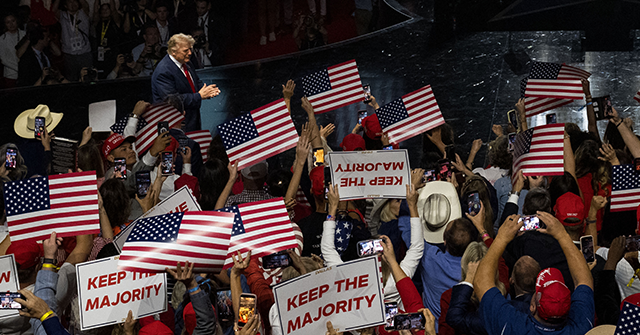
With fewer than 50 days to go until the election, Republicans have emerged from last week’s RNC midterm convention with signs that their momentum is growing in key Senate races.
Legacy media is working overtime to crush the spirit of Republican voters across the country. Their bogus polls, softball interviews, and TV hacks want Republicans to stay home this election, but the reality on the ground in these battleground states shows a very different picture: Republicans with the wind at their back.
Days after the convention in Dallas, the Democrat-held New Hampshire flipped to a toss-up race, and a new Minnesota poll put Michele Tafoya tied in a state Republicans haven’t won statewide in two decades. Various Michigan polls show the race in a dead heat. Meanwhile, races in Georgia, Iowa, North Carolina, and Ohio remain competitive, setting up a final seven weeks in which several states could prove decisive.
What was once a race that the media wrote off for the Democrats, New Hampshire is now one of the most competitive races in the country. A September 14 poll shows Republican John Sununu and Democrat Chris Pappas tied, and Cook Political Report moved the race from “Lean Democrat” to “Toss Up.”
As Sununu looks to become the Granite State’s only Republican in Washington, DC, Republicans, Democrats, and Independents are rallying around him. He hosted a Unity Breakfast with the New Hampshire Republican Party on September 14 where he appeared with Scott Brown, who he defeated in the New Hampshire primary just weeks ago.
Pappas, on the other hand, is panicking over the race becoming a toss-up, raising the red flag to supporters in a campaign update titled “I won’t sugarcoat this.” He admitted, “This race is tightening, and we have a lot of work to do,” before begging supporters for more money.
The red shift is growing even in traditionally blue Minnesota. Following August’s primaries in Minnesota, Democrat candidate Peggy Flanagan held a five point lead over Tafoya. Now, the race is tied with each candidate at 42 percent according to Minnesota’s top pollster.
Flanagan served as lieutenant governor under Tim Walz for eight years, and the Walz-Flanagan administration oversaw more than $9 billion in alleged fraud. That has only hurt Flanagan in her run for Senate, as Minnesota voters list fraud as a top issue in this year’s race.
Meanwhile, former NFL sideline reporter Tafoya is gaining steam and is hopeful for a win that Republicans haven’t had in a statewide election since 2006. And Flanagan is well-aware of Tafoya’s increasing momentum. In a panicked email to her supporters this week, Flanagan told donors the race is “razor-close” and “there’s no room for error.”
In Michigan, the race between Republican Mike Rogers and Democrat Abdul El-Sayed has been dubbed “essentially a statistical tie” as various polls have the two within the margin of error of one another.
But Rogers’ campaign is gaining ground as voters and organizations on both the left and right are rallying around the former representative.
This week, Rogers received the Detroit Regional Chamber Political Action Committee’s endorsement, becoming the first Republican Senate candidate in 32 years to do so. “We believe he will put the needs of Michigan and Michiganders above partisan politics and political rhetoric as he did in his previous service in Congress,” said Sandy K. Baruah, president and chief executive officer of the Detroit Regional Chamber.
Rogers also earned the backing of the Detroit News editorial board this week, where in their endorsement they hammered El-Sayed, saying: “A candidate who feels the need to hide his past from voters is not someone who can be trusted.”
El-Sayed, meanwhile, continues to work to drive away establishment voters as he refuses to condemn radical streamer Hasan Piker, who this week said America is worse than al-Qaeda and has “caused tremendous terror all around the world.” El-Sayed also announced this week his decision to campaign with Kamala Harris, a strategy many Senate candidates have avoided out of fear it would tank their campaigns.
El-Sayed appears to recognize the predicament he’s in. In an email to supporters on Sept. 14 responding to recent polling, El-Sayed said Rogers is “pummeling” him in the weeks leading up to the election. This came as El-Sayed dodged answering questions while entering the Democratic Senatorial Campaign Committee building in D.C., presumably to ask for more money from his party’s establishment leaders.
But the panic isn’t just from the candidates themselves. The DSCC, who El-Sayed pleaded with for money this week, also raised the alarm of the growing Republican momentum, telling its supporters, “We must defend blue seats and flip red seats to win the majority.”
President Donald Trump gestures as he stands onstage after concluding his remarks at the RNC midterm convention in Dallas, Texas, on September 10, 2026. (Kent NISHIMURA / AFP via Getty Images)
Even in states where Democrats have a slight lead over Republicans, they’re feeling the pressure. Republicans are also forcing Democrats to spend heavily in Georgia, where Sen. Jon Ossoff is defending his seat against Rep. Mike Collins. Collins has appeared alongside Trump administration officials and at the Georgia Faith & Freedom Coalition’s victory dinner, while a Trump-aligned super PAC has reserved more than $2 million in the state.
Democrats, meanwhile, are pouring resources into protecting Ossoff. Senate Majority PAC reserved $20 million for the race, and Ossoff has directed more than $3.6 million into the Georgia Democratic Party’s coordinated campaign as he works to increase voter participation alongside gubernatorial nominee and former Atlanta mayor Keisha Lance Bottoms. Democrats are right to worry about their chances in the Peach State.
In North Carolina, Republicans are applying similar pressure to Democrat candidate Roy Cooper’s campaign. President Trump traveled to Gastonia on Wednesday to campaign alongside Michael Whatley, urging supporters to “pretend I’m on the ticket.” Cooper leads in recent public polling, but his campaign has warned Democrats not to grow complacent, with the Washington Post noting Cooper is “running like he’s behind.”
Even where Democrats maintain small polling advantages, Republican pressure is forcing them to spend, campaign, and organize as though little can be taken for granted.
And as the Republican post-Labor Day surge has spread across several battleground states, Democrats are having a hard time keeping up. Never rule out Republicans when they’re motivated to turn out.
Tayte Christensen is a published writer and investigative journalist. Her work has been featured in national publications, including The Washington Examiner, Townhall, and The Daily Caller.
Read the full article here