




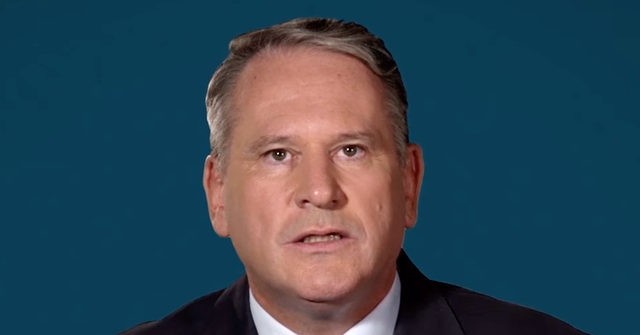
Retired British Army Colonel Richard Kemp, a former operational commander in Afghanistan, said Iran “seriously miscalculated” President Donald Trump’s resolve — a misjudgment he argued led to the most significant strike against the Islamic Republic since 1979 and one that could now fundamentally reshape the regional order.
In an exclusive interview Saturday evening, hours after President Donald Trump confirmed the death of Iran’s Supreme Leader, Ayatollah Ali Khamenei, following the opening phase of the sweeping joint U.S.-Israel campaign, Kemp called the operation “clearly the most significant strike against Iran since the revolution.”
“It has the potential — depending on how it works out — to completely change regional dynamics, potentially removing the biggest security threat in the region and also to the world, which is, of course, Iran with its ballistic missile capabilities and its terrorist proxies operating throughout the region and around the world.”
Khamenei’s elimination — along with that of other senior regime figures in the opening wave — was not merely symbolic, Kemp emphasized.
“The killing in itself is very significant,” he said. “Not that he couldn’t be replaced — but the fact that Israel and the United States were able to locate him and eliminate him, even after very clear warnings that such a strike was coming, says a huge amount about the respective strengths of the two sides.”
But Kemp argued the regime’s exposure reflected more than simple vulnerability — it pointed to a deeper strategic miscalculation at the highest levels in Tehran.
“It may also indicate that Iran did not really take seriously the U.S. threat,” he said. “They may have miscalculated who Trump is and what Trump is prepared to do, based on the weakness of former presidents when confronting Iran.”
The fact that senior leadership figures were gathered and exposed despite months of escalating warnings, military buildup, and explicit deadlines, he implied, suggests a regime that believed prior patterns would hold — and that Washington’s threats would once again prove rhetorical rather than operational.
Iran ‘Seriously Miscalculated’ Trump’s Resolve
The result, he said, is devastating for a centralized authoritarian system.
“Anyone can be replaced,” Kemp said. “But it’s devastating for a country like Iran to be decapitated like that.”
He added that the strike is likely to embolden internal opposition, though regime change would ultimately depend on internal actors rather than foreign troops.
“I think it’s very likely to encourage oppositionists in Iran to overthrow the regime,” he said. “But I don’t think it can be overthrown by external forces like the U.S. and Israel unless they were prepared to put boots on the ground — which neither are.”
At the same time, Kemp noted that it would be naïve to assume no groundwork had been laid.
“There’s no question that both the U.S. and Israel will have been working for some considerable time with opposition groups to prepare for this very moment,” he said.
He identified Iran’s conventional military as a possible stabilizing force in a transitional scenario.
“Among the potential contenders to take control, at least temporarily, would be the Iranian army,” Kemp said — particularly if the Islamic Revolutionary Guard Corps has been badly degraded by sustained strikes.
File/Former commander of British forces in Afghanistan Colonel Richard Kemp speaking at a rally calling for the release of the hostages taken in the October 7 Hamas attacks at St Johns Wood United Synagogue in London on Sunday April 7, 2024. (Lucy North/PA Images via Getty Images)
Beyond leadership decapitation, Kemp stressed that the campaign’s opening phase would also have targeted Iran’s offensive capabilities.
“This operation will have begun not only with targeting the top level of the regime, but also with disabling their offensive capabilities,” he said, noting that those capabilities had already been weakened during last year’s 12-day conflict and would now be further degraded.
Iran’s retaliatory strikes against Gulf Arab states, he argued, produced the opposite of their intended effect.
“What they’ve done by lashing out all over the region is consolidate almost a coalition against them among Arab countries — one that probably didn’t exist to the same extent before,” Kemp said. “Because of what they’ve done, they’ve now really cemented significant opposition to them in the region.”
As for the duration of the campaign, Kemp said it would likely be dictated by effectiveness rather than a preset timetable.
“The length of the conflict will depend on the effectiveness,” he said. “It could go on for three or four days, perhaps a bit longer. I don’t think even American and Israeli planners will have defined exactly how long it takes.”
What follows, however, is less predictable, Kemp cautioned.
“You could end up with a comparatively peaceful transfer of power,” he said. “Or you could end up with a long period of violence as remnants of the regime attempt to hold on and oppositionists begin fighting among themselves.”
Strike Could Reshape Region, Restore Western Deterrence
Still, Kemp described the operation as unprecedented in political will.
“This is incredibly significant,” he said. “In however many years this terrorist regime has been in power, no one has had the will to do anything about it until Trump came along.”
With Trump and Netanyahu joining forces in the joint campaign, he said, “it’s changed the equation totally.”
“It’s a historic moment.”
Kemp underscored that former President Barack Obama’s strategy had been to intentionally strengthen Iran against its more moderate neighbors in the region.
“This is the opposite strategy — to bring it down,” he said, suggesting that a successful campaign would likely produce far greater stability across the Middle East.
The implications of enforcing that red line, he added, extend well beyond Iran.
“It sends a very strong message to other enemies — whether jihadists, China, or Russia — that Trump is not going to put up with threats. He’s going to deal with them,” Kemp said.
With a successful outcome, he argued, the campaign would begin restoring Western deterrence that had eroded over previous administrations.
The effects would reverberate through Iran’s proxy network and severely weaken its regional surrogates.
“What’s happening with Iran is going to be devastating for Hamas,” he said. Hezbollah and the Houthis, long dependent on Iranian backing, would likewise face severe weakening.
Russia, too, would feel the consequences of losing a key military supplier.
“Russia has relied heavily on support from Iran, particularly on drones,” Kemp said. “Without that, it’s going to have a negative impact on their capability to wage war in Ukraine.”
Ultimately, Kemp said the objectives appear clear: degrade Iran’s ballistic missile arsenal, dismantle support for regional proxies, and pursue regime change — though not necessarily through open-ended escalation.
“You don’t necessarily have to keep attacking until there’s a different regime formally in place,” he said. “Once there’s an intelligence assessment that things are shifting internally, the conflict could wind down — while maintaining the capability to respond if the situation reverses.”
Given the scale of force already delivered in the opening phase, Kemp predicted a decisive outcome.
“Looking at the sheer power that’s been delivered onto Iran,” he said, “my guess is this is going to be decisive for the regime.”
Joshua Klein is a reporter for Breitbart News. Email him at jklein@breitbart.com. Follow him on Twitter @JoshuaKlein.
Read the full article here


