


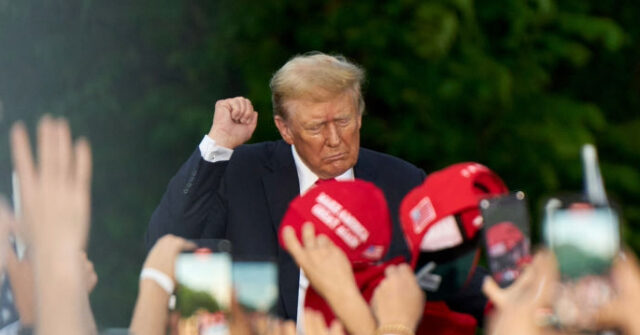
Chris LaCivita, co-campaign manager of President Donald Trump’s 2024 presidential campaign, told Breitbart News Saturday that Republicans are continuing the voter turnout strategies developed during the 2024 election, with Trump planning to hit the campaign trail for 30 days as the party works to maintain its congressional majorities.
During an exclusive interview with Breitbart News Washington Bureau Chief Matthew Boyle, LaCivita pushed back against Republican consultants expressing pessimism about the midterms, criticizing their reliance on conventional political wisdom and public polling.
“You hear all this belly aching and whining and bedwetting, and quite frankly, it’s done out of a position of ignorance because these are people that accept status quo or accept conventional wisdom,” LaCivita said. “Something President Trump has never done, and certainly his team has never adopted conventional wisdom.”
“Midterms suck; they always do for the party in power,” he continued. “But if there’s one, if there’s one operation, if there’s one president that can change that, it’s this one.”
LaCivita pointed to congressional approval ratings as a potential advantage for Republicans despite their own negative ratings.
“The Republicans in Congress are upside down in their favor unfavorable rating. Okay, that’s to be expected to some degree. The Democrats are like 15 points worse,” LaCivita said. “They don’t like Republicans in Congress, but they hate the Democrats in Congress, and so that gives us a definite position to operate from.”
He highlighted the administration’s tax provisions covering tips, overtime and seniors, criticizing Democrats over their opposition to the legislation. The legislation established an additional deduction of up to $6,000 for eligible seniors rather than eliminating federal taxes on Social Security benefits altogether.
“I used to dream of contrasts like that, of having that kind of stuff just to pound the other side with,” LaCivita said.
Asked about the reliability of public polling, LaCivita accused some news organizations and universities of designing surveys to produce predetermined results.
“They will deliberately go in and survey a larger pool of Democrat voters, maybe voters who aren’t as likely to vote as well as opposed to likely voters, and it’s for a predetermined outcome,” LaCivita said.
“You have to have a professional calling house. You have to have the modeling that goes in trying to determine what you think turnout is going to look like, or do you let it float?” he continued. “There’s all of these strategic assumptions that go into designing a survey, and then of course the way you ask a question.”
LaCivita said campaigns should pay particular attention to candidates’ favorable and unfavorable ratings rather than relying exclusively on ballot-test results.
“While the ballot is important, it’s not nearly as important as the favorable unfavorable, favorable unfavorable ratings are leading indicators,” he said. “That’s where the ballot goes. So that’s why campaigns spend so much time beating the hell out of their opponent because the higher the negative, the higher the anti-vote becomes.”
He also pointed to the 2022 midterms, when expectations of a substantial Republican victory failed to materialize, as an example of the limitations of polling and election forecasts.
“If you remember, the Republicans, they got it all wrong in 2022. It was all going to be this red wave, and of course, that didn’t materialize,” LaCivita said. “No election is determined until all the ballots are cast.”
LaCivita explained how Republicans plan to build on their 2024 voter turnout operation ahead of November’s midterms.
“One of the keys to success in 2024, tactically on the ground, was in the battleground states, us identifying these casual voters and then turning them out,” LaCivita said. “A lot of the targeting and a lot of the tactics that we’ve implemented and started in ’24, we’ve kept going, and it’s going to be a large part of our focus this November.”
Boyle raised the North Carolina Senate race, where Republican Michael Whatley is running against Democrat Roy Cooper, and asked how changes in voter registration and turnout could affect the contest. LaCivita emphasized the importance of identifying Republican voters and understanding the priorities of persuadable voters.
“Having that voter registration, having these types of things available, and actually knowing where our voters are, and then having knowing what the persuadable voters care about,” LaCivita said. “The persuadable voters, yes, they care about the cost of gas. Yes, they care about the cost of living.”
LaCivita also highlighted Republican investments in North Carolina, estimating that outside groups have already spent more than $100 million on the race. He acknowledged the costs associated with campaigning in the state, including its expensive media markets.
“It’s a big state, expensive state in context of, you know, the Charlotte media market and all of these things,” he said.
The discussion subsequently turned to the Senate’s overall electoral map, including Republican-held seats in Iowa, Ohio, Alaska and Texas. LaCivita emphasized that each of those states supported Trump in the 2024 presidential election and said his participation in the midterms would help Republicans reach voters who supported him.
“Ohio’s our turf. Alaska’s our turf. Iowa’s our turf. Texas is our turf,” LaCivita said. “The Democrats have to literally win in a state that the president won, and, you know, in some of these places, convincingly.”
LaCivita said Trump’s upcoming campaign appearances would complement Republicans’ spending and turnout operations.
“We have an advantage of tactics, we have an advantage of money, and we have a superior advantage in that we have the president who’s going to be hitting the road for 30 days and motivating and turning out the electorate that we need to get to show up,” he said.
Asked specifically about Republicans’ prospects of retaining control of the House, LaCivita acknowledged the difficulties associated with defending a congressional majority during a midterm election but expressed confidence in the party’s ability to mobilize voters.
“The House obviously is going to be tough, but I’m again very, very cautiously optimistic about our ability to turn on voters,” LaCivita said. “All we have to do is alter the turnout two to three to four points in every congressional district, and we win.”
He also pointed to divisions within the Democratic Party, alleging that disagreements between its progressive and moderate factions could affect voter enthusiasm. He said Republicans would concentrate their national messaging on Trump’s economic agenda, including tax cuts and efforts to address the cost of living.
“We want to make it about the president so that we can continue to cut taxes, get the economy going, and get the cost of living where it needs to be,” LaCivita said. “So we actually have something substantive to talk about.”
While discussing the importance of national messaging, LaCivita emphasized the role of district-level campaign operations in mobilizing Republican voters.
“While the overall national environment is very important,” he said, Republicans have “superior ground tactics in all of these individual congressional districts that will drive turnout.”
Boyle concluded the interview by asking about Trump’s ability to mobilize Republican voters, referencing accounts he had heard of increased turnout during a recent South Carolina Senate primary runoff following the president’s participation in a campaign rally.
LaCivita said Trump’s personal involvement would be particularly important for Republican candidates who need to reach voters who do not consistently participate in congressional elections. He cautioned Republican candidates against distancing themselves from the president.
“If you’re a Republican candidate and you’re thinking or contemplating, maybe not embracing the president, you’re making a horrible mistake because you’ve got to be able to maximize your turnout,” LaCivita said. “Got to be able to maximize those Trump voters and get them to vote.”
He also highlighted Trump’s plans to participate in telephone rallies alongside his upcoming campaign appearances, describing both as important components of Republicans’ turnout strategy.
“Having the president hit the trail and then he’ll be doing these tele rallies, which are crazily effective,” LaCivita said. “There’s no better person from our standpoint that can turn out voters than President Trump.”
LaCivita concluded by emphasizing that Republicans intend to campaign on the administration’s accomplishments rather than relying solely on promises about future policies.
“We’re not talking about what we hope to do, we’re talking about what we’ve done,” he said. “Having the president motivate the voters and turn them out in that context is just going to put us in a lot better position than we would be normally in any other midterm.”
Read the full article here