
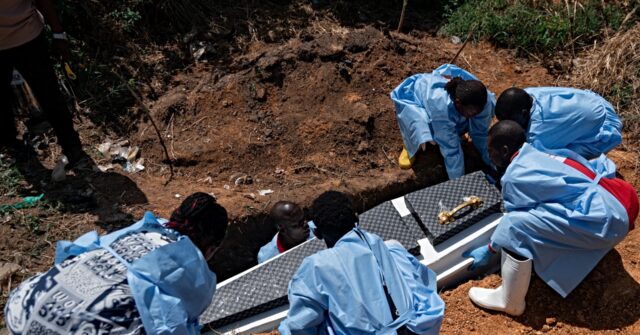
More than 2,900 people have died as a result of the Ebola outbreak in the Congo, authorities announced Monday.
The outbreak is considered the fastest-growing in history and officials said there are currently 6,000 cases and 2,911 people have died while over 1,360 patients have recovered, the Associated Press (AP) reported.
“The World Health Organization has said that it remains out of control and is on track to surpass the 2014-2016 West Africa Ebola outbreak, the deadliest on record, which killed more than 11,000 people, primarily in Guinea, Liberia and Sierra Leone,” the outlet continued.
The U.S. Centers for Disease and Prevention (CDC) said Friday that officials were responding to the situation in the Congo and so far no cases have been confirmed in the United States due to the outbreak.
“The outbreak is caused by Bundibugyo virus, a type of Ebola virus,” the CDC noted.
Responding to the outbreak, the agency said, has been difficult due to limited health infrastructure, conflict in the area that has created security problems, violence against health care workers, shortages of personal protective equipment, population movement, cross-border travel, a lack of trust in government officials, and misinformation.
Breitbart News reported of the situation in the Democratic Republic of the Congo (DRC) on August 17:
The current public health emergency is an outbreak of Ebola Bundibugyo, a strain for which no treatment or cure has been approved at press time. The strain is distinct from Ebola Zaire, the one responsible for the west African outbreak a decade ago and for which a vaccine product exists as a result of research conducted after that outbreak. That the current outbreak is being fueled by Bundibugyo is one of several factors complicating emergency response. The part of DRC affected, the eastern provinces of Ituri and North Kivu, are among the least stable and most remote in the country, plagued by incessant fighting among a host of militias and warlords seeking to control the illicit mining industry.
Locals have also reportedly shown high levels of distrust of foreign humanitarian aid workers and others in the health sector, attacking quarantine locations, stealing the bodies of the dead, and spreading rumors that Ebola is not a real disease. The violence against health workers has led to several strikes as those at highest risk demand higher salaries and more protection from both infection and mob attacks.
Early symptoms of Ebola included fever, aches, pains, and fatigue, but as the illness progresses, a patient may experience diarrhea, vomiting, and unexplained bleeding, per the CDC.
“The viruses that cause Ebola disease pose little risk to travelers or the general public,” the agency said.
“People can get Ebola disease through contact with the body fluids of an infected sick or dead person. A person is only contagious once they begin showing symptoms of the disease. You cannot get Ebola from simply being near someone or passing them in public spaces because it doesn’t spread through the air.”
Read the full article here