


Voters are in an uproar over data centers — and Democrats are trying to direct anger toward Republicans by pointing to a tax provision buried in the GOP’s “big, beautiful bill.”
Of the myriad talking points on this issue that Democrats are preparing deploy heading into the midterms, they this week began alluding to “Opportunity Zones” — an initiative designed to boost growth in areas deemed underdeveloped and which, at one point, Republicans had touted as a way to spur the construction of data centers.
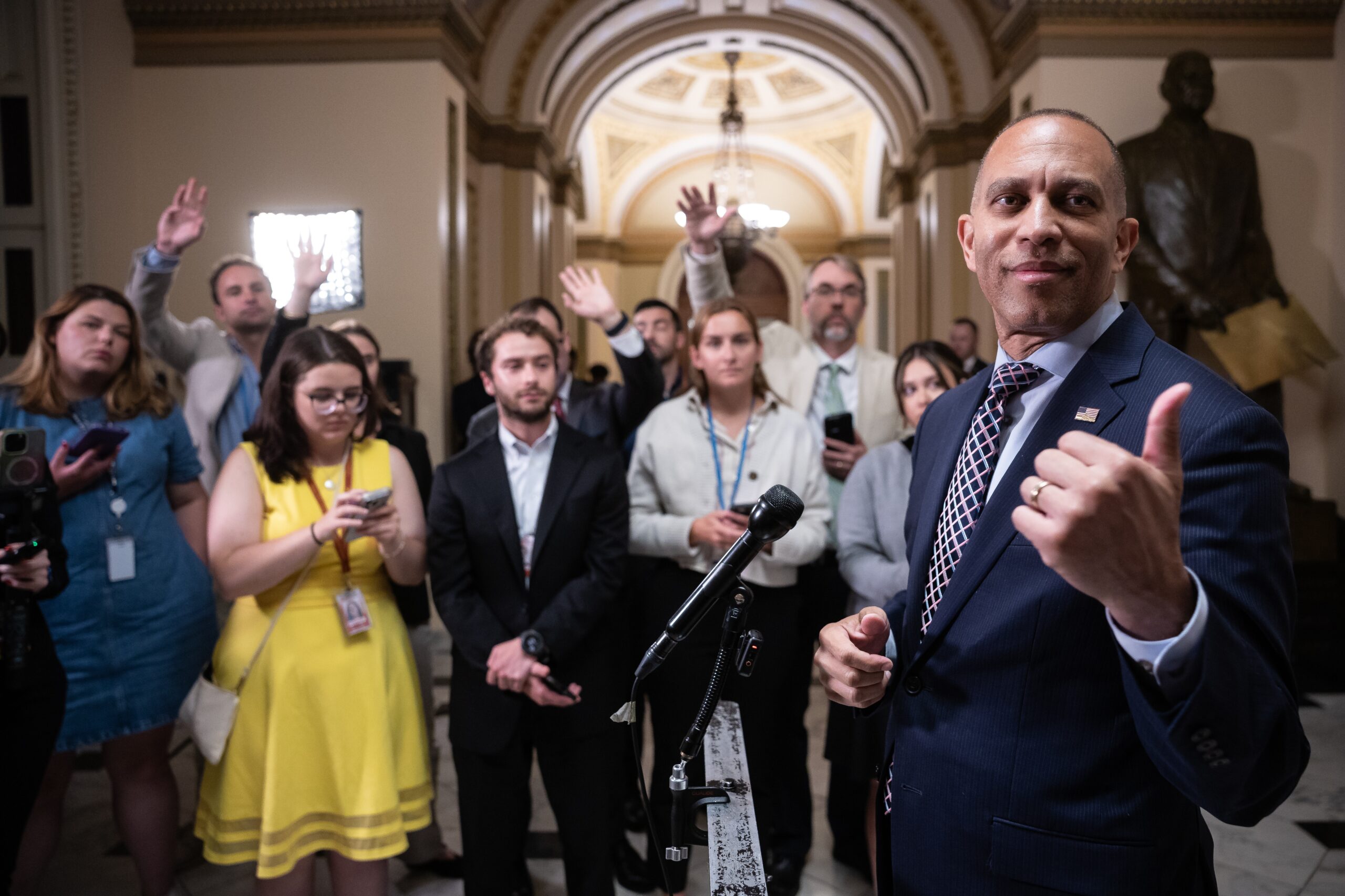
“Every single House Republican but one or two voted to unleash data centers on the American people in an unfettered fashion,” said House Minority Leader Hakeem Jeffries at a news conference Monday.
The next day, a senior House Democrat — Rep. Jim McGovern of Massachusetts — made a similar observation on the chamber floor.
“A year ago, Republicans were bragging about giving tax breaks to Big Tech in order to build data centers,” McGovern said. “With November on the horizon, some House Republicans are acting as if they did not turbocharge the data center buildout.”
Republicans — and Opportunity Zone advocates — scoff, noting data centers are just one of many possible uses of a program that was never designed to support any one industry specifically.
“Huge stretch,” said House Ways and Means Chair Jason Smith (R-Mo.), who oversaw the expansion of the Opportunity Zone tax credits in the One Big Beautiful Bill Act. “Opportunity Zones control, like, everything — from child daycare centers to manufacturers. Can data centers be used in them? Yes. But so can everything else.”
But the narrative has been building steam in recent weeks, tucked inside reports from Sen. Ron Wyden of Oregon, the top Democrat on the Senate Finance Committee, and the National Community Reinvestment Coalition. The message was further boosted Monday with social media posts from liberal policy influencers like Brendan Duke, an economist at the left-leaning Center on Budget and Policy Priorities, and Pod Save America cohost Jon Favreau.
A Truth Social post from President Donald Trump calling for Americans to “let Data Reign” gave Democrats an opening to pounce.
Democrats’ new line of attack comes as Republicans are already grappling with a fresh dilemma: How do they respond to voter concerns about data centers driving up energy costs, when their president is publicly downplaying those worries?
The messaging tactic also arrives as Republicans are already struggling to sell voters on their 2025 tax law ahead of the midterms — and Democrats are now using data center anxiety as another way to undercut that effort.
Poll after poll show mushrooming frustrations with data centers throughout the country, including in House and Senate races necessary for the GOP to hold onto its majorities on Capitol Hill.
House Republicans were likewise hounded in their districts on data centers throughout their summer recess. Now back in Washington, they are pressing Speaker Mike Johnson on whether leadership has plans to put any data center-related legislation on the floor in the next month, but have received no commitments.
One vulnerable Republican who has found himself under scrutiny is Rep. David Valadao of California, who Jeffries called out by name at his news conference as someone who voted for the 2025 megabill that Democrats claim will give way to more data center construction.
“Is Hakeem opposed to the data centers?” Valadao asked in an interview. “Does he not think the data centers, at some point, have to be developed? Is that what he’s trying to imply, or is he just trying to make a political issue out of something that probably needs to be addressed?
“I mean, obviously there are local concerns that need to be addressed,” he continued, but added, “trying to use something that a lot of people would argue is important for national security or national security interests as a political weapon sounds pretty irresponsible.”
Smith said that “Democrats will use any issue to help empower themselves to victory. They don’t have to abide by truth. They’ll say whatever they can and they’ll mislead whatever they can. So anything Hakeem Jeffries says — if it’s coming out of his mouth, it’s probably not true.”
Sen. Tim Scott of South Carolina, chair of the Senate Banking Committee and the National Republican Senatorial Committee, conceived of Opportunity Zones alongside Democratic Sen. Cory Booker of New Jersey, to attract developers to hard-hit communities. The program offers breaks on capital gains taxes to those who invest in one of more than nearly 9,000 designated areas around the country.
Since the program went into effect as part of the GOP’s 2017 tax law, developers have used these incentives to build a range of projects — apartment complexes, warehouses, parking garages and hotels — largely in more populated areas, while rural areas went mostly ignored.
To address this disparity, Republicans in their 2025 megabill beefed up the tax advantages for projects in less-dense areas. As it turns out, some of these rural projects have included data centers.
Republican tax writers didn’t shy away from the byproduct. In an August 2025 press release celebrating passage of the megabill a month earlier, they quoted a Bloomberg Tax commentary piece that noted the expanded tax credits could be used for data centers.
An analysis from the National Community Reinvestment Coalition published this month figures that 14 percent of data centers are in Opportunity Zones, while 17 percent of those currently planned or being built are similarly situated. The organization, which focuses on low-income issues, also predicts that a large portion of the next batch of Opportunity Zones could be used for data centers because they are near key resources, like good sources of power.
“You’re seeing an increasing trend of [opportunity zones] being utilized to develop data centers,” Simon Wang, NCRC’s economic mobility specialist, said in an interview.
Wyden — who could reclaim the Finance Committee gavel next year if Democrats take the Senate majority in the midterms — has explicitly called for banning data centers from benefiting from Opportunity Zone incentives, saying they do little to help for the surrounding communities.
Spokespeople for Scott in his personal office and at the NRSC did not respond to requests for comment, as GOP Senate candidates in states like Michigan and Ohio face data center backlash on the campaign trail. Booker’s office also did not return a comment request.
Republicans are responding to Democratic criticism by ticking off the long list of other investments that have been made through the Opportunity Zone program. They also note the current crop of zones was established in 2018, long before the current data center boom began.
But if Democrats are able to further popularize their narrative, it could affect both data center expansions and the success of the Opportunity Zone initiative. State elected officials are currently deciding where to place the next batch of locations based on certain socioeconomic criteria — something that happens only once every decade — and many local leaders are now being aggressively lobbied on the issue.
“You can bet that the choices governors are making right now — that the data center industry is in their office saying, ‘Please pick this tract, and not that tract,’” said Brett Theodos, director of the Urban Institute’s Center for Local Finance and Growth.
Some Opportunity Zone advocates are playing up the benefits of such projects.
“Data center construction fuels demand for blue-collar jobs in construction, maintenance, and the building trades while generating substantial tax revenue to fund local services and reduce the tax burden on local residents,” said John Lettieri, president of the Economic Innovation Group and a longtime Opportunity Zone advocate, in an email. “Steering those kinds of economic benefits towards struggling communities is exactly what the policy was designed to do.”
But data center proponents could now face headwinds. Many states have begun canceling or phasing out their own tax incentives for data center construction; just last week, Democratic Gov. Mikie Sherrill of New Jersey signed a law ending a special data center tax credit.
Asked how data center blowback could hit Republicans in November, Democratic Rep. Ro Khanna, who represents Silicon Valley, said his party had a chance to show their alliance with data center skeptics making up large swaths of the electorate.
“Trump has made it an issue by saying that he wants data centers reigning everywhere; he’s basically saying he doesn’t care about local control, he doesn’t care about local communities,” Khanna said in an interview Wednesday. “We can be on the side of local cities, rural communities, factory towns, suburbs — places that don’t want Big Tech coming and telling them what to do.”
Andres Picon contributed to this report.
Read the full article here