




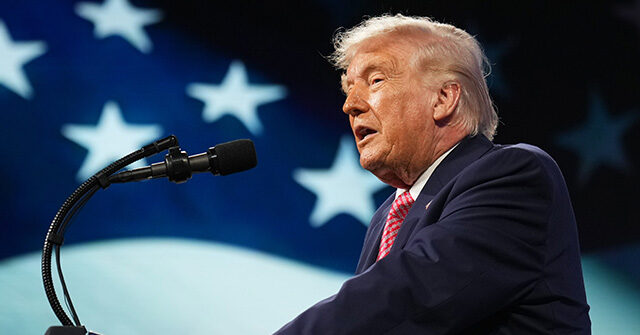
President Donald Trump warned Iran “the entire country can be taken out in one night” as his Tuesday 8 p.m. Eastern Time deadline loomed, threatening a four-hour blitz he said could leave every bridge “decimated” and every power plant “burning, exploding and never to be used again” if Tehran fails to make a deal and reopen the Strait of Hormuz.
Speaking Monday at a White House news conference, Trump said the deadline would not be moved again, stressing that after 8 p.m. Tuesday, “they’re going to have no bridges” and “they’re going to have no power plants.”
“We have a plan where every bridge in Iran will be decimated by 12 o’clock tomorrow night, where every power plant in Iran will be out of business, burning, exploding and never to be used again,” Trump said. “I mean complete demolition by 12 o’clock, and it will happen over a period of four hours if we wanted to.”

Trump said Iran had made “a significant proposal” but added that it was “not good enough,” while insisting the United States was still negotiating with what he described as “an active, willing participant on the other side.”
Still, signs increasingly point toward collapse. The Wall Street Journal reported Monday night that some U.S. officials believe the gap between Washington and Tehran is too wide to close before Trump’s deadline, and that Trump has privately become less hopeful a deal will materialize. The outlet added that he is expected to decide on final strike orders Tuesday evening.
Axios, in a separate report Monday night, similarly said Trump has lately sounded less optimistic in private even as mediators continue pressing for an off-ramp and the White House weighs whether diplomacy still has a path forward.
Iran has rejected a temporary 45-day ceasefire proposal and instead floated its own terms for ending the war, including guarantees it would not be attacked again, sanctions relief, and conditions tied to the future of the Strait of Hormuz. Tehran has insisted on a permanent end to the conflict rather than a short pause.
Mojtaba Ferdousi Pour, the head of Iran’s diplomatic mission in Cairo, told the Associated Press on Monday that Tehran would accept only an end to the war backed by guarantees that it would not be attacked again.
Trump, however, made clear that free traffic through the Strait of Hormuz remains central to any agreement, calling it “a very big priority” and warning Iran had already been given sufficient time.
“It’s not going to be moved again,” Trump said of the deadline. “I gave them a chance, and I hope they take the chance. If they don’t, it’s trouble.”
Tehran answered Trump’s threats with a barrage of defiant responses Monday going into Tuesday. Mahdi Mohammadi, an adviser to Iranian Parliament Speaker Mohammad Bagher Ghalibaf, wrote that Trump had roughly “20 hours” to “submit to Iran” or his allies would return “to the Stone Age,” while senior Iranian figure Saeed Jalili mocked the president’s rhetoric, writing, “Let him speak more.”
Other Iranian officials struck a similar tone. A spokesman for Iran’s Khatam al-Anbiya Central Headquarters denounced what he called the “rude” and “baseless threats of the delusional U.S. president,” while Iranian Deputy Foreign Minister Kazem Gharibabadi warned that any attack on power plants would trigger a “decisive, immediate, and regret-inducing response.”
Diplomatic channels remain active, though strained. NBC News reported that a 45-day ceasefire proposal delivered through Pakistan was among several ideas floated in recent talks, though Iran has rejected a temporary pause and the White House has made clear Trump has not signed off on such a framework. Trump himself said Monday, “The only one who is going to set a ceasefire is me.”
Politico reported that Vice President JD Vance is on standby to join talks if backchannel diplomacy advances to direct engagement with Iranian officials, with negotiations currently led by Steve Witkoff and Jared Kushner.
At the same time, military preparations are accelerating. CNN reported that Israel has approved an updated list of Iranian energy and infrastructure targets in anticipation of a diplomatic collapse, while a separate Politico report said Pentagon planners are expanding potential strike options to include dual-use energy sites that supply both civilian and military needs.
The planning has drawn renewed scrutiny because Trump’s public threats have centered on bridges and power plants, targets that have raised war-crimes and international-law concerns. Still, the administration has signaled it believes it has viable legal options.
RELATED: President Trump — ‘God Doesn’t Like What’s Happening, I Don’t Like What’s Happening’

White House press secretary Karoline Leavitt said the Pentagon’s role is to provide the commander in chief with “maximum optionality,” while Trump said he was “not worried about it.”
As the deadline approaches, the standoff has entered what Trump himself described as a “critical period,” with diplomacy still technically alive but increasingly overshadowed by preparations for a major escalation.
Joshua Klein is a reporter for Breitbart News. Email him at jklein@breitbart.com. Follow him on Twitter @JoshuaKlein.
Read the full article here


