




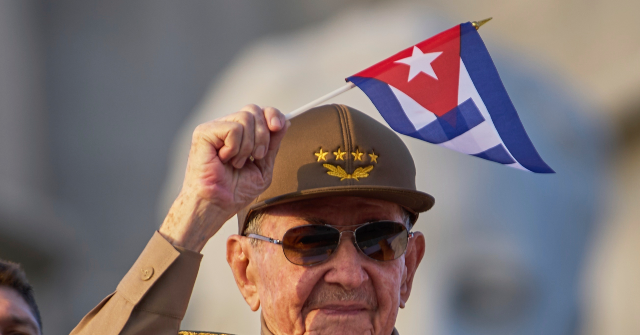
Miguel Díaz-Canel, the figurehead “President” of Cuba, revealed on Wednesday that Raúl Castro, the actual dictator of the country, is involved in ongoing talks with the United States.
Díaz-Canel delivered the remarks during an interview he held this week with Pablo Iglesias, a Spanish leftist politician, former member of the European Parliament, and former Iranian state television host.
Iglesias recently traveled to Havana as part of the “Nuestra America” convoy, an international gathering of leftist personalities who visited Cuba to express support for the communist Castro regime and to allegedly deliver “humanitarian aid” to the Cuban people whose lives have been forcefully plunged into a state of abject misery as a result of over 67 years of communism.
The interview was published on the YouTube channel of CanalRed, a Madrid-based far-left television channel founded by Iglesias in 2023. Iglesias, who for years has been an openly anti-U.S. figure, claimed that “fascists” are currently in power in the United States.
Throughout the interview, Díaz-Canel disclosed details of the ongoing talks between the Cuban regime and the administration of President Donald Trump, which he claimed to be in the “initial” stages. Díaz-Canel asserted that Castro, the 94-year-old brother of late murderous dictator Fidel Castro, is among the list of regime top brass members who are “guiding” the talks with the U.S.
“He [Castro] is one of those who, alongside me and in close coordination with other bodies within the party, the government, and the state, has guided how we should proceed with this dialogue process,” Diaz-Canel said.
“He closely follows the progress of the dialogue — which is still very much ongoing — and he encourages us when he sees that our efforts are yielding results,” he continued. “Above all, he remains committed to the people, to the revolution, and to saving the country from aggression.”
“So, under that guidance, under that leadership — which is a collegial leadership headed by him and me and working in concert with the rest — our officials have recently held talks with officials from the State Department aimed at discussing our bilateral differences to find a solution,” he asserted.

Although Díaz-Canel is nominally in charge of the Cuban communist regime, in reality, the nonagenarian Castro is the true dictator of Cuba, and has continued to rule over the communist-ruined nation even after he stepped down in 2018 and Díaz-Canel was installed as “president.”
Díaz-Canel described Castro as the “historic leader of the revolution, even though he has stepped down from his official duties.” dismissing any prospect of “division” among the regime’s leadership.
“Yet no one can deny the prestige he enjoys among the people, his place in history, his contributions, or his historical legacy,” he said. “As is the case in other parts of the world, there are people who are leaders not because of their titles, but because of their history and their experience.”
Díaz-Canel admitted this month that Cuban regime officials have engaged in “sensible” talks with U.S. government officials. The conversations, which President Trump had repeatedly mentioned prior to the Cuban regime finally acknowledging them, occur at a time when the ailing and notoriously dysfunctional communist regime finds itself in an extremely complex situation following the arrest of one of his key benefactors, Venezuela’s socialist dictator Nicolás Maduro, who was detained by U.S. forces in Caracas on January 3. At the time of his arrest, the Cuban regime provided security to Maduro.
“From the very beginning, the revolution has always made it clear that it was willing to engage in a dialogue with the U.S. government — based on mutual respect and equality, without pressure or preconditions — to find solutions to our differences,” Díaz-Canel claimed. “In other words, this willingness has been a constant throughout the history of the revolution. Therefore, what we are proposing now in no way contradicts the history of the revolution.”
Díaz-Canel referred to the “significant” talks between Raúl Castro and former President Barack Obama amid a process known as the “Cuban Thaw,” which saw Obama grant significant concessions to the ruling communists without requiring tangible steps towards freedom for the Cuban people. The figurehead “president” described the Castro-Obama talks as “concrete agreements,” as some of the sanctions imposed on the Cuban regime were lifted.
The figurehead “president” asserted that is still too early to determine what Washington would demand through the talks because there are “thousands” of issues, but suggested several subjects such as U.S. government engagement in the Cuban economy, migration, and drug trafficking. Asked by Iglesias what would be “unacceptable” for Cuba in the talks, Díaz-Canel said, “we refuse to be told that in order to engage in dialogue, we must adopt a certain position.”
“They must respect our sovereignty, our independence, and our political system just as we would respect theirs,” he said. “Those things are not up for debate. Those things are not up for debate. We must work on the basis of reciprocity and in accordance with international law.”
Christian K. Caruzo is a Venezuelan writer and documents life under socialism. You can follow him on Twitter here
Read the full article here


