


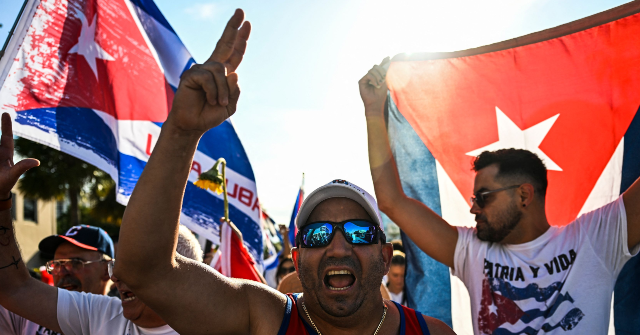
The Communist Party of Cuba announced on Monday a plan to “facilitate the participation of Cubans abroad in the national economy” — a move that the Cuban exile community responded to with disgust, highlighting the billions of dollars stolen from them when mass murderer Fidel Castro took power.
The Castro dynasty ruling Cuba has found itself at a critical juncture after the arrest of Venezuelan dictator Nicolás Maduro on January 3 by American forces exercising a warrant on a variety of narco-terrorism charges. Maduro’s regime had, for decades, sustained its patrons in Cuba through nearly free shipments of oil which powered the country’s lavish tourism industry but did little to ameliorate the abject poverty that Cubans have been subjected to since the 1959 coup. Following the arrest, Venezuela stopped sending oil shipments to Cuba, as did neighboring Mexico, effectively ending tourism to the island and collapsing the nation’s dilapidated power grid.
In light of the routine absence of electricity — and, with it, surveillance technology — the frequency of protest activity has skyrocketed in Cuba in the past month. This weekend, citizens in the city of Morón, Ciego de Ávila set the local Communist Party headquarters on fire, one of several such outbursts of protest activity at night, when it becomes more difficult for state security thugs to identify protesters.
The Castro regime admitted on Friday that it was engaging in negotiations with the administration of President Donald Trump to improve the longstanding hostile relations between Washington and the state sponsor of terrorism — a move that appears to have emboldened the protests. Shortly after, on Monday, the official newspaper of the Communist Party Granma published an explanation of new “measures” inviting the Cuban diaspora to invest in the Party. The Cuban population outside of the island is largely made up of exiles and their children; as Cuba heavily restricts the rights of its citizens to travel freely, those who escaped often have stories of being forced into years of slavery at labor camps, tortured in political prisons, or otherwise humiliated before making it out.
First Vice-Minister and top official on Exterior Commerce and Foreign Investment Oscar Pérez-Oliva Fraga — the grandson of 94-year-old dictator Raúl Castro’s older sister — made the announcement, appearing on NBC News.
Pérez-Oliva explained that the new policy would allow Cubans without residency on the island to invest in “private companies” in Cuba, which do not exist as Cuba is a communist government. Cuba’s “private” enterprises are either small, near-illicit enterprises, or corporations run by the Castro family and its inner circle of loyalists.
“The doors of Cuba are open to free commerce with American companies,” Pérez-Oliva claimed, asserting that the move is “intended fundamentally to seek a greater decentralization of the economy, encourage greater participation of foreign capital in our economic and social development, and also to diversify the private sector’s participation in various areas of the economy.”
Pérez-Oliva falsely claimed that the American “embargo,” which only prevents large American corporations from enriching themselves in cooperation with the Castro regime, was the “principal obstacle” for the new policy. In reality, any corporation from any country outside of the United States — including states friendly to Cuba such as Canada, China, and Russia — have had the freedom to invest in Cuba for over a half century with no American intervention, but have chosen not to invest heavily due to the incompetence of the Cuban Communist Party.
The Castro grandson declared that the Party is seeking to attract Cuba’s “sons residing in other latitudes, recognizing their role in the construction of a nation that is ever more prosperous and sustainable.”
Pérez-Oliva did not address a major obstacle to Cuban-American investment on the island: the persecution of Cubans inside and outside the island, the repeated instances of murder of Cuban-Americans by the Castro regime, and the fact that the Castro regime does not recognize the American citizenship of Cuban-Americans, including Americans born in the United States of Cuban descent who have never been to Cuba.
The response from the Cuban-American community to the new policies has been overwhelmingly negative. In a press release shared with Breitbart News, the Assembly of the Cuban Resistance (ARC), which convenes anti-communist activists inside and outside of the island, offered its “firm rejection” of any investment in the survival of communism in its homeland.
“Representing the broad Cuban diaspora, the ARC maintains that genuine political change must be the non-negotiable precursor to any investment, freedom, or democracy on the island,” the press release stated.
“The ARC views this move as a transparent attempt by the Castro family and their military junta to buy time,” the coalition stated. “We call on all Cubans to support the cry for freedom and refuse to become partners in a murderous regime that continues to snatch the assets and future of its people.”
ARC Secretary-General Orlando Gutierrez Boronat — a Breitbart News contributor the Castro regime has repeatedly, and falsely, branded a “terrorist” — described the new move as “truly desperate.”
“We know this administration despises free Cubans who refuse to be controlled by the Communist Party. It is vital to withhold investment now and wait for a truly free Cuba,” he asserted.
Longtime Miami radio host and political commentator Ninoska Pérez Castellón described the new economic measures as “abominable” in commentary on Monday.
“They are inviting their victims to invest in their failed economy and throw them a life line to stay in power,” she wrote on social media. “It’s as if the mafia families were bankrupt and would call upon their victims to invest in their organized crime schemes.”
Ramón Saúl Sánchez, the head of the Democracy Movement anti-communist organization based in Florida, similarly condemned the attempt by Havana to enrich itself even further with the wealth of its victims.
“Our policy is clear: disconnect from the regime and connect with the people,” Sánchez recommended in comments to the Spanish news agency EFE. “This is what the exile community wants.”
“It is time to understand that this is the end,” Cuban journalist Norges Rodríguez told EFE, “and that you cannot give a single bubble of oxygen more to the regime. What we need is an open path to return home and reclaim what belongs to us.”
Miami-Dade Commissioner Natalie Milian Orbis recalled the billions in theft that Fidel Castro enacted in communist “expropriations” after his 1959 coup d’etat.
“The Cuban communist dictatorship stole homes, businesses, land, and savings from millions of families. My own family is among them,” she wrote in a message on social media. “Anyone willing to invest money in a system that already stole everything once should not be surprised when it happens again. The regime has never returned what it took and it has never respected private property.”
In a report on Monday, Bloomberg News estimated that Cuba owes about $9 billion in property stolen from Americans and now Cuban-American families during the Castro coup. This money, it reported, is tied up in about 6,000 cases, some involving massive American companies such as Exxon Mobil.
The Castro regime has never expressed any interest in paying reparations to the United States or the Cuban diaspora for the billions stolen.
Follow Frances Martel on Facebook and Twitter.
Read the full article here