




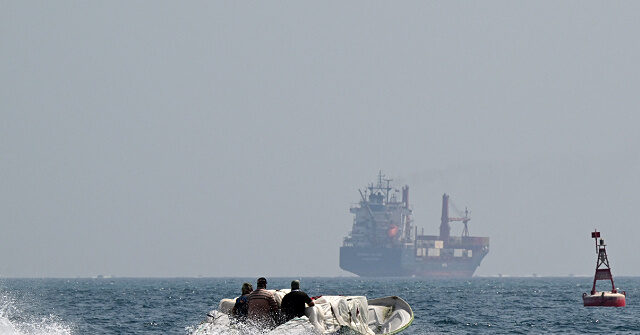
Commercial vessels sailing near the Strait of Hormuz are reportedly identifying themselves as Chinese-owned or crewed by Chinese nationals, in an effort to avoid terrorist attacks from Iran.
According to the Associated Press (AP) on Friday, at least eight vessels in the Persian Gulf and Gulf of Oman have been observed changing their destination transponder signals to broadcast messages such as “China Owner” or “China Owner & Crew.” The destination signal is normally a short message that indicates a vessel’s next port of call.
Ship tracking services said a few of the vessels in question were actually flagged by China or had clear ties to Chinese ownership. At least some of them were apparently able to transit the Strait of Hormuz safely by claiming links to China.
Tehran has offered assurances to China, its largest trading partner and political ally, that Chinese ships will not be attacked if they use the Strait of Hormuz. Iranian forces have attacked several civilian vessels with drones since the beginning of Operation Epic Fury on February 28, causing substantial damage to some of their targets and inflicting at least one fatality.
“During earlier Houthi attacks in the Red Sea, some vessels adopted a similar approach by declaring themselves or their crew as having links to China, which appeared as an effort to try to reduce risks of attacks from the Iranian-backed Houthis,” the AP noted.
Secretary of War Pete Hegseth said on Friday that Iran has been “exercising sheer desperation in the Straits of Hormuz.”
“We have been dealing with it, and don’t need to worry about it,” he said.
“Of course, for decades, Iran has threatened shipping in the Strait of Hormuz. This is always what they do, hold the strait hostage. We planned for it. We recognize it,” he insisted.
U.S. officials told the leftist outlet New York Times (NYT) on Thursday that Iran is attempting to lay mines in the Strait of Hormuz using small boats after U.S. strikes eliminated all of the larger ships in Iran’s navy.
The NYT’s sources said Iran’s new mining effort was “not particularly fast or efficient,” and it was unclear if Iran could use these methods to drop mines faster than the U.S. could clear them out. Mining the Strait of Hormuz would also seem to undermine Tehran’s promises to China that its ships would be given safe passage.
CEO Cameron Chell of the drone firm Draganfly told Fox News on Friday that the most serious threat in the Strait of Hormuz at the moment is Iran’s drone boats or “suicide skiffs,” remotely controlled surface craft that can be deployed in swarms against slow-moving tankers or cargo ships.
“The Iranians probably have use of radio remote control, line of sight, frequency hopping, or encrypted radio communication between the skiffs and the Hormuz shoreline,” Chell said.
“These can be jammed and tracked, but when there’s 50 of these boats, it’s hard to try to find them all along this shoreline or to find a 20-foot wooden fishing boat that is laden with explosives,” he noted.
Chell said it was possible for a single person to control up to ten of the simple surface drones at once, and they might even be capable of “autonomous swarming” under computer control. He warned it would require intense surveillance and heavy firepower to keep the narrow strait completely clear of the unmanned surface vehicles (USVs).
“The Iranians can disguise them as fishing boats and can be anywhere from 12 to 30 feet and a boat could be of any description,” he said.
The most destructive Iranian attack on a civilian vessel to date, Thursday’s attack on a U.S.-owned, Marshall Islands-flagged tanker off the coast of Iraq, appears to have been perpetrated with a USV.
Read the full article here


