




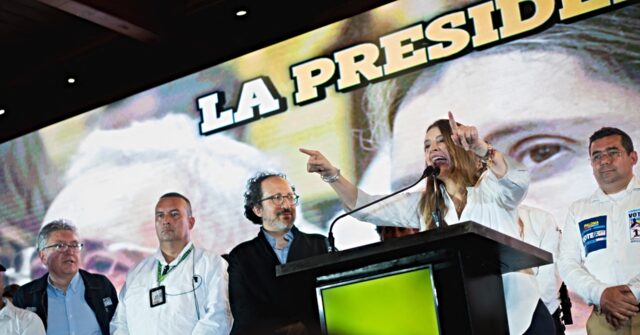
Colombian voters on Sunday elected a new, divided Congress that will see no party hold a majority of seats in both the Chamber of Representatives and Senate on their own.
At press time, results indicate that the ruling leftist Historic Pact party obtained the most number of seats in the Senate and the conservative Democratic Center won the largest number of seats in the Chamber of Deputies — but both falling short from holding a majority in Congress, which will prompt the two parties to seek out parliamentary alliances with the rest of the parties.
Colombia held legislative elections on Sunday to choose the new 183 members of the Chamber of Representatives and 102 of the 103 members of the Senate for the 2026-2030 period. Colombian law states that the 103th and final seat will be directly appointed by the presidential candidate who comes in second place in the elections later this year. Additionally, several different political parties and coalitions held their respective presidential primaries on Sunday ahead of the first round of the presidential election on May 31.
The newly elected Congress, which will be seated on July 20, will be five seats smaller than the outgoing 108-member body, as the additional five seats represented the uncontested seats given to the Revolutionary Armed Forces of Colombia (FARC) Marxist terrorist group as part of the as part of the “peace deal” the group signed in 2016.
The FARC party, which renamed itself Comunes in 2021, lost all of its uncontested seats on Sunday after it failed to attain the required three-percent vote threshold to maintain its presence in Congress.
Preliminary results published at press time indicate that, with 99.5 percent of all votes tallied, President Gustavo Petro’s Historic Pact party is poised to obtain 25 seats in Congress while the Democratic Center, led by conservative former President Álvaro Uribe Vélez, secured 17 Senate seats.
Both parties fell short of the 52-seat majority at the upper chamber. The Liberal Party of Colombia came in third place with 12 Senate seats, followed by the Green Alliance for Colombia and the Conservative Party, each securing ten seats.
Similarly, in the Chamber of Representatives, the Democratic Center stood as the party with the most number of seats obtained on Sunday with 31 of 166, less than half of the 84-seat majority. The Liberal Party of Colombia came in second place, securing 25 seats, followed by the Conservative Party of Colombia with 23 seats. According to the preliminary results, the ruling Historic Pact party only secured 11 seats at the lower house.
Voter turnout was reported at a little over 50 percent, a low rate that the Argentine outlet Infobae claimed “reflects the public’s lack of interest in the consultations and in the composition of the Senate and the House of Representatives.”
“Based solely on preliminary counts and pending final results, it is clear that the Pacto won a landslide victory in the congressional elections. However, it does not have an absolute majority, so the idea of a grand Alliance for Life and Prosperity must be maintained,” President Petro wrote on social media.
“To avoid a repeat of what happened with Anapo [former leftist party], new congressmen and congresswomen must study, and a school of new politics for Colombia must be created,” he continued. “In the next session of the current Congress, bills for social reforms will be presented, with health reform being a priority.”

Colombia will hold its 2026 presidential election on May 31 and a prospective runoff on June 21 between the two most voted candidates should no candidate obtain 50 percent plus one of the votes to win in the first round.
President Petro, Colombia’s first leftist president ever, is barred from running again as the Colombian constitution strictly bars a president or vice president from serving beyond one four-year term. Petro’s Historic Pact party will be represented in the upcoming election by leftist Senator Ivan Cepeda after he won the party’s October 2025 primary election. The Democratic Center, and other Colombian parties, held their primaries on Sunday ahead of May, resulting in Colombian Senator Paloma Valencia’s election as the conservative party’s candidate.
At press time, there are 16 different candidates that will appear on the May 31 ballot from across the political spectrum, including several former members of Petro’s administration such as former Foreign Minister Luis Gilberto Murillo and Carlos Reyes, the former head of Colombia’s Dian tax and customs office. Prospective candidates have until the end of Friday, March 13, to register their candidacies.
Miguel Uribe Londoño, the father of slain conservative senator Miguel Uribe Turbay, will also appear on the ballot after he distanced himself from the Democratic Center party. Uribe Turbay was Colombia’s 2026 presidential frontrunner before he was assassinated by a 14-year-old boy, who shot Uribe during a rally in Bogotá in June 2025, inflicting two gunshot wounds to the skull and one to a leg. Uribe fought for his life for weeks, but ultimately passed away on August 2025.
Christian K. Caruzo is a Venezuelan writer and documents life under socialism. You can follow him on Twitter here.
Read the full article here


