




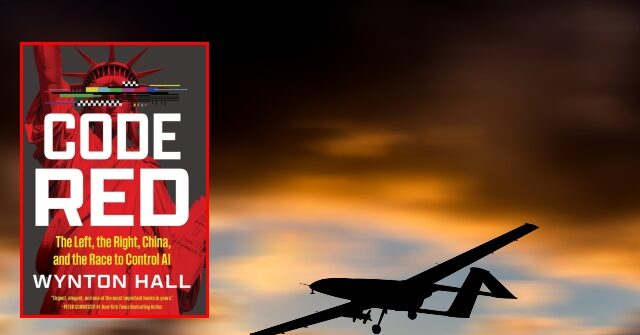
Wynton Hall’s new book Code Red: The Left, The Right, and The Race to Control AI includes a sobering look at the rapidly evolving danger of autonomous weapons, which look to change warfare in the Twenty-First Century as profoundly as nuclear weapons did in the Twentieth — and it will be far more difficult to keep the AI genie bottled than it was to restrain the proliferation of nuclear bombs.
The problem is that unlike uranium enrichment and intercontinental ballistic missile design, AI is cheap and increasingly ubiquitous. The physical components of autonomous weapons are not terribly expensive or difficult to produce. Hall notes in CODE RED that the first confirmed example of autonomous weapons hunting down and killing human targets, without direct human control, apparently occurred in 2020 in Libya, using equipment manufactured by a Turkish defense firm. AI warfare is not an exclusive game that only the world’s superpowers can afford to play.
“The democratization of lethal A.I. weaponry means that technology that was once the exclusive domain of superpowers will increasingly be available to a host of actors, both state and nonstate,” Hall notes.
Of course, the great powers will use more devastating weapons to play for higher stakes. Israel’s use of AI to prosecute the Gaza war was an astounding example of how machine learning can process intelligence and lock down targets much faster than human operators. According to Israel Defense Forces (IDF) officials, the three AI systems they used to track down Hamas terrorists was dozens of times faster than Israel’s extremely efficient human intelligence analysts.
Connecting such powerful data processing systems to autonomous weapons brings mankind closer to the brink of hyperwar — an all-out conflict between powerful nations that both rely on artificial intelligence. As CODE RED points out, autonomous weapons have a speed advantage that will prove to be crushing on the lightning-fast battlefields of tomorrow. No army can afford to let its enemies monopolize the use of systems that can pinpoint and eliminate targets faster, any more than an old-time gunslinger would pour glue into his holster before a shootout.
“In the kill-or-be-killed reality of combat, a nanosecond delay might send an American soldier home in a flag-draped coffin instead of alive,” Hall observes. “While it’s wise to maintain a human-in-the-loop capability, it’s equally important to let AI weapons run autonomously if an enemy is doing the same.”
This inescapable logic brings us inexorably closer to the day when autonomous weapons fight each other, and neither side can afford to slow its roll by letting human beings exercise control over their drones. Putting human fingers on the triggers would be suicidal. Leaving humans out of the warfare loop is terrifying.
Another challenge facing the United States is that our adversaries face nothing like the moral panics or activist obstacles that we do. CODE RED chronicles how workers in the U.S. tech industry have rebelled against military contracts and demanded assurances their code will never be sold to the Pentagon, even when their intransigence puts the lives of American service members at risk.
“You can be sure that the Chinese Communist Party (CCP) doesn’t face such resistance to its civil-military fusion. And Russia’s tech sector doesn’t oppose Vladimir Putin over his military modernization agenda,” Hall dryly points out.
CODE RED offers a bit of optimism that this state of affairs is changing, as even the most left-leaning, Kamala Harris-donating captains of Silicon Valley realize that helping brutal authoritarian regimes gain a qualitative advantage in militarized AI over the last bastion of true freedom on Earth would be a dangerous gamble.
The chapter on AI weapons opens with a quote that “whoever becomes the leader in this sphere will become the ruler of the world.” The author of that quote was Russian President Vladimir Putin. Big Tech appears to be hearing the distant early warning alarms.
The bottom line is that AI is a tool like any other: it makes work cheaper and faster. Artificial intelligence is bidding to make things cheaper and faster than any other human tool — perhaps all previous human tools put together.
Hall reminds us that the first “autonomous weapons” were land mines developed during the American Civil War. The basic principles of the new autonomous weapons are not so different — except land mines don’t follow their victims home by hacking into their social media profiles, or make nanosecond decisions about who to kill, and who to spare.
Applying that power to the sphere of armed conflict and information warfare means vicious non-state actors will soon have access to the same killer drones, cyber weapons, propaganda machines, and recruiting tools as superpowers. The strength of the Titans will be available to the lowest miscreants at fire-sale prices. CODE RED warns us that not a moment can be spared to ensure that America has an insurmountable lead in the new arms race.
Read the full article here


