


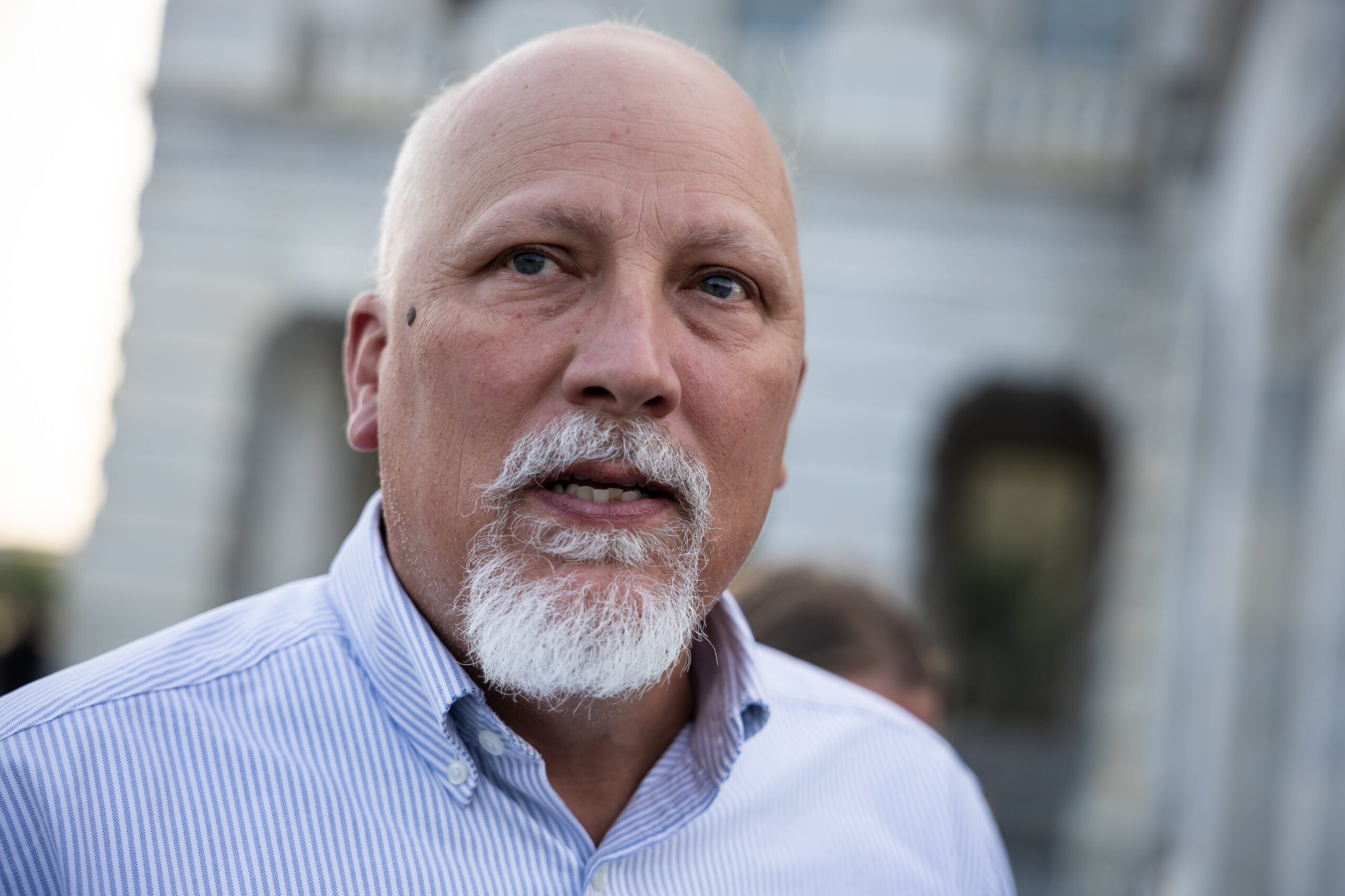
Rep. Chip Roy isn’t known for his touchy-feely approach to legislating. But as the staunch conservative is preparing to leave Congress at the end of the year, he’s raising difficult, philosophical questions about whether the rapid rise of artificial intelligence could turn over human dominion to “entities that have no soul.”
The Texas Republican is grappling with how to square his small-government, anti-regulatory values with what he sees as an urgent need to bring some accountability to an industry that has answered few questions about whether the rapidly evolving technology could fundamentally change what it means to be a “free human.”
And as many of his fellow Republicans warn that regulating AI in the U.S. could cede ground to China, he keeps coming back to a nagging question: At what cost?
“All the proponents of technology will say, ’Oh, your life is better. You can do so many more things, so many advancements, curing cancer … blah blah blah.’ And I’m like, ‘yeah, but what world am I living in?’ And I think that’s a question we have to ask as we kind of work through all this stuff.”
The interview has been edited for length and clarity.
We’re speaking the day after an ex-AI researcher went on social media to issue a warning about the potential extinction threat posed by unchecked AI development. What do you think is going on here?
Everybody’s feeling like they’re losing control. They don’t know what their job’s going to look like. They don’t know what their life’s going to look like. They’re being told that we need to have all these data centers and invest in those, and whatever that means, whatever the impact is, don’t worry, it’ll be better, and there’ll be plenty of water, there’ll be plenty of electricity. But you got to do it because, “beat China?”
I’m a free market guy. I’m a limited government guy. I’m a guy that believes that the government can’t solve problems very well, but I’ve tried to have some conversations with folks about this in terms of responsibility. Is this not unlike nuclear proliferation?
Did you think you’ve had to rethink your free market inclinations at all?
None of this makes me rethink free market. The free market is the best thing you could possibly have to provide as many options as possible without government interference. However, what I want people in this space to acknowledge is, this is a unique issue. This is not the simple transition from a horse and buggy to a car. This is an earth shattering potential human replacement on multiple levels. And with no clear direction for what it means, and then ultimately no clear understanding of who’s in charge of what is supposed to be a tool for humanity — but can ultimately make humans the tools of the technology.
One researcher has put it at a greater than 10% chance that AI could end civilization. Do you take that seriously and, if so, does that mean Congress should act sooner rather than later?
I think that certainly raises eyebrows and opens eyes to, “wait, what are we talking about here?” And the biggest problem is that most of the people in the industry cannot just unilaterally deny it. They cannot answer the question of, “what does it do for the dignity of work and the ability of humans to continue to work and produce with their hands and through their own toil and production?”
At what point can the genie not go back in the bottle?
I am of the mindset that the genie cannot go back in the bottle. I am of the mindset that technology and entrepreneurs are our best hope for figuring out how to manage all of this — not government. But I do think government can provide some safety valves, right? If everything is digitized and AI is sort of running things, if everything goes sideways, what do I do? We have to be philosophical about what it means to live. Not all advancements make the world better; they make it different, and some of them do make it better, right? Was it better to grow up in the ’90s or in 2026 as a kid? I don’t know.
If your ultimate backstop as a human is that God gave us life and dominion over your world, why should I have to answer to a world that chose an AI-driven world? Why? I mean, you have to live in the world you’re in, but shouldn’t I have an option as a free human?
You’re talking about your faith — what role could Christians play here?
Do I think that there is a God question in this entire AI debate? I absolutely do. Do I think that God gave man dominion over the world, and that we owe it to ourselves and our posterity and to God to try to make sure that we maintain that dominion and not turn that over to, essentially, entities that have no soul and have no ability to understand humanity? You cannot turn leadership and decision-making over to soulless entities, and I think that that is a central question to everything that we’re going to be debating on this topic.
Do you think this will be a big issue in faith circles?
Yes. I don’t think people have caught up to it yet, but I do think that’s going to be a growing issue in faith circles, in Christian circles.
The White House’s position has largely been about the need for the U.S. to beat China.
So I’ll be honest. I don’t know what the proper role of government is here. The Big Tech bros need better answers if they want us just to all say, “oh yeah, just let the market figure it out.” Well, then give me my answers. So far the Big Tech bros’ answer has been: “but China.” And “but China” is not a policy prescription. It’s a fear mechanism.
It seems like you are really wrestling with the role of government here.
Yes. And all of us should be wrestling with it. And our predisposition as free market conservatives should be that the market is going to produce the best and most efficient and most effective solutions for all of these problems. But the people that are running the industries, they owe us an understanding that they’re doing that. Government has a role to have hearings. Government has a role to raise questions. Government has a role to maybe demand certain levels of safety or security, or maybe government has a role to demand some certain level of escape valve.
The reactions to the warnings from the AI researchers have come overwhelmingly from Democrats. Do you think we could see Republicans start to say, “oh, maybe progressives who want to ban superintelligence are right?”
I do not believe “we’re going to shut it all down” is either plausible or the best solution. I do think we must have some degree of guardrails and that the same laws and rules that apply to humans are going to have to apply to a world of AI, and there are other existential questions that have to be raised.
If you’re sitting as a red coat and a blue coat in the revolution, staring across the field, you know that if you walk out there, you’re gonna get shot, or you might get shot, and you got to be willing to risk it. And you’re risking your life. What is a robot risking? I think that’s a big deal.
Read the full article here