


The Chinese government is scrambling to end hostilities between Pakistan and Afghanistan, two countries where Beijing has made enormous financial and political investments — including the crown jewel of China’s Belt and Road infrastructure project, the China-Pakistan Economic Corridor.
China’s state-run Global Times on Wednesday reported on Beijing’s frantic efforts at shuttle diplomacy, naturally framing them as a noble and selfless quest for world peace rather than China trying to keep Afghanistan’s valuable mineral resources from slipping out of its grasp:
On Monday local time, the United Nation Security Council adopted a China-penned resolution extending the mandate of United Nations Assistance Mission in Afghanistan (UNAMA) for three months.
Meanwhile, Yue Xiaoyong, China’s Special Envoy for Afghan Affairs, traveled between Afghanistan and Pakistan to conduct shuttle diplomacy, urging both sides to exercise restraint and to achieve a ceasefire as soon as possible, earning appreciation from both countries.
…
From March 7 to 14, Special Envoy Yue Xiaoyong visited both Afghanistan and Pakistan. In Afghanistan, he met separately with Afghan Foreign Minister Mawlawi Amir Khan Muttaqi and Minister of Industry and Commerce Nooruddin Azizi. In Pakistan, he held talks with Pakistan’s Foreign Secretary Amna Baloch and Mohammad Sadiq, Islamabad’s special envoy for Afghanistan, urging both sides to remain calm, reach a ceasefire as soon as possible, and resolve differences through dialogue.
China fulsomely thanked the United Nations (U.N.) for pitching in by extending its mission in Afghanistan, without mentioning that the extension was for a shorter-than-usual three months because the United States has been asking tough questions about where all of UNAMA’s money is going. China wanted a full one-year extension.
U.S. Ambassador to the United Nations Mike Waltz — a former Green Beret who served in Afghanistan — pointed out that UNAMA has the largest budget of any U.N. special mission in the world, even though the Taliban regime has willfully obstructed its work, taken hostages, seized humanitarian aid, and flaunted the U.N.’s demands for equal rights for women.
“In light of the Taliban’s intransigence, we must carefully evaluate the utility of international assistance and engagement in Afghanistan,” Waltz told the U.N. Security Council last week. “This council must consider carefully the funds we collectively provide for this mission’s budget, when the mission’s female national staff are not even able to go into the office to work.”
The U.S. has also been concerned about big-budget U.N. assistance programs undermining the effect of sanctions against the brutal Taliban junta, and to put it bluntly, American taxpayers will not be eager to underwrite a U.N. effort to protect China’s business interests.
China allocated some $62 billion under its Belt and Road Initiative (BRI) to create the China-Pakistan Economic Corridor (CPEC), a naked attempt to build influence in the region that began backfiring a few years ago when Pakistan noticed the program was saddling it with debts to China that were far out of proportion to the benefits.
CPEC has dramatically underperformed on its promises, with less than half of its projects completed after ten years of work and some of its biggest projects generating only a fraction of the promised revenue. China has, not entirely without reason, blamed some of the problems on inefficiency and corruption in Pakistan, but such criticism does not rest easily in Pakistan’s ears.
China has big dreams of extending CPEC into Afghanistan after President Joe Biden’s disastrous withdrawal of American forces in 2021 left the country up for grabs. The Taliban has minerals to sell, China is eager to buy, and the Chinese do not care how badly the Taliban abuses women.
Bringing Afghanistan into China’s orbit was also intended to resolve one of Beijing’s major security concerns, which ironically is very similar to the concerns that prompted Pakistan to go to war with Afghanistan: China is worried about terrorists and insurgents hiding on the Afghan side of the border with East Turkestan, the restless region China refers to as the Xinjiang Uyghur Autonomous Region (XUAR).
Security inside Afghanistan has proven to be a major stumbling block for China’s ambitions, as the Taliban has struggled to protect Chinese workers and executives from terrorist attacks. Chinese workers have also been attacked in Tajikistan, which has its own border squabbles with Afghanistan, and in the more unstable provinces of Pakistan.
There is little doubt that the already appalling humanitarian situation in Afghanistan is getting worse due to the escalating war with Pakistan. The Pakistanis would pin the blame for that on the Taliban, who have insisted on protecting and supporting terrorist groups that want to overthrow the Pakistani government, without regard for the suffering inflicted on the Afghan people.
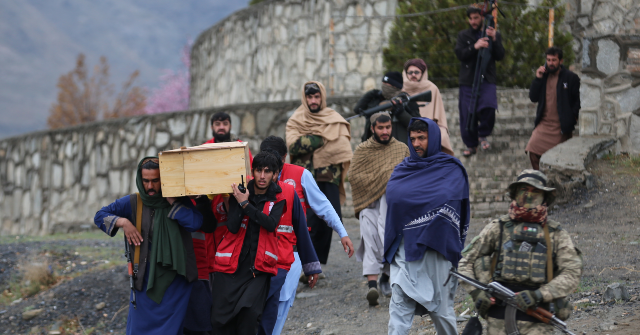
China went into panic mode after Tuesday’s Pakistani airstrike on a rehabilitation hospital in Kabul, which reportedly killed hundreds of people. Pakistan insists it conducted an accurate “precision strike” against the Taliban’s “technical support infrastructure and ammunition storage facilities.” Chinese calls for ceasefire negotiations became more strident, but so far Beijing has proven unable to bring its two economic client states to the bargaining table.
The Council on Foreign Relations (CFR) speculated on Tuesday that China might soon be forced to stop pleading for bilateral peace negotiations and actively take Pakistan’s side against the Taliban, especially if the United States weighs in.
The U.S. has been warming up relations with Pakistan lately, it certainly has no love for the Taliban, and it might find Pakistan’s arguments about terror threats emanating from Afghanistan to be persuasive. As for Beijing, it might be desperate to preserve its investments in both countries, but when push comes to shove, it has about 65 billion reasons to favor Pakistan.
Read the full article here