




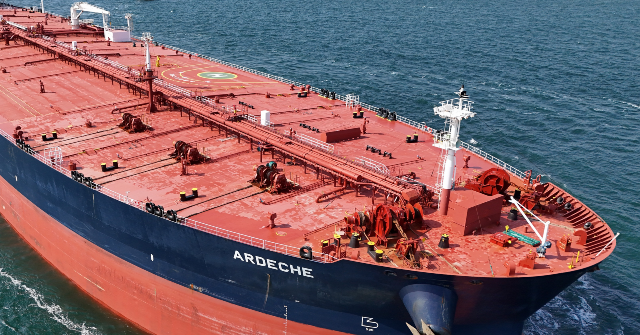
China is pleading with Iran to keep the Strait of Hormuz open for oil shipments, but the terrorist Islamic Revolutionary Guard Corps (IRGC) insisted on Monday that any ship attempting to pass through the strategically vital strait will be “set ablaze.”
China issued a public call for “all parties” to “stop military operations at once, avoid further escalation, keep the shipping routes in the Strait of Hormuz safe, and prevent further impact on the global economy,” but only Iran is threatening to wantonly attack civilian vessels using one of the world’s most-traveled oil shipping routes.
“The Strait of Hormuz and its adjacent waters are an important international trade route for goods and energy. To keep the region secure and stable serves the common interests of the international community,” Chinese Foreign Ministry spokeswoman Mao Ning said on Monday.
Bloomberg News reported on Tuesday that China is applying intense pressure behind the scenes on Iran, using its leverage as Iran’s top trading partner, to make the Strait of Hormuz safe for oil shipments to China’s ravenous refineries.
Executives at Chinese state-owned gas firms were told by government officials that Beijing is also urging Iran not to attack major energy export hubs, like the one in Qatar, which handles about 30 percent of China’s liquified natural gas (LNG) imports.
On Monday, Qatar halted production at Ras Laffan — the world’s largest LNG export facility — after it was attacked by Iranian drones. Ras Laffan supplies about a fifth of the entire world’s LNG products.
Industry analysts said China would begin feeling the pinch from Qatar’s LNG shutdown in a matter of days and Asian and European buyers would soon find themselves facing shortages comparable to the loss of Russian supplies after Russia invaded Ukraine in 2022.
Iran’s oil is an irreplaceable input for China’s “teapot refineries,” independent operations that have thrived by picking up Iranian and Russian oil at discount prices. China obtains up to half of its oil through the Strait of Hormuz, from Iran and other Middle Eastern sources, depending on seasonal variations.
Iran insisted on Monday that the Strait of Hormuz is shuttered for all commercial traffic and any ship defying Iran’s terrorist blockade will be attacked. The Iranian media has been broadcasting radio threats to commercial shipping since the beginning of Operation Epic Fury on Saturday.
“The Strait of Hormuz has been closed. We will attack and set ablaze any ship attempting to cross,” vowed IRGC commander-in-chief Ebrahim Jabbari.
“We will not let oil be exported from the region,” Jabbari added, threatening to attack oil pipelines across the Middle East.
Shipping data and satellite photography showed that traffic through the Strait of Hormuz has effectively halted, but U.S. military officials insisted on Monday that Iran’s threat of a blockade is a “pressure tactic” that it is rapidly losing the power to enforce.
The U.S. Central Command (CENTCOM) said the strait is “open” and, while the possibility of Iranian missile or drone attacks against civilian vessels still exists, there is no sign of the IRGC attempting to plant mines in the vital waterway. Most of Iran’s large surface combat vessels have been destroyed, and multiple fires have been seen at Iran’s major naval base, the Port of Bandar Abbas.
“Two days ago, the Iranian regime had 11 ships in the Gulf of Oman, today they have ZERO,” CENTCOM said via social media on Monday.
“The Iranian regime has harassed and attacked international shipping in the Gulf of Oman for decades. Those days are over,” CENTCOM added.
The Joint Maritime Information Center (JMIC), a collaborative project established during attacks on Red Sea shipping by the Iran-backed Houthi insurgents of Yemen, said on Monday that while “no formal legal closure of the Strait of Hormuz has been declared,” it has raised its security level for the passage to “critical” because “the operational environment reflects active kinetic hazard conditions in this area.”
JMIC noted that four commercial vessels have been hit and damaged in the Arabian Gulf, Strait of Hormuz, and Gulf of Oman since Operation Epic Fury began, including a U.S.-flagged tanker that was hit by two missiles while docked at the Port of Bahrain.
Read the full article here


