
Close Menu
The Politic ReviewThe Politic Review
  • News
  • U.S.
  • World
  • Politics
  • Congress
  • Business
  • Economy
  • Money
  • Tech
  • More Articles
Trending

UK Govt ‘Playing Politics’ With Safety of Lawmakers, Warns Reform UK’s Jenrick in Wake of Widdecombe Killing

July 15, 2026

Nolte: Wall Streeter Urges Disney to Drop Stagnant Disney+

July 15, 2026

Merkley: Senate Republicans ‘Stressed About’ Iran

July 15, 2026
Facebook X (Twitter) Instagram
  • Donald Trump
  • Kamala Harris
  • Elections 2024
  • Elon Musk
  • Israel War
  • Ukraine War
  • Policy
  • Immigration
Facebook X (Twitter) Instagram
The Politic ReviewThe Politic Review
Newsletter
Wednesday, July 15
  • News
  • U.S.
  • World
  • Politics
  • Congress
  • Business
  • Economy
  • Money
  • Tech
  • More Articles
The Politic ReviewThe Politic Review
  • United States
  • World
  • Politics
  • Elections
  • Congress
  • Business
  • Economy
  • Money
  • Tech
Home»News»China, India, and the US: A Complex Relationship with Long-Term Implications for Washington
News

China, India, and the US: A Complex Relationship with Long-Term Implications for Washington

Press RoomBy Press RoomAugust 12, 2025No Comments5 Mins Read
Share Facebook Twitter Pinterest Copy Link LinkedIn Tumblr Email VKontakte Telegram
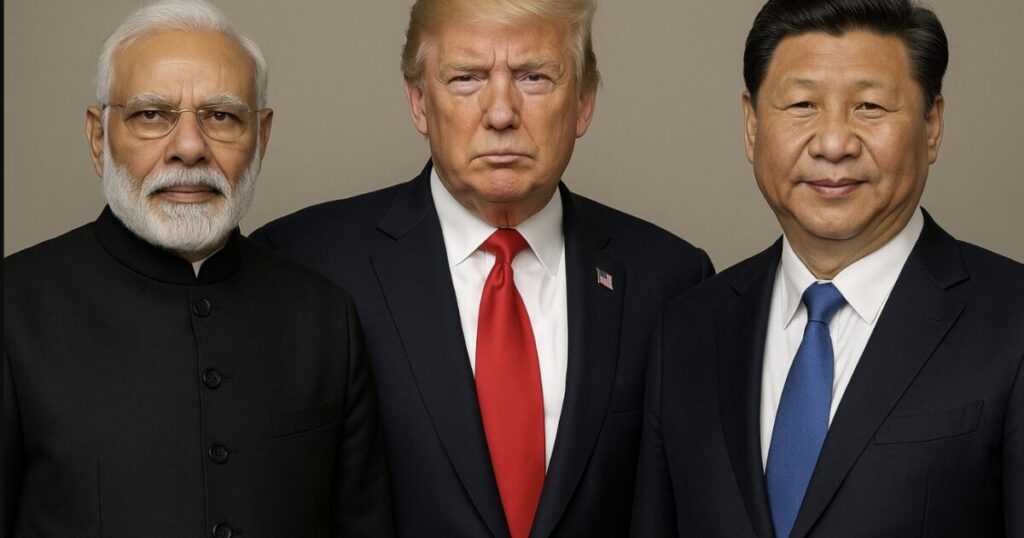
Modi, Trump, and Xi , image generated by ChatGPT.

China and India, both members of BRICS, align on some issues but maintain a deeply complex relationship. Their economic and security interests often conflict, and both are competing to lead the Global South with divergent visions for the international order. The direction India chooses could tilt the balance of global power, making this dynamic critical for US strategy.

The India-China rivalry includes economic as well as military disputes. The June, 2020 Galwan Valley clash was the deadliest Sino–Indian border incident in decades, leaving twenty Indian soldiers dead and an undisclosed number of Chinese casualties. It followed a May 2020 PLA buildup in eastern Ladakh that blocked Indian patrols at several strategic points along the Line of Actual Control (LAC). While no shots were fired, consistent with decades of border protocols, the confrontation marked a turning point in relations.

Tensions flared again on December 9, 2022, in Tawang, Arunachal Pradesh, when about 300 PLA soldiers attempted to alter the status quo, resulting in hand-to-hand combat and minor injuries on both sides. Such encounters reportedly became more frequent, with some incidents in Arunachal Pradesh occurring multiple times a month.

Both nations have significantly militarized the border. By 2021, India had deployed 50,000 troops and maintained a strong air presence, while China stationed 50,000–60,000 troops without prior notification required by a 1996 agreement.

The rivalry also extends to the Indian Ocean, where India views Chinese “research” vessels as covert intelligence platforms supporting military objectives. These ships, such as the Yuan Wang 5 and Yuan Wang 6, have forced India to postpone missile tests and are suspected of tracking Indian naval operations. Large-scale Chinese survey missions, such as the Xiang Yang Hong 06 expedition, map the seafloor for resource exploration and submarine operations.

Strategically, India fears a Chinese-dominated Indian Ocean, given that 95 percent of its trade and 80 percent of its oil imports pass through these waters. Beijing’s growing network of commercial ports, many capable of hosting naval assets, and its naval deployments fuel concerns over a “string of pearls” encirclement strategy. These concerns have prompted India to adopt “Mission Based Deployments” to monitor Chinese warships entering the region.

India and China are also locked in a fierce economic rivalry spanning manufacturing, infrastructure, technology, and leadership of the Global South, with each promoting a different model for development and regional order. In manufacturing, the gap is stark: China produces 30 percent of global output, compared to India’s 3 percent.

Unlike China, which rose by competing against high-cost Western labor, India now faces low-cost rivals such as Bangladesh, Vietnam, and China itself. In machinery manufacturing, it struggles to match the scale and technology of competitors from China, Europe, Japan, South Korea, and Thailand.

Beijing has even been accused of trying to limit India’s manufacturing rise, as seen in its July 2025 recall of more than 300 engineers from Foxconn’s iPhone plant in India. In response, New Delhi has partnered with Taiwan, the United States, South Korea, and Japan to secure skilled personnel and critical equipment. While its manufacturing sector still lags, India has built global strength in services, particularly in IT and legal outsourcing, with companies like JP Morgan employing thousands of Indian professionals to handle contracts and operations worldwide.

Technology and supply chains form another front in the rivalry. Bilateral trade remains significant, $114.2 billion in 2021–22, with China supplying 30 percent of India’s imports, up from 21 percent over the past 15 years, largely in manufactured goods and electronic components vital to India’s consumer market.

Rising labor costs in China, environmental constraints, and geopolitical tensions are driving global manufacturers to diversify. India is positioning itself as the leading alternative hub, supported by industrial policies and initiatives such as the Quad (United States, Japan, India, Australia), which have strengthened economic cooperation since 2019.

Strategically, the two nations have divergent visions for Asia’s order. India seeks a multipolar system in which it is a central player, while China envisions a single-pole order dominated by Beijing.

India’s long-standing policy of non-alignment has quietly evolved into a new guiding principle: strategic autonomy. Described as a blend of realism and India’s traditional independent posture, this approach prioritizes sovereignty, self-sufficiency, and the freedom to make foreign policy decisions without external constraints. Indian leaders frame it as “multi-alignment” or “vishwa mitra” (“friend of the world”), signaling a willingness to form issue-based partnerships while avoiding permanent alignment with any single bloc.

India’s relationship with Russia underscores its resistance to outside pressure and remains a key obstacle to closer US–India ties. Moscow is now India’s top crude oil supplier, providing 36 percent of imports—a trade that expanded after the 2022 Ukraine war diverted supplies to Europe. This decades-old defense and energy partnership has repeatedly tested the limits of alignment with Washington, with tensions peaking in July 2025 when President Trump publicly condemned the purchases.

While taking sides in the US–China rivalry could shift the global balance of power, India is seeking to align with neither. New Delhi’s grand strategy is to position itself as an independent pole in a multipolar world, not as a junior partner in a US-led bloc. By maintaining balanced relationships with major powers, including the US, Russia, and even China where interests align, India aims to secure economic, technological, and security gains from all sides while pursuing its long-term goal of great power status on its own terms.

For US policymakers, the relationship with India will need to be built around shared concerns, such as confronting China in the Indian Ocean or cooperating on shifting US manufacturing supply chains from China to India, but even broad alignment on many issues is unlikely to make India a US-aligned nation within Washington’s sphere of influence.

Read the full article here

Share. Facebook Twitter Pinterest LinkedIn Tumblr Email Telegram Copy Link

Related Articles

News

The Real Point of the “Patriot Front” Psy-Op

July 15, 2026
News

The New Socialists: Elite, Ungrateful, and Toxic as Ever

July 14, 2026
News

The American System Rejects Europe’s Economic Suicide

July 13, 2026
News

How an Unvaxxed Dating App Accidentally Started an International Incident (and a Movie)

July 13, 2026
News

It’s Time To Stop Pretending That Migrants Are Entitled To Equal Citizenship

July 12, 2026
News

Don’t Be Fooled By The “Democratic Socialists”, More State Bureaucracy Won’t Fix Our Problems

July 12, 2026
Add A Comment
Leave A Reply Cancel Reply

Editors Picks

Nolte: Wall Streeter Urges Disney to Drop Stagnant Disney+

July 15, 2026

Merkley: Senate Republicans ‘Stressed About’ Iran

July 15, 2026

Oversight panel sets date to depose Leon Black in Epstein probe

July 15, 2026

Republican senator backs Trump’s push to limit birthright citizenship

July 15, 2026
Latest News

U.S. Bombs Iran’s Bushehr, Home to Its Only Known Nuclear Power Plant

July 15, 2026

U.S. Treasury Unveils Coin with Trump’s Face, $100 Bill Featuring Presidential Signature

July 15, 2026

Homan: There’s ‘Temporary Pause’ for Most ICE Vehicle Stops, We Can Arrest Before They Get Into Vehicle

July 15, 2026

Subscribe to News

Get the latest politics news and updates directly to your inbox.

The Politic Review is your one-stop website for the latest politics news and updates, follow us now to get the news that matters to you.

Facebook X (Twitter) Instagram Pinterest YouTube
Latest Articles

UK Govt ‘Playing Politics’ With Safety of Lawmakers, Warns Reform UK’s Jenrick in Wake of Widdecombe Killing

July 15, 2026

Nolte: Wall Streeter Urges Disney to Drop Stagnant Disney+

July 15, 2026

Merkley: Senate Republicans ‘Stressed About’ Iran

July 15, 2026

Subscribe to Updates

Get the latest politics news and updates directly to your inbox.

© 2026 Prices.com LLC. All Rights Reserved.
  • Privacy Policy
  • Terms of use
  • For Advertisers
  • Contact

Type above and press Enter to search. Press Esc to cancel.