




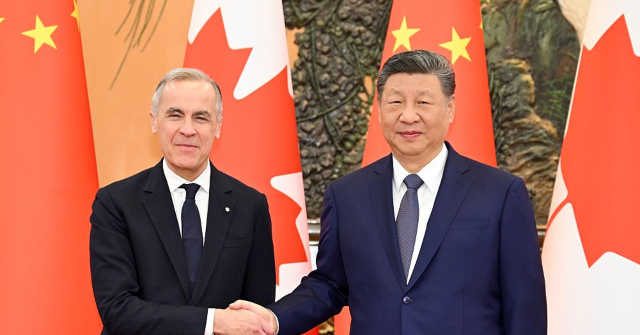
Chinese Premier Li Qiang embraced Canadian Prime Minister Mark Carney to Beijing on Thursday, telling the Canadian leader that his visit represented a “new starting point” for the previously strained relations between their countries.
“Standing at a new starting point, China is willing to work with Canada to uphold the strategic partnership, strengthen dialogue and communication, enhance political mutual trust, respect each other’s core interests, seek common ground while shelving differences, and continuously expand pragmatic cooperation to add more impetus to the development of both countries,” Li said.
Li said the “turnaround” in relations was the result of work from both sides, and China was now ready to seek “stable growth in bilateral trade” in areas like digital technology and agriculture.
“China is ready to enhance cooperation with Canada within frameworks such as the United Nations, the World Trade Organization, G20, and the Asia-Pacific Economic Cooperation, jointly uphold multilateralism and free trade, improve global governance, and make the international order more just and equitable,” Li said.
Carney responded that Canada is “willing to strengthen dialogue with China in various fields on the basis of mutual respect, leverage complementary advantages, and promote cooperation in areas such as economy, trade, energy, green economy, agriculture, and people-to-people exchanges.”
“Chinese companies are welcome to invest and do business in Canada, and Canadian enterprises are fully confident in deepening cooperation with the Chinese side,” he said.
Carney and Li both agreed to work together in supporting the United Nations and defending multilateralism. Li added China’s desire to “make the international order more just and equitable.”
Relations between China and Canada soured after Canada arrested Chinese Communist Party royalty Meng Wanzhou to face charges for financial crimes in the United States in 2018. China took several Canadians hostage and brought enormous pressure to bear against Canada to secure Meng’s release.
Carney’s private-sector business ties to China were an issue during his campaign for prime minister, but he convinced voters that he had no conflicts of interest, and he regarded China as the greatest threat to Canadian national security. There was little evidence of that healthy suspicion during his trip to Beijing, the first by a Canadian prime minister since 2017.
The South China Morning Post (SCMP) thought it was obvious that Carney wanted to broaden Canada’s trade options after sparring with President Donald Trump over tariffs:
Canada’s steel, aluminum and car sectors have been hit hard by U.S. President Donald Trump’s tariffs, with talks between Ottawa and Washington to ease those duties suspended.
Most Canadian goods can now enter the U.S. thanks to a free-trade agreement between the U.S., Canada and Mexico. But the pact is up for a review this year, and its extension is uncertain. Trump has repeatedly suggested that Canada, a long-time American ally, could become a U.S. state.
This has prompted Ottawa to reassess the vulnerabilities inherent in its heavy economic reliance on America and set a target of doubling its non-U.S. exports over the next decade.
Carney said on social media that one of his goals in China was to reduce Canada’s dependence on the United States as its top trading partner.
“China is our second-largest trading partner, and the world’s second-largest economy. A pragmatic and constructive relationship between our nations will create greater stability, security and prosperity on both sides of the Pacific,” he said.
On Friday, after meeting with Chinese dictator Xi Jinping, Carney made a major break with U.S. trade policy by agreeing to reduce its 100 percent protective tariff on Chinese electric vehicles (EVs).
Carney said the tariff would be replaced by an annual cap of 49,000 Chinese EV imports, increasing to 70,000 over five years, to prevent China from swamping the Canadian EV market with its cheap, heavily-subsidized cars.
In exchange for lifting the EV tariff, Carney said China agreed to reduce its tariffs on Canadian canola from 84 percent to 15 percent. Canola products are among Canada’s major agricultural exports, but export volume was down sharply in 2025, due in part to the 100 percent tariff China slapped on canola in retaliation for Canada’s EV tariffs.
Ontario Premier Doug Ford was unhappy with Carney’s cave on EVs, accusing the prime minister of “inviting a flood of cheap made-in-China electric vehicles without any real guarantee of equal or immediate investments in Canada’s economy, auto sector, or supply chain.”
Ford also warned that Carney’s deal with China could mean “closing the door on Canadian automakers to the American market.”
Carney told reporters on Friday that he found Communist China to be a more “predictable” trading partner than the United States, and he praised the Chinese government for its “realistic and respectful” attitude.
Xi unsubtly made it clear that Canada is the junior partner in their new “strategic partnership,” using the language of mutual “respect” to make it clear that criticism of China’s human rights abuses will no longer be acceptable, and he expected all of Canada’s barriers to China’s “high-quality development” to fall.
Carney appeared submissive to these requirements, deflecting questions from reporters about past criticism of China on subjects like forced labor by saying he will henceforth be “pragmatic” when dealing with Beijing. He claimed he has mentioned his human rights concerns in private discussions with Chinese officials, but he no longer believes it would be helpful to express those concerns in public.
“We take the world as it is, not as we wish it to be,” he said.
Read the full article here


