




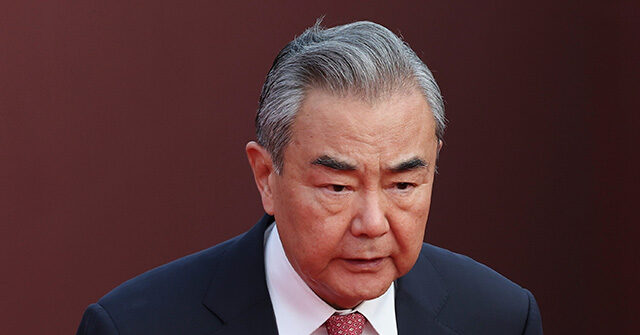
Chinese Foreign Minister Wang Yi issued a robust defense of the murderous Iranian regime on Thursday, warning America not to impose “the law of the jungle” by supporting massacred protesters during a conversation with his Iranian counterpart.
Wang, the Chinese Foreign Ministry confirmed on Thursday, held a conversation with Iranian Foreign Minister Abbas Araghchi in the context of two weeks of deadly protests in the country, triggered by massive inflation, barely livable conditions in major cities such as Tehran, and an expected tax hike at the end of the Islamic calendar year to sustain the Iranian terror regime. The government has responded to the protests, which have explicitly called for an end to “supreme leader” Ali Khamenei’s leadership, with a torrent of violence, killing thousands of people. Some estimates by human rights groups suggest as many as 20,000 people have been killed since the protests erupted on December 30.
The Chinese Communist Party, maintaining a stranglehold on power for over 70 years, has a similar track record of mass murdering protesters – most prominently following the pro-democracy protests of the 1980s that concluded with the 1989 Tiananmen Square massacre.
Rather than addressing the protests, Wang commented on American President Donald Trump’s assurances to Iranian protesters that “HELP ITS ON ITS WAY.” The Treasury Department has since imposed a new round of sanctions on Iran – already significantly sanctioned as a state sponsor of terrorism – and a 25-percent tariff on countries that do business with Iran, which prominently includes China.

“China opposes the use or threat of force in international relations, opposes imposing one’s own will on others, and opposes a return of the world to the ‘law of the jungle,’” the Chinese state propaganda newspaper Global Times paraphrased Wang as telling Araghchi. Wang also reportedly offered optimism that the regime would pull through and crush the overwhelming popular opposition in the country to its continued existence.
According to the South China Morning Post, Araghchi told Wang that the protests were not representative of the true Iranian people and “incited by external forces,” a claim Tehran has made repeatedly but not corroborated with any evidence. He also claimed that his nation seeks “dialogue,” without elaborating.
The protests in Iran have attracted some modest attention in Beijing, which has attempted to maintain its main influence pipeline in the Middle East while keeping a distance from the carnage within Iran. On Wednesday, Foreign Ministry spokeswoman Mao Ning insisted that China had made its position “clear … more than once”: one of verbal support for the Iranian regime and opposition to the United States, which at press time is playing no publicly known significant role in the protests.
“We hope the Iranian government and people will overcome the current difficulties and uphold stability in the country,” Mao said. “We oppose external interference in other countries’ internal affairs, object to the use or threat of force in international relations, and hope parties will act in ways conducive to peace and stability in the Middle East.”
The Chinese Communist Party has not condemned the killing of protesters in Iran but, rather, vocally condemned the Trump administration imposing a 25-percent tariff on countries that do business with Iran.
“China’s position on the tariffs issue is very clear. Tariff wars have no winners,” Mao said on Tuesday. “China will firmly protect its legitimate and lawful rights and interests.”
The Chinese Embassy in Washington similarly declared that “protectionism harms the interest of all parties,” failing to comment on the human rights reasons behind the imposition of the tariff. The embassy vowed to take “all necessary measures” against the tariffs.
The tariff was imposed shortly after President Donald Trump ordered the arrest and extradition of socialist former dictator of Venezuela Nicolás Maduro and wife Cilia Flores – and reestablished relations with the remaining chavistas to begin shipping Venezuelan oil that would have previously gone to China up to the United States. Reports citing oil industry experts following Maduro’s arrest suggested that the Chinese government would soon greatly increase its purchases of Iranian oil to offset the Venezuelan losses – a possibility significantly limited by the tariffs and unrest in Iran.
The Global Times, the Chinese state newspaper, covered the Iran protests as a primarily American news item, criticizing the United States for allegedly launching a “hybrid pressure campaign” against Tehran. Its Party-approved “experts” predicted only a “limited, short-term and controllable action” from the United States if it does choose some military attack on Tehran in response to the repression, but nonetheless accused Washington of exacerbating the situation with “increasingly belligerent rhetoric.”
In reality, President Trump has instead revealed this week that the Iranian government is attempting to negotiate and suggested “they’re tired of being beat up by the United States.”
“There seem to be some people killed that aren’t supposed to be killed. These are violent, if you call them leaders. I don’t know if their leaders are just, they rule through violence, but we’re looking at it very seriously,” Trump told reporters on Tuesday.
Follow Frances Martel on Facebook and Twitter.
Read the full article here


