




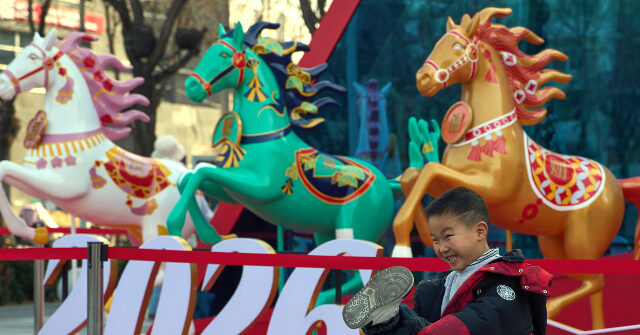
China’s National Development and Reform Commission estimates that 9.5 billion trips will be made during the 40-day Lunar New Year travel rush this year.
Lunar New Year, also known as the Spring Festival, has long been China’s biggest travel season, and is often described as the world’s largest annual human migration. The actual holiday falls on February 17 this year, beginning the Year of the Horse in the Chinese zodiac, but vacations always begin a few weeks earlier, so the travel season known as chunyun officially began on February 2.
State planners anticipated some 540 million train tickets would be purchased, 95 million trips would involve air travel, and the balance of the expected 9.5 billion holiday journeys would be made by road and boat.
China’s transportation ministry claimed on Monday that 1.4 billion “inter-regional passenger trips” were made between February 2 and 8, including 86 million by train, 16 million by air, and 4.9 million by water.
By a fortunate coincidence of the calendar, the official Chinese national holiday will be nine days long this year, from February 15 to 23. The Chinese government hopes this first-ever nine-day holiday will encourage more travel and consumer spending, rousing domestic consumption from its post-pandemic stupor.
Some of the early feedback given by Chinese citizens to foreign media outlets was not encouraging. Reuters reported on February 2 that early travel reservations were robust, but Chinese consumers remain “shaken by the country’s uncertain economic outlook and would rather save than spend.”
A few travelers complained that the buzz about record-high plane and train ticket sales was making them nervous about fighting through the crowds and China’s transportation networks seemed to be struggling with the surging demand.
“Why do I feel it’s even more stressful to buy tickets this year compared to last year? For example, the flight back to my home is already sold out. If you don’t buy early, the price range fluctuates a lot, and can even double,” one air traveler complained.
“Things feel worse this year than last. The economy is bad and it’s getting harder to make money,” a passenger getting ready for a 30-hour train ride told the Associated Press (AP). He said he could have gotten a high-speed rail ticket to make the trip in just nine hours, but it was too expensive.
Many travelers seemed more interested in getting together with distant family members than taking expensive vacations.
“It has become more difficult for a big family to get together. After I started working, I realized such a long holiday is rare and we see each other less and less in person, which makes the Spring Festival significant,” a young woman at a train station in Beijing reflected to the AP.
International analysts are watching China’s luxury goods market as a barometer for how much the holiday season can inspire consumer confidence. The exact Chinese Zodiac sign for 2026 is the Year of the Fire Horse, a rare conjunction that happens once in a generation. The Fire Horse symbolizes boldness, adventure, and passion, so Chinese consumers influenced by Zodiac mysticism might be more inclined to make big purchases.
China’s central bank, the People’s Bank of China (PBOC), registered a vote of confidence in the consumer economy last weekend by injecting 600 billion yuan ($86.4 billion) into the money supply.
Chinese financial analysts anticipated a liquidity drain of up to 900 billion yuan from the extended Lunar New Year season. In addition to travelers needing cash, money tucked into red envelopes is a traditional Spring Festival gift.
Read the full article here


