




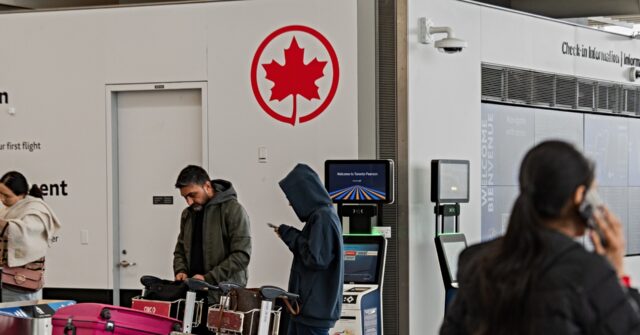
The largest airlines in Canada announced on Monday and Tuesday that they would be suspending flights to Cuba for the immediate future as a result of the Castro regime announcing it no longer had any jet fuel.
Canada is one of the Communist Party of Cuba’s most longstanding economic allies due to the high number of tourists from that country that visit the impoverished and repressed island nation. Some estimates suggest that Canadians made up the largest number of nationals engaging in tourism in Cuba – which solely bankrolls the Castro regime – in 2025, although numbers dwindled due to an ongoing power grid crisis, major food and medicine shortages, and the routine collapse of dilapidated buildings in Havana and other top cities. Canada’s leftist governments, particularly under former Prime Minister Justin Trudeau, have been supportive of the Communist Party and Trudeau himself celebrated communist mass murderer Fidel Castro, a friend of his parents, after his much anticipated death in 2016.
The jet fuel crisis in Cuba appears to be a direct result of the arrest of deposed Venezuelan dictator Nicolás Maduro on January 3. Maduro and wife Cilia Flores were arrested by U.S. forces in Caracas that day on charges of narco-terrorism, leaving the country in the hands of Vice President Delcy Rodríguez. Under Maduro and his predecessor Hugo Chávez, Venezuela had for decades offered Cuba free or deeply discounted oil in exchange for security and espionage services, as well as political clout. Rodríguez, working in tandem with the administration of President Donald Trump, has halted oil shipments to the country and is working to rebuild the Venezuelan oil industry and charge a fair price for the product.
Following the arrest of Maduro, Trump declared in a message on his website Truth Social: “THERE WILL BE NO MORE OIL OR MONEY GOING TO CUBA — ZERO! I strongly suggest they make a deal, BEFORE IT IS TOO LATE.”
Following the end of Cuba’s Venezuelan oil supply, Mexico is believed to have become the top shipper of oil to Cuba. Last week, President Trump signed an executive order declaring the communist regime a “national security threat,” citing its status as a state sponsor of terrorism with ties to the rogue regimes of China, Russia, and Iran, among others. The executive order allows for the imposition of tariffs on third-party countries offering oil to Cuba. Mexico has not publicly confirmed any shipments of oil to Cuba since the signing of the executive order.
Other allied nations, such as North Korea and China, have offered words of support to Cuba, but do not have oil to offer. Mexico has offered humanitarian aid, but no oil. Russia, one of the world’s largest fossil fuel producers, is also at press time not known to have offered any oil to Cuba, though it has also objected to Trump’s policies against the Castro regime.
As a result, the Cuban government alerted international airlines on Sunday that it no longer had any jet fuel to supply planes on the island. According to the Spanish newswire service EFE, Cuba’s aviation authority posted an international message reading, “JET A1 FUEL NOT AVBL,” expected to remain in place from Monday through March 11.
Canada’s CBC reported on Tuesday that the major airlines in the country offering flights to Cuba all confirmed they will no longer do so. Air Canada announced that it would additionally be sending fully fueled jets to Cuba to pick up stranded passengers.
“Air Canada took the decision following advisories issued by governments (NOTAMs) regarding the unreliability of the aviation fuel supply at Cuban airports,” the airline reportedly explained in a statement. “For remaining flights, Air Canada will tanker in extra fuel and make a technical stops as necessary to refuel on the return journey if necessary.”
The airline expects to bring home an estimated 3,000 people from Cuba, according to the CBC. The broadcaster also listed Air Transat and WestJet as airlines also announcing an end to flights and plans to travel to Cuba. The earliest an airline stated it is planning to return to Cuba is April 26, the plan for WestJet to return to travel there.
The government of Canada issued a travel advisory on Monday telling Canadians to expect “worsening shortages of electricity, fuel and basic necessities including food, water, and medicine” – which have ravaged the residents of the island for decades – to also potentially have an effect on the luxury resorts run by the Castro regime and frequented by Canadians.
“Resorts can be affected by shortages. The timing, location, and type of impacts on resorts vary and are difficult to predict,” the warning suggested.
Canadian tourists are critical to the survival of the Communist Party in Cuba. While Canadian tourism has declined in the past year – long before the arrest of Maduro – due to Cuban regime incompetence in maintaining basic services, Canada is still believed to be a top source of tourism to the island. Canada is also a member of the Club of Paris, a financial institution that has allowed the Castro regime to accumulate and then not pay exorbitant debts to European and other Western nations.
Follow Frances Martel on Facebook and Twitter.
Read the full article here


