
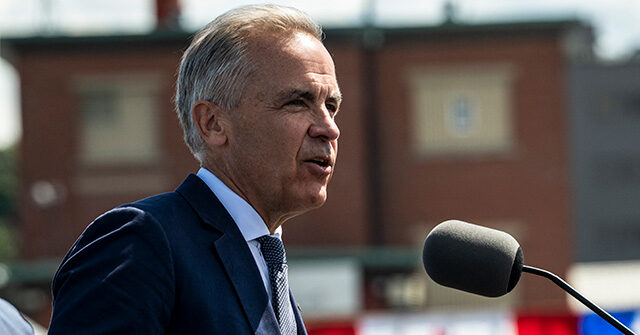
Alberta Premier Danielle Smith and Saskatchewan Premier Scott Moe gave separate press conferences on Wednesday in which they refused to impose retaliatory tariffs against the United States on natural resources, in defiance of leftist Prime Minister Mark Carney’s trade war agenda.
Smith and Moe said they had no problem with matching U.S. tariffs dollar-for-dollar, but they rejected Carney’s urge to escalate the trade war by applying punitive tariffs to vital natural resources in their provinces, such as oil and potash.
“What we, as a province, cannot and will not support is any kind of export tariff on our natural resources,” said Moe.
“I cannot think of a more disastrous policy decision than cutting off or taxing Alberta’s oil to the United States. Doing so would absolutely devastate the Canadian economy,” said Smith.
At his press conference, Moe said planned to match a 50-percent U.S. tariff on Canadian spirits, while Smith said she was not quite ready to go that far. Smith called for more diplomacy with the United States and suggested the citizens of both countries could persuade their leaders to come back to the negotiating table.
“It means being more Canadian – too friendly, kind and helpful to resist,” she said of her preferred strategy.
Smith pointed out that Canada lacks the strategic oil reserves of the United States, so putting heavy tariffs on Canadian oil would “bring the economies of Ontario and Quebec to a grinding halt.”
“Canada will not win this battle through brute force,” she argued. “We will win it through being smarter, more strategic, more agile and using our reputation and relationship with the American people to have these tariffs reversed.”
Smith faces the additional complication of the Alberta independence referendum, which is currently scheduled for October 19. She has resisted calls to cancel the referendum in light of the U.S. trade dispute, although she said she wants Alberta to remain part of Canada.
“This is an important time for us to be looking at the benefits that come from being a part of Canada,” she said on Wednesday. “That’s what I’ve been advocating. It’s why I’m voting to remain.”
“I feel like we have a real momentum in our country now, working together, and I hope to persuade as many people as possible to vote with me,” she added.
Columnist Cory Morgan of Rebel News defied conventional wisdom, and Smith’s argument, on Wednesday by predicting that the trade dispute could strengthen the independence movement in Alberta, rather than destroying it.
“What we are seeing is an illustration of the failure of the federation to present an effective trading bloc. This only strengthens the case for Alberta independence,” Morgan wrote.
“The trade collapse does not refute the independence argument in Alberta. It illustrates it. Ottawa could not close a deal. Other provinces now want Alberta’s oil treated as a weapon. And the people who would pay first for that weapon are not sitting in Toronto or Ottawa,” he continued.
“Alberta’s energy resources are treated as a national asset when convenient and a political problem when it is not. You cannot spend a decade blocking pipelines, lecturing the oil patch, and then, when Washington turns hostile, discover that Alberta crude is the federation’s strategic reserve,” he added.
Canada’s Federal Industry Minister, Melanie Joly, refused to answer questions on Wednesday about whether the national government would pressure provincial governments to follow its trade war plans.
“We don’t negotiate in public. We’ve already made important decisions when it comes to countermeasures,” Joly said.
The Conservative Party of Canada was pressing Carney’s government to release the full text of the U.S. trade proposal rejected by Canadian negotiators last week – heavily implying that Carney and his officials have not been entirely honest about what it contained and why they rejected it.
“Canadians deserve to know what is the deal that the prime minister at first planned to accept and later decided to reject. Release the proposed text. Canadians deserve to know what was on the table so all of us can know what we are fighting for and what we are fighting against,” said Conservative leader Pierre Poilievre on Tuesday.
Liberals and their supporters responded that releasing such details about trade negotiations would weaken Canada’s position for future trade negotiations.
“We may be sitting down with the Americans, I think, at some point in the future and talking to them again. You don’t want to have all kinds of political gamesmanship surrounding papers that Canada might have put on the table during the suspended negotiations,” advised trade lawyer and C.D. Howe Institute senior fellow Lawrence Herman.
The Conservatives were by no means friendly to the U.S. position on the trade dispute. Poilievre said his party was “disappointed that the United States has chosen to impose further unjustified tariffs on Canada.”
“Canadians must stand united to defend our country against these unfair attacks on our jobs and businesses. Canada cannot accept one-sided tariffs that will deindustrialize our country. Nor can we accept a bad deal. Instead, we must continue the fight for tariff-free trade,” he said.
“Conservatives support action to protect Canadians and our industries targeted by these unfair U.S. tariffs,” he said.
Poilievre threw in a jab at Carney’s economic policies, calling for “urgent economic reforms to restore growth, protect jobs and save our industry.”
“That must include ending the industrial carbon tax, repealing anti-development laws, green lighting the 500 economic projects awaiting federal approval and major tax reforms to return investment to our country, reward work and recharge our economy,” he elaborated.
Carney has stubbornly resisted calls to scrap the ruinous carbon tax, even with the pressure of U.S. tariffs descending upon Canadian businesses.
Read the full article here