


Reopening the Strait of Hormuz is critical to prevent an economic catastrophe, but the UK government isn’t sending warships yet because the Prime Minister has reservations about the lack of a legal basis for action, a “credible” plan, and the endorsement of the international community, he has said.
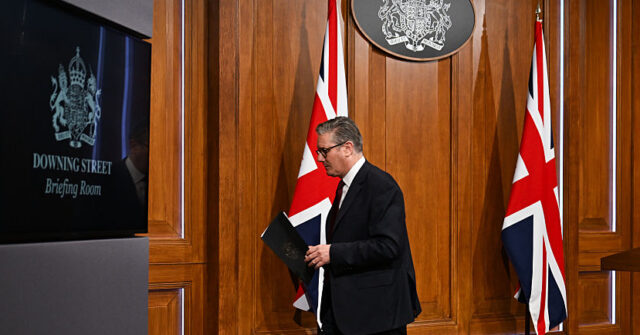
British Prime Minister Sir Keir Starmer addressed the nation on Monday morning to give an update on his position on the conflict in the Middle East, after two weeks of military strikes by the United States and Israel against Iran and its proxies in the region. Trying to flaunt both his own superior ethics and leadership while explaining why he wasn’t doing anything, Sir Keir’s speech veered into the vaguely contradictory, not to mention indecisive, as he explained why he’d not yet made up his mind on whether to take action to keep the Strait of Hormuz open.
Starmer’s comments followed a call by U.S. President Donald Trump over the weekend for the Western alliance to now stand up and use their navies to keep the oil flowing through the Gulf to the global economy. Specifically naming France and the United Kingdom of the European nations as those he expected to see “keep the Strait open and safe”, President Trump wrote: “the Countries of the World that receive Oil through the Hormuz Strait must take care of that passage, and we will help… This should have always been a team effort, and now it will be — It will bring the World together toward Harmony, Security, and Everlasting Peace!”
While the UK’s left-wing leader said he was sympathetic to British people fearful of their energy prices soaring if the global markets were knocked by the Strait remaining closed, he nevertheless said “we’re not at the point of decisions yet” on whether to use some of the country’s naval might to maintain freedom of navigation, one of the British military’s core defining roles. This is, in part, he said, because he isn’t personally satisfied with the “legal basis” for action, and because he’s not confident there is a “proper, thought-through plan”. Indeed, Starmer repeatedly made reference to wanting a “credible plan”, as he has done throughout the history of America’s present action against Iran, underlining the implication that he believes President Trump is acting illegally and irrationally.
“We will not be drawn into the wider war”, Starmer said, as he articulated his clear belief that the war would not achieve any meaningful change and would end with negotiations with the present regime still in Tehran and as belligerent as ever. The Prime Minister said:
…it’s clear the U.S. operation has massively weakened the military capability of the abhorrent regime in Iran. The question is what comes next? When the fighting stops we are going to need some sort of negotiated agreement to constrain the threat posed by Iran, to limit their ability to rebuild their nuclear programme, to pose a ballistic missile threat and arm their proxy militias, and limit the threat they pose to international shipping.
Emphasising his own rational approach to everything and massive personal strength in resisting President Trump’s calls for assistance where others, he claimed, would have acquiesced, Sir Keir insisted attempted to weave a narrative demonstrating both his own leadership while also explaining that he wouldn’t take any action without the backing of international law and the international community. Expressing this essential contradiction, he said:
I have been attacked by some for my decision not to join the offensive against Iran. But at every stage I have stood by my principles… our decision should be based on a calm, level-headed assessment of the British national interest. And that if we are to send our servicemen and women into harms way the very least they deserve is to know they do so on a legal basis and with a proper, thought-through plan. There are those who would have made a different decision two weeks ago. They would have rushed the UK headlong into this war without the full picture of what they are sending our forces into, and without a plan to get us out. That is not leading, it is following.
…
There have been discussions going on in relation to a viable plan and we want to make sure that involves as many partners as possible, particularly turning to European partners, inevitably talking to Gulf partners, and the U.S.. Because we need a credible, viable plan… This isn’t just about what the UK can do, it’s about how we play a part in bringing others together behind a viable plan… there are no decisions that have been made. It will have to be something that will have to be agreed with as many partners as possible, is my strong view.
Sir Keir also argued that turning down the United States time and time again when it called for aid wasn’t damaging to the Western alliance. The Prime Minister claimed to have had a “pretty good” telephone conversation with President Trump on Sunday, during which these matters were discussed. And in any case, the Strait of Hormuz question couldn’t damage NATO because the strategic waterway is in the Middle East, not Europe or the Atlantic, so it is irrelevant to the alliance, he argued.
Despite President Trump’s warnings of how damaging refusal will be to the West, European states have queued up to say they don’t want a part in ensuring the energy that keeps their economies rolling still flows. France said that while Paris had dispatched a comparatively large force to the Eastern Mediterranean, it would be remaining purely “defensive”. Like Starmer, France’s President Emmanuel Macron made clear he sees the future as a negotiated settlement with the present Iranian regime, stating on Sunday that:
I have just spoken with Iranian President Massoud Pezeshkian. I called on him to put an immediate end to the unacceptable attacks Iran is carrying out against countries in the region… Freedom of navigation in the Strait of Hormuz must be restored as soon as possible.
Spain, already Europe’s loudest — if least consequential — critic of President Trump, which blocked American flights from their NATO airbases altogether, also ruled out getting involved in the Strait of Hormuz, saying they didn’t want to get involved in an “illegal” war. Meanwhile, Germany complained the conflict is “not our war” and “we have not started it”, so they have no moral obligation to step in to preserve their own energy supply.
Read the full article here