


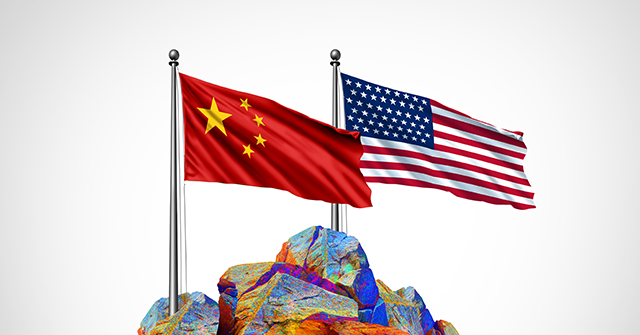
A Price Floor for Freedom: Beating China’s Rare-Earth Trap
When the Trump administration announced plans for a price floor on U.S.-produced rare earths, critics immediately decried it as a violation of free-market principles.
In truth, it’s closer to economic self-defense. For three decades, every attempt to rebuild America’s rare-earth industry has ended in collapse because China turned the market into a weapon.
Rare earths are the metals that make modern life possible. They’re essential for electric vehicles, jet fighters, smartphones, and wind turbines. America once led in mining and processing them. In the 1990s, China decided it wanted that dominance and used every lever of state power to get it.
The Dumping Playbook
As the Wall Street Journal reported this week, Beijing declared rare earths a “strategic resource” in 1991, blocked foreign ownership, subsidized production and consolidated hundreds of local mines into a handful of national champions. Whenever Western producers began to recover, China opened the spigots and crashed prices.
When Molycorp restarted the Mountain Pass mine in California a decade ago, Chinese state companies flooded global markets with supply until prices fell below cost. Molycorp went bankrupt in 2015. When MP Materials and Australia’s Lynas later tried to scale up, Beijing raised output quotas by 25 percent two years in a row, tanking prices again. Each time, Western investors lost their shirts; each time, China tightened its grip.
This wasn’t creative destruction. It was state-sponsored predation. A government willing to sell at a loss indefinitely cannot be beaten by a private company subject to quarterly earnings.
Free-market types sometimes say we should just enjoy cheap exports from China, perhaps stockpiling them in case Beijing cuts them off and only producing our own if prices rise. But one of the effects of China’s strategies has been to discourage investors from financing competition against it. China is effectively the monopoly processor of rare earths. As a result, Beijing can charge higher prices than a competitive market would.
What’s more, because processing rare earths requires investment in physical and intellectual capital, it is not something we can simply switch back on when China hikes prices. You need a persistent rare-earth mining and processing business in the U.S. to entice students to study the science and workers to enter the field. Both financial investments and human capital investments will shy away from a sector that China can bankrupt with a change of policy.
Why a Floor Matters
A price floor—a guaranteed minimum price for domestically produced rare earths—is the best way to neutralize this strategy. It turns a manipulated market back into a functional one by setting a line that Beijing can’t undercut.
It breaks the boom-bust cycle. When China dumps supply to destroy competitors, U.S. producers can keep operating above the floor instead of collapsing.
It invites private capital. With predictable returns, investors can finance new mines and magnet plants on ordinary commercial terms.
It saves taxpayer money. A price floor backed by forward-purchase contracts is cheaper than perpetual bailouts or emergency shutdown rescues.
Treasury Secretary Scott Bessent put it bluntly: “For twenty-five years we weren’t vigilant. Everyone was asleep at the switch.” A price floor is how Washington stays awake.
The Strategic Stockpile
Rebuilding a national stockpile of critical minerals complements the floor. The Pentagon once kept reserves for wartime use, but they were sold off in the 1990s under the illusion that globalization made them unnecessary. That illusion ended the moment Beijing imposed export restrictions on rare-earth elements this spring, forcing temporary shutdowns at U.S. auto plants.
A revived stockpile would stabilize demand, absorb excess production during downturns, and ensure that defense contractors never run short of vital materials. It would also give Washington leverage in any future negotiation with Beijing.
Of course, price guarantees and stockpiles won’t matter if it still takes a decade to open a mine. Environmental reviews and litigation drag projects out until investors give up. A Critical Minerals Fast Track, modeled on the waivers used for LNG terminals and defense infrastructure, could compress approval times to two or three years without sacrificing safety.
A Market Worth Defending
China didn’t capture this industry through superior efficiency. It did it through a state-engineered strategy: declaring rare earths “strategic,” weaponizing prices, and forcing the world to depend on them. The only way to break that control is to build a domestic market immune to manipulation.
A price floor ensures that when Beijing dumps, America doesn’t fold. Is it central planning? Perhaps. But we do not have a choice whether our rare-earths processing is centrally planned or not. The only question is whether it is centrally planned in Washington or in Beijing.
Read the full article here