


Mamdani Won the Coalition Nobody Expected
Zohran Mamdani just pulled off something remarkable in New York City.
A few months ago, he was unknown to most New Yorkers and polling in the single digits in the Democratic primary for this year’s mayoral race.
This week the 34-year-old democratic socialist didn’t just win the mayor’s race—he shattered turnout records, assembled a coalition that defied conventional political categories, and revealed fault lines in American economic life that neither party has adequately addressed.
Over a million New Yorkers voted for Mamdani, the highest total for any mayoral candidate since 1969. He won with around 80 percent of the vote in Prospect Heights and Park Slope, and saw similar support in Bushwick, Williamsburg, and Fort Greene. His support swept through gentrified Brooklyn like a wildfire, and then did something nobody predicted: he flipped working-class Black and Latino neighborhoods that had rejected him just months earlier in the primary.
But here’s what matters: the margins tell you everything about where his real coalition lived. In Brownsville, one of New York’s poorest neighborhoods, Mamdani went from a 40-point loss in the primary to an 18-point win in the general. In East New York, he won by 22 points. In Mott Haven and East Harlem, he won by 22 and 30 points respectively.
These are real victories. But compare them to his margins in gentrified Brooklyn: Park Slope (+57), Prospect Heights (+67), Bushwick (+67). He didn’t just win these neighborhoods, he achieved the kind of margins you see in uncontested elections.
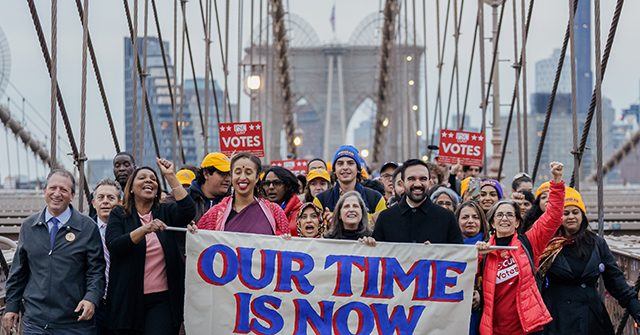
New York City mayoral candidate Zohran Mamdani, center right, and his supporters carry a banner across the Brooklyn Bridge in New York City on Monday, November 3, 2025. (Adam Gray/Bloomberg via Getty Images)
The immediate reaction from many conservatives has been predictable: dismissal. Another victory for Park Slope socialists with graduate degrees and oat milk lattes, they say. Performative radicalism and luxury politics from people who’ve never struggled a day in their lives
But this reading misses what actually happened. Before the election, we said that conservatives were making a mistake by writing off ”the economic pain of New York City’s downwardly mobile professional class.” The results proved our assessment correct—but in ways that are even more striking than the primary suggested.
Mamdani didn’t win because affluent Brooklynites suddenly became Marxists. He won big because he identified something real that cuts across traditional class boundaries: a pervasive sense that the fundamental bargain of American economic life has broken down.
The Core and the Expansion
Look carefully at Mamdani’s coalition and you see two distinct phenomena that shouldn’t be confused with each other.
The core—the engine of his victory—was the gentrified neighborhoods of Brooklyn. Park Slope, Prospect Heights, Bushwick, Fort Greene: these delivered 60-70 point margins. This wasn’t tactical voting or lesser-of-evils thinking. This was enthusiasm. These neighborhoods turned out at near-presidential levels and voted as a bloc.
These aren’t wealthy enclaves in any traditional sense. They’re populated by people who did everything right according to the old playbook: got educated, found professional jobs, moved to the city for opportunity. Many of them earn $80,000, $100,000, even $150,000 a year.
And they’re financially underwater.
In the nicer neighborhoods and good school districts in Brooklyn, median rent for a two-bedroom apartment available on the market now exceeds $4,600 per month. That means a household earning $150,000—comfortably in the national top 10 percent—is spending over a third of their income just on rent, with nothing left to save for a down payment they’ll never be able to afford anyway. These are people with good jobs who live with roommates into their thirties, who’ve given up on homeownership, who’ve delayed having children because they literally cannot afford the space.
This is Mamdani’s real base: not trust-fund socialists, but what we might call the professionally precarious. They have credentials and decent incomes, but just holding on, barely, to housing, jobs, and their social position. They followed the script they were handed and discovered that the promised rewards had been replaced with a treadmill. They own nothing—and they do not like it.
The expansion into non-white working-class neighborhoods was real but different in character. Mamdani won Brownsville by 18 points, East New York by 22, Mott Haven by 22, and East Harlem by 30. These are genuine victories—and the swings from the primary were dramatic. But they’re 20-30 point wins, not 60-70 point landslides. He successfully built a coalition, but the energy and enthusiasm came from gentrified Brooklyn.
Why the Working-Class Expansion Matters
Between the primary and the general election, Mamdani flipped the Bronx by 29 points and made substantial gains in working-class Black and Latino neighborhoods across the city. This is significant—but not because it means his coalition was evenly distributed across class lines.
The working-class expansion matters because it shows his message could travel beyond gentrified Brooklyn, even if that’s not where his passionate base lived. A teacher earning $120,000 paying $4,000 in rent and a working-class family in the Bronx facing eviction are experiencing different versions of the same crisis. Mamdani’s platform—rent freezes, free child care, expanded public services—spoke to both, even if only one group turned out with 70-point enthusiasm.
This is what made him electable citywide rather than just a Park Slope phenomenon. The gentrified neighborhoods provided the energy, the volunteers, the donations, the intensity. The working-class neighborhoods provided enough votes to make the math work.
Conservatives who have spent years building a coalition of working-class Americans to Make America Great Again should be paying attention. In tomorrow’s Breitbart Business Digest, we’ll expand on how conservatives should react to the election.
Read the full article here