


Boom Goes the Productivity!
Productivity is surging in America, which will likely mean subdued inflation even while wages rise and rapid economic growth continues.
The government confirmed on Thursday that productivity rose at an annualized rate of 4.9 percent in the third quarter of last year and 4.1 percent in the second quarter, matching the earlier estimates. That makes the first two full quarters of Trump’s presidency the best two consecutive quarters since, well, since the last time Trump was president.
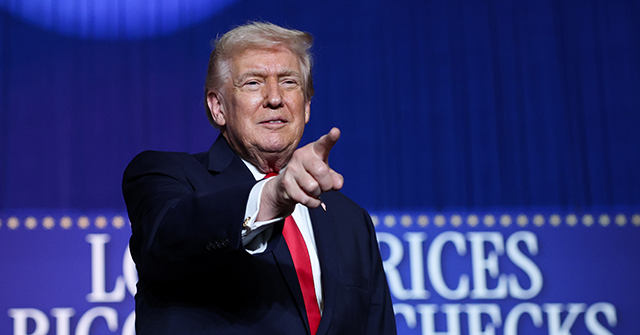
President Donald Trump takes the stage to speak at a rally on January 27, 2026, in Clive, Iowa. (Win McNamee/Getty Images)
The numbers actually understate the remarkable upward shift in productivity. Back during the pandemic, productivity spiked because millions were laid off. That’s pretty typical of downturns, where the least productive workers are let go; and so the ratio of output to hours worked—which is how the government calculates productivity—increases. Now, however, we’re seeing productivity numbers above four percent while unemployment is stable and output is growing.
There’s some reason to suspect that we may have entered a high productivity growth era. After a few quarters of strikingly good productivity in 2023, Cleveland Fed economists ran a statistical model aimed at detecting what they term productivity “regime changes.” They put the odds that we had shifted into a high-growth phase at around 40 percent and noted that it would take a few more quarters to reach a “more unambiguous conclusion.”
The second and third quarter data are helpful in that regard. They suggest that what the Cleveland Fed economists were picking up last year—they ran their model in January 2025—was not just a temporary burst but a sustainable pace of growth.
What’s Driving Productivity Higher?
Economists are scratching their heads about this boom. Most think it is too early to be driven by the adoption of artificial intelligence. And the fact that manufacturing productivity and output are rising rapidly suggests that it is not AI but rather investment in innovation more broadly that is the driver.
What could be behind this? The most likely candidates are a tight labor market and the end of the offshoring regime. After a few decades of productivity suffering because businesses could rely on abundant and cheap labor at home and abroad, many have now realized that they have to switch to domestic investment in order to grow.
Even after Trump is no longer president, we’re not going back to the permissive immigration regime we saw under Biden and Obama (and Bush before that), and we’re not returning to the era of globalization.
We can add to this the One Big Beautiful Bill’s tax incentives for capital investment. Making 100 percent expensing for capital expenditures permanent has likely encouraged companies to invest more heavily and to adopt business models built around capital investment rather than payroll expansion. The old tax rules made capital investment costly by only allowing deductions spread over several years while labor costs were immediately deductible. The new rules level the playing field.
It’s not all Trump policies—or at least not all recent Trump policies. The improvement in productivity began back in 2023 and 2024, which is when it caught the eye of those economists at the Cleveland Fed. The most likely drivers, however, were Trumpian. For one thing, Biden had surprised many by leaving the tariffs from Trump’s first term in place. That signaled to businesses that tariffs were not something they could wait out. For another, the labor market was extraordinarily tight in those years, with job openings far exceeding the number of people looking for work.
Trump’s immigration and tariff policies in the second term are doubling down on these. The growth of the workforce has slowed dramatically because of immigration restriction and the rising cost of relying on imports. As a result, the relative rewards of investing in domestic productivity have shot up.
Importantly, this is the opposite of what tariff critics predicted. They said that if tariffs forced the U.S. to produce more domestically, productivity would decline as workers were drawn into less efficient sectors. What they had missed was that foreign intervention in the economy had so badly distorted global production that reshoring production would improve productivity and that businesses would seek to lower costs by investing in productivity-increasing technology.
Read the full article here