


How Two Fed Governors Saw Through the Tariff-Inflation Panic
Back in April, when tariff panic gripped Washington and Wall Street, Federal Reserve Governor Christopher Waller stood nearly alone. While economists warned of a 1970s-style inflation spiral, Waller calmly argued that the new tariffs would create a one-time jump in prices, not a new inflation regime.
By September, newly confirmed Fed Governor Stephen Miran joined the cause with sophisticated quantitative analysis showing monetary policy was roughly 200 basis points too restrictive. Nine months after Waller’s initial call, the latest Summary of Economic Projections (SEP) tells us something simple: The Federal Reserve has become Wallerite—and perhaps even Miranian. The inflation hawks have stood down. And the data suggest Waller and Miran were right all along.
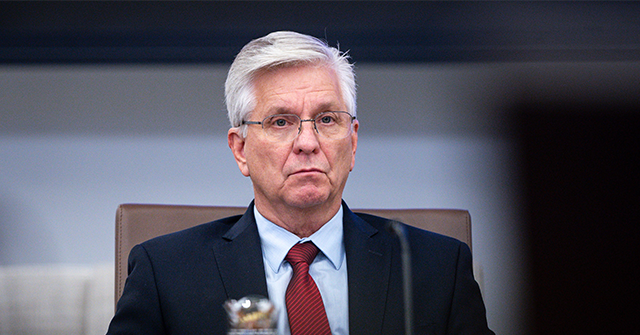
Fed Governor Christopher Waller is seen at the Federal Reserve Board open meeting in Washington, DC, on Oct. 24, 2025. (Al Drago/Bloomberg via Getty Images)
The evolution is visible in Chair Jerome Powell’s own words. At the May 7 press conference, with tariff panic at its peak, Powell hedged heavily: “If the large increases in tariffs that have been announced are sustained, they are likely to generate a rise in inflation.” He used variations of “we don’t know” eighteen times.
But by June 18, Powell’s language became structured: “A reasonable base case is that the effects on inflation will be relatively short-lived—a one-time shift in the price level.” He laid out clear conditions for persistent inflation: tight labor markets, unanchored expectations, and broad demand pressures.
In other words, Powell was now speaking Waller’s language. As summer data rolled in, that framework proved prophetic.
Miran’s Quantitative Case
When Miran joined the Board, he brought rigorous analysis supporting Waller’s concepts. In his September 22 speech, Miran showed how immigration policy changes would lower both inflation (reduced rental demand) and the neutral interest rate—the level of interest consistent with stable inflation. He calculated how tariff revenue would increase national saving, further reducing the neutral rate. He explained why deregulation would expand potential output faster than actual output, creating disinflationary pressure.
Most importantly, Miran explained the mechanics: Trade policy generates relative price changes, not aggregate demand shocks. Without tight labor markets or unanchored expectations—neither of which materialized—one-time price increases wouldn’t become persistent inflation.
The Fed establishment wasn’t buying it. Miran dissented in September, arguing for 50 basis points instead of 25. Three months later, the Committee’s projections would vindicate his analysis.
The Pass-Through That Never Came to Pass
Between June and the December SEP, the Fed watched for signs tariff inflation was becoming embedded. They didn’t materialize. Labor markets cooled gradually without overheating or crashing. Inflation expectations remained anchored. Wage pressures moderated. Services inflation continued “grinding down” toward 2 percent.
The tariff pass-through that “every forecaster” expected to add “two or three more tenths, or four more tenths”? By December, Powell was talking about “a couple tenths or even less than that”—barely a rounding error in the broader story of disinflation.
Rental inflation played out exactly as Miran predicted. With immigration policy sharply reducing housing demand, new tenant rent inflation fell to around one percent—far below elevated official statistics.
The December Summary of Economic Projections tells the story in numbers. Look at Figure 3.C showing the distribution of inflation projections. In September, participants spread widely on 2026 forecasts, with a meaningful tail at 2.6 to 2.8 percent. That’s well above target, suggesting persistent tariff effects.
By December, that upper tail vanished. The distribution tightened dramatically around 2.4 percent. The median projection for 2026 fell from 2.6 percent to 2.4 percent—a 20-basis-point drop that came almost entirely from former hawks revising down their views. The participants most worried about tariff inflation moved the most. The Committee converged on the framework that Waller articulated in April and that Miran quantified in September.
The Intellectual Journey
When unprecedented trade policy shifts created genuine confusion, the Fed established a theoretical framework (Waller), added quantitative rigor (Miran), watched the data (Powell), and adjusted forecasts as evidence accumulated. The core insight, now validated: Tariffs are relative price changes, not aggregate demand shocks. Without tight labor markets, unanchored expectations, or excessive demand, one-time price shifts don’t become ongoing inflation.
The Fed’s models, built on anti-tariff prejudice and assumptions without supporting evidence, overstated pass-through. They underweighted modern dynamics, especially competitive pressures forcing cost absorption.
Miran’s September dissent looked radical at the time, arguing for aggressive cuts when conventional wisdom said wait. But his analysis showed policy was 200 basis points too tight when properly accounting for neutral rate changes. Three months later, the Committee moved materially in his direction.
By December, Powell could state matter-of-factly: “If you get away from tariffs, inflation is in the low 2s.” The one-time price shift theory held up. Tariffs could move prices once without changing the underlying inflation trend.
Markets now price in a Fed seeing limited inflation pressure ahead. The December SEP projects 2.4 percent inflation next year, and 2.2 percent in 2027. Policy can continue normalizing. The soft landing remains intact.
Chris Waller and Stephen Miran got the economics right when it mattered, when they had the courage to articulate an unpopular view at peak tariff panic. In April, Waller was the optimist. In September, Miran added quantitative firepower. By December, the Fed was full of Wallerites. The data made them that way.
Read the full article here