


How to Think About a Hormuz Navigation Toll
The idea that the United States might accept an Iranian fee regime in the Strait of Hormuz has produced something close to panic in the usual quarters.
The hysterics claim that acquiescing to a fee for passage through the strait would violate international law, make the U.S. complicit in piracy, and betray everything America has ever stood for. It’s the familiar tone of scolding and fear-mongering: once again, that reckless Trump is going to derail the world.
Yet that’s a misreading of our history. America was not founded on the doctrine that every strategic waterway must remain toll-free forever. The history of American diplomacy is one of the pursuit of our commercial interests and the defense of our liberty. It was the European imperial powers who sought to police the world, although they also did so with an eye on economic gains. And our early history is full of moments when Washington negotiated, paid, and improvised its way through charged chokepoints.
A view from Oman of the vessels passing through the Strait of Hormuz following the two-week temporary ceasefire reached between the United States and Iran on April 8, 2026. (Shadi J. H. Alassar/Anadolu via Getty Images)
Charging a Hormuz Fee Doesn’t Violate International Law
Let’s start with the objection that charging a fee would be illegal in “international waters.” The weakness here is that the shipping lanes through Hormuz run primarily through the territorial waters of Oman and partly through those of Iran. They are not the open ocean or high seas. While the orthodox law-of-the-sea position bars charges levied simply for permission to pass through an international strait, it allows fees for specific services such as policing the seaway for pirates or managing traffic.
Turkey provides a clear modern precedent. Under the Montreux Convention of 1936, merchant vessels enjoy complete freedom of transit through the Bosporus and Dardanelles. Yet Turkey routinely collects a straightforward tonnage-based fee for ships passing without stopping at its ports. These charges are framed as payment for specific services authorized by the Convention, including providing lighthouses and monitoring traffic, making sanitary and health inspections, and conducting rescue and salvage operations. Free navigation and reasonable service fees have coexisted for decades.
While some will complain that a Hormuz fee would violate the 1982 United Nations Convention on the Law of the Sea, neither the United States nor Iran has ever ratified the treaty. Iran explicitly rejected key provisions—including the strict bar on fees for passage—upon signature.
The Wrong Suez Analogy
The strongest historical precedent comes from the State Department’s own files. In a 1956 memorandum on the Suez Canal, the Department noted that the 1888 Constantinople Convention’s guarantee that the canal would be “free and open” did not mean “without charge.” It explicitly recognized dues for construction, maintenance, management, pilotage, towage, and anchorage. Freedom of navigation, in other words, has never meant “free of charge.” The two concepts are not even close to synonymous. Free passage is a rule of non-discrimination, not a rule against fees for services.
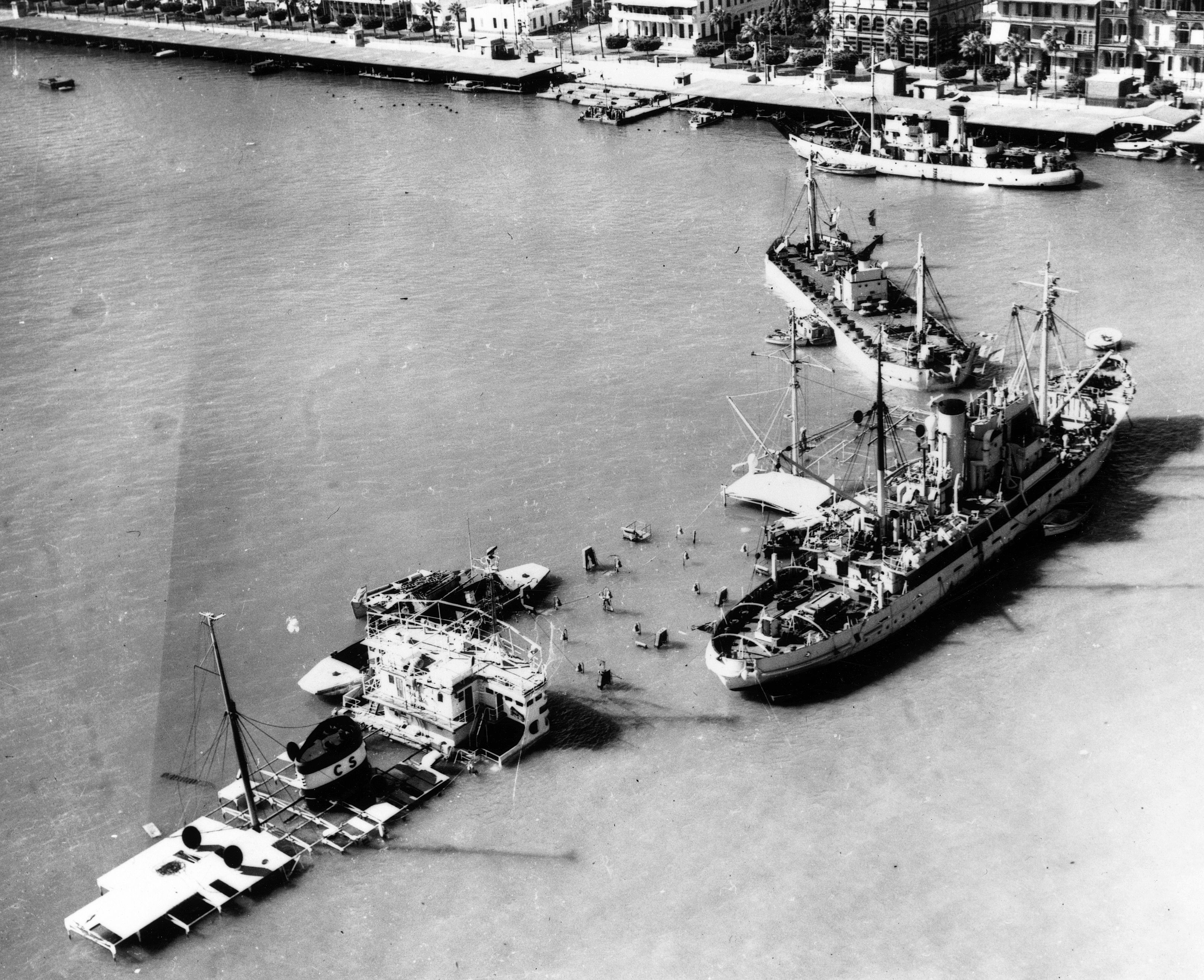
An aerial view of ships which have been sunk at the entrance to the Suez Canal to prevent passage during the Suez crisis in November 1956. On the right is a naval vessel already engaged in a salvage operation. (Photo by Central Press/Getty Images)
The fashionable analogy right now is that the conflict with Iran is “America’s Suez moment,“ by which the commentators mean British decline and imperial humiliation. But the analogy is being used backward. In 1956, the United States sided against Britain and France when they tried to reverse Egyptian nationalization of the canal by force. Washington pushed a United Nations ceasefire and publicly condemned the invasion. The correct historical analogy is not America as Britain. It is Trump as Eisenhower — refusing to use military force to preserve an idealized status quo that the regional power has already changed on the ground.
And Suez also proves that the disaster talk can be wrong. After the crisis, Egypt reaffirmed free and uninterrupted navigation and continued levying tolls under a managed schedule. The canal reopened for normal traffic in April 1957. National control plus tolls did not mean the end of world trade. It meant a new arrangement, and commerce adapted.
Our Young Republic’s Naval Adventures
America’s older tradition on chokepoints was the pursuit of our national interest, not an ideological commitment to support every nation’s commercial interest in toll-free passage through important waterways. Our navy was not providing gunboats for the Dutch East India Company or Spain’s Asia outposts. The early United States was not out policing every toll, tariff, or tribute on earth. When British diplomats told the Barbary states that American ships were open to attack following our war for independence, our young republic lacked the money for a navy or even the tribute payments that might have protected its commerce. So, America negotiated to pay the tribute. We eventually did go to war against the Barbary Pirates but only after they rejected the tribute and started seizing our ships and sailors.
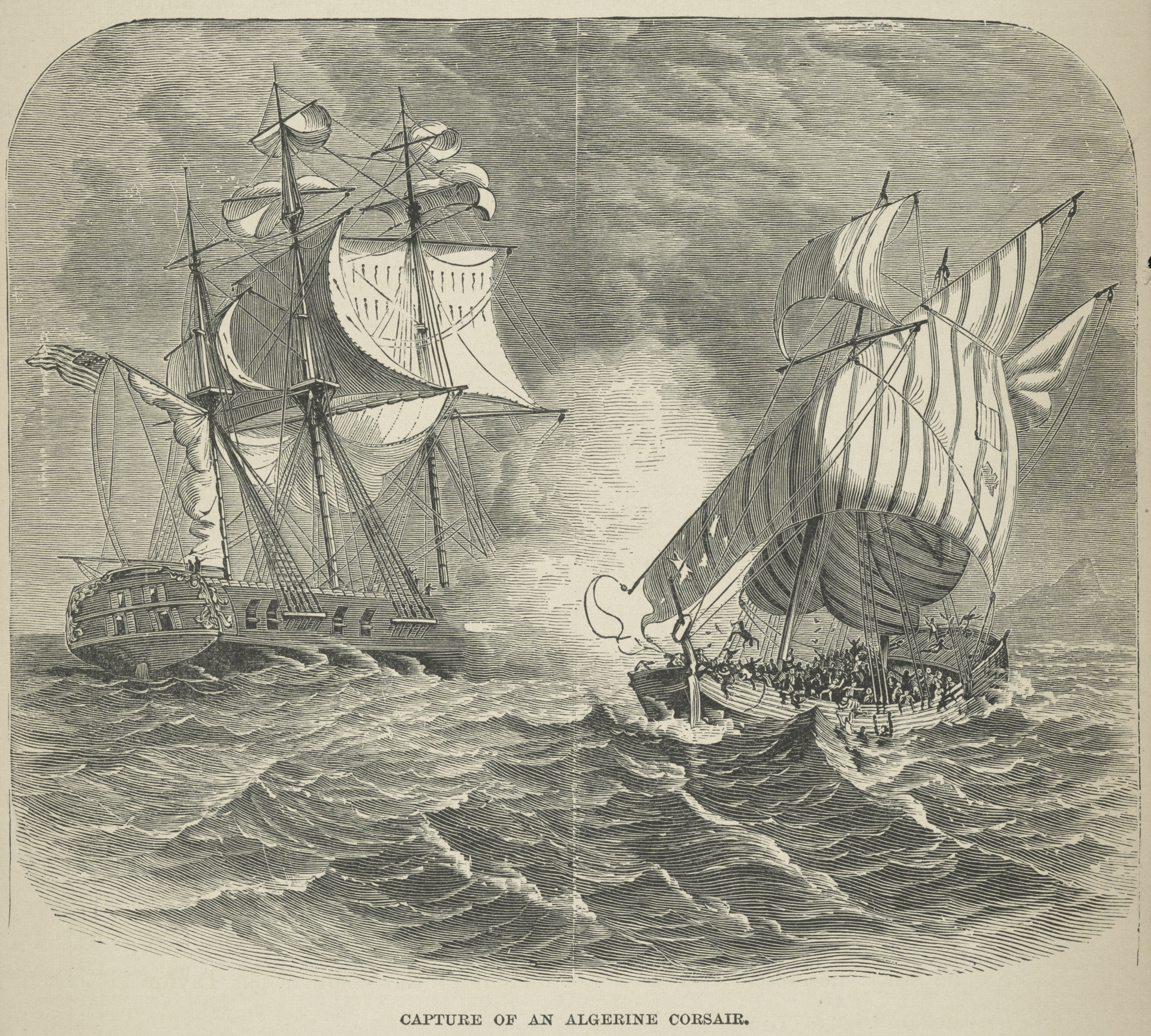
An engraving depicting an American naval vessel capturing an Algerian pirate ship during the First Barbary War, circa 1803. The original caption read “Capture of an Algerine Corsair.” (Photo by Kean Collection/Archive Photos/Getty Images)
In the early 19th century, when Britain launched major punitive expeditions against the Qawasim confederation that then controlled the Persian Gulf and charged fees for passage, the United States remained entirely on the sidelines. American merchant shipping in the Gulf was minimal at the time, and Washington had neither the naval capacity nor the strategic interest to involve itself in Britain’s effort to suppress what London labeled piracy along the “Pirate Coast.” Our young republic focused its limited maritime resources closer to home and on protecting its own commerce in the Atlantic and Mediterranean. This hands-off approach was typical of pre-Cold War American policy: intervene when direct U.S. interests were clearly threatened, but otherwise leave distant waterway disputes to others.
Will European powers object? Fine. Let the countries that refused to let us even fly through their airspace while we battled Iran send their navies to try to convince Iran to give up its ambition to charge for passage through the strait.
An America First Law of Navigation
The best way to think of a Hormuz fee-for-passage deal is not a “toll” or a “tribute.” It is a Hormuz Security and Navigation Services Charge: non-discriminatory, published in advance, tied to real services such as traffic management, patrol, deconfliction, pilotage, salvage, and emergency response. That follows the template that Montreux and Suez have already established.
The objection that tolls are permitted for manmade canals like the Suez or Panama but not natural straits is a distinction without a principled difference. These canals are waterways that are critical to global trade. If the tolls were ever justified as a way to recover the cost of construction, that has long since been completed, with a handsome profit. In any case, neither canal is now controlled by the countries that constructed them. Instead, they belong to the countries through whose sovereign territory they pass. Lacking a deeper principle, the rule seems to boil down to “fees for me but not for thee.”
The real choice is not between a pure liberal-maritime ideal and moral stain. It is between a fee-bearing managed transit regime and a far more expensive reality: blockade, war risk, insurance spikes, disrupted LNG and oil flows, and the need for endless and uncompensated American naval enforcement in waters that are within the territory of sovereign states.
The United States has spent 80 years treating unrestricted transit as a universal principle worth enforcing at gunpoint. That posture may have made sense when America was attempting to stave off the global communist menace and was dependent on the oil that passed through the Strait of Hormuz. Those days are gone. As with trade, our posture toward securing navigation is being reformed to fit the needs of America in the 21st century.
America’s older tradition is the one that negotiated with the Barbary states and saw Eisenhower side against his own allies at Suez because the role of the U.S. was not to enforce the rules created for the British Empire or the French Republic. It was the tradition that put America first. If Trump consents to Iran charging a Hormuz transit fee, he would be making the foreign policy of our young Republic great again.
Read the full article here