


The Weekly Wrap: Trump Refused the “Economic Pain” Script—and That Was the Point
Welcome back to Friday! This is the State of the Union special edition of the Breitbart Business Digest. Are you crazy? Why aren’t you standing up and applauding yet? You should be ashamed of yourself.
This week President Trump reminded us that the state of our union is great again, the economists spilled nerd blood over the definition of a balance of payments problem, and AI came for the technology companies, like a mythological god murdering his father. No payments were unbalanced in the creation of this digest.
The Turnaround for the Ages
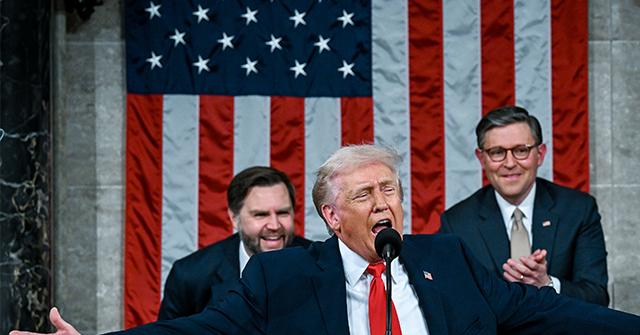
President Trump delivered the longest State of the Union address in American history on Tuesday night, surpassing the previous record holder, who coincidentally also was named Donald Trump. Let’s start with what the speech was not: Dark Maga. This was not a speech about the devastation wrought on our country by decades of political mismanagement, kleptogeneic plutoarchic economic policy, and wokeist obsession. Its focus was on the dawning of a new golden age and the “turnaround for the ages.”
It was also not the speech that the legacy media and ravenously anti-Trump pundicariat were demanding. They wanted the president to deliver a malaise speech, one in which he apologized, bit his lip, and felt your pain. They were so convinced that Trump should do this that they depicted his refusal to read from their script as a failure. “Trump struggled to acknowledge Americans’ economic pain,” the New York Times “reported,” sighing that “he appeared less willing to acknowledge that Americans were still struggling.”
In an almost perfect feat of unconscious and unintended irony, the New York Times described this as not just the president delivering the wrong message but as evidence of a persistent personal failing: “The president has often shown little discipline when it comes to addressing these worries.” Why won’t the president admit he’s the problem? This is what they were really demanding. If Trump did focus on “these worries” without “taking responsibility” for our economic woes—if he pointed to the actual causes, in other words—his speech would be attacked as dark, vengeful, and evasive.
And, of course, the New York Times’ take is the photographic negative of the truth. President Trump’s adamant refusal to adopt the “economic pain” and “affordability” framing of the Democrats and their masters in the legacy media is a demonstration of messaging discipline.
Instead, Trump emphasized the fact that inflation has come down and the prices of many goods are actually falling. The year-over-year increase in the core consumer price index in January was the smallest since before the Bidenflation crisis hit. By our calculation, around one-quarter of all core goods prices are down. Egg prices fell 63.9 percent in January and are down 87 percent from a year ago, according to the producer price index, highlighting the absurdity of last year’s Democrat talking point about eggflation.
Trump delivered a positive, optimistic message about the economy, saying it is “roaring like never before.” While noting the weakened state of our economy at the conclusion of Biden’s term, Trump did not dwell on it. Instead, he focused on the reinvigoration we saw in the first year of Trump’s second term and the promise of even greater prosperity to come. Instead of lamenting lingering inflation, he focused on its best cure: the growth of America’s ability to build, to create, to innovate, and to grow.
As our friend Larry Kudlow pointed out on his Fox Business program: “Mr. Trump, with his one big, beautiful growth platform, believes we can grow even faster. And I’ll say nothing solves problems better than economic growth. Proper growth solves inflation. Proper growth solves debt and deficits. Proper growth makes people happier. Growth makes defenses stronger. Growth solves more problems than you could ever shake a stick at.”
“The revolution that began in 1776 has not ended; it still continues because the flame of liberty and independence still burns in the heart of every American patriot,” President Trump said. “And our future will be bigger, better, brighter, bolder and more glorious than ever before.”
I BOP, You BOP, They BOP, Be BOP, Be Bop, a Lu She Bop
The week saw the outbreak of one of the nerdiest economics fights ever to escape the narrow confines of a graduate seminar room: the great Balance-of-Payments battle.
The proximate cause was President Trump’s announcement that his administration would invoke Section 122 of the Trade Act of 1974 after the Supreme Court struck down the International Economic Emergency Powers Act duties. Section 122 lets the president respond to certain international payments problems through temporary surcharges and other import restrictions, as the White House explained.
That triggered a bunch of economists (and the people who take their cues from them) to insist that the United States cannot have a fundamental payments problem because we have a floating exchange rate. Those problems, they moaned, can only exist when the dollar is pegged, when an imbalance would force a drawdown of reserves. In a modern floating-rate world, they said, “balance of payments problems” are impossible.
A damaged discarded globe is left on the pavement near the Port of Southampton on February 25, 2026, in Southampton, England. (Anna Barclay/Getty Images)
But that argument collapses when exposed to a whiff of history. The Trade Act of 1974 was enacted for the post–Bretton Woods world—after the U.S. had already broken with gold and the old pegged system. In other words, Section 122 was written to operate in a floating-rate regime. The “Impossibility Theorem,” as we’re calling it, requires believing that Congress passed a statute that was obsolete on passage. To put it mildly, that is not a conventional way of interpreting statutes. And it’s the kind of move the Supreme Court would surely reject.
The irony is that the people claiming we cannot have an external payments problem today are the ones using an outdated model. In a floating-rate system, imbalances don’t show up as a gold drain. They show up as financial-system stress: leverage cycles, funding fragility, and vulnerability in wholesale markets and FX-hedged flows—swaps, repo, haircuts, the plumbing. If you want to over-nerd on a Friday, they show up in the capital account.
The constraint isn’t “are the gold reserves dwindling,” but “can the system intermediate these flows safely without creating fragility?” That’s a judgment call the statute leaves to the president. It certainly doesn’t leave it to the judgment of credentialed economists convinced they know the real truth about the balance of payments.
Tarifflation Narrative Fail
January’s producer price index (PPI) report put the “tarifflation” story in a body bag. Overall producer prices rose 0.5 percent, but finished consumer goods fell 1.3 percent—the sharpest consumer-goods drop in months—hardly what you’d expect if tariffs were supposedly squeezing households through the pipeline.
What did move the numbers wasn’t a broad consumer-price squeeze, but a weird combo of cheaper basics and fatter middleman spreads. Gasoline fell 5.5 percent, eggs for fresh use plunged 63.9 percent, and trade margins jumped 2.5 percent—meaning a lot of the “services inflation” was wholesalers and retailers widening their markups, not producers jacking up costs.
And the inflation that is real looks like the good kind: investment-driven. Core goods excluding food and energy rose 0.7 percent, with big spikes in equipment tied to the AI buildout—communication and related equipment surged 8.6 percent in a single month—classic signs of surging demand meeting hard capacity constraints. That is, spending on innovative technology is surging even faster than supply can keep up. And it isn’t squeezing consumers but coming out of profits recycled into investment.
Trump Made The AI Boom Possible
The specter of artificial intelligence haunted the markets this week. Software stocks took a bath on the idea that AI would make their work redundant. Private credit followed because the asset class is seen as over-exposed to companies vulnerable to AI disruption, including those software big shots. Jack Dorsey fired 40 percent of Block, specifically citing AI as the reason, and sent shares soaring. Nvidia’s results were unimpressive because not every dollar of capital expenditure is yet dedicated to buying its chips. A small research firm called Citrini Research spooked everyone with a dystopian fantasy “think piece” which envisions a 2028 scenario where unemployment rises to 10.2 percent as AI destroys software businesses and the margins of food delivery companies.
Overlooked in all the AI coverage, however, is the centrality of the Trump economic vision to its rise. The immense energy consumption needs of AI would have been impossible to satisfy in the Green New Deal/Net Zero world sought by Democrats. It is only possible in the world of energy abundance fueled (literally) by oil, gas, and coal that Trump’s policies are creating.
This is not without risk. If the public turns against AI—and the Democrats are certainly lining up to become anti-AI—or the AI investment boom turns into a bust, Trump may face political backlash.
Papering Over the French Invasion of Britain
On March 2, 1797, the Bank of England did something it had never done before: it printed a one-pound note.
Like so many novelties in monetary policy, this wasn’t planned innovation. It was the reaction to a panic. French Revolutionary forces had just landed on British soil—the now forgotten invasion of Fishguard in Wales—sparking a bank run that drained the Bank’s gold reserves from £16 million down to barely £2 million. With the nation’s metallic currency disappearing into mattresses and floorboards, Prime Minister William Pitt ordered the Bank to stop paying out gold and start issuing low-denomination paper notes instead. The first pound notes were handwritten promissory notes, signed individually by Bank cashiers, promising to pay the bearer “on demand”—a promise that would remain temporarily impossible to fulfill.
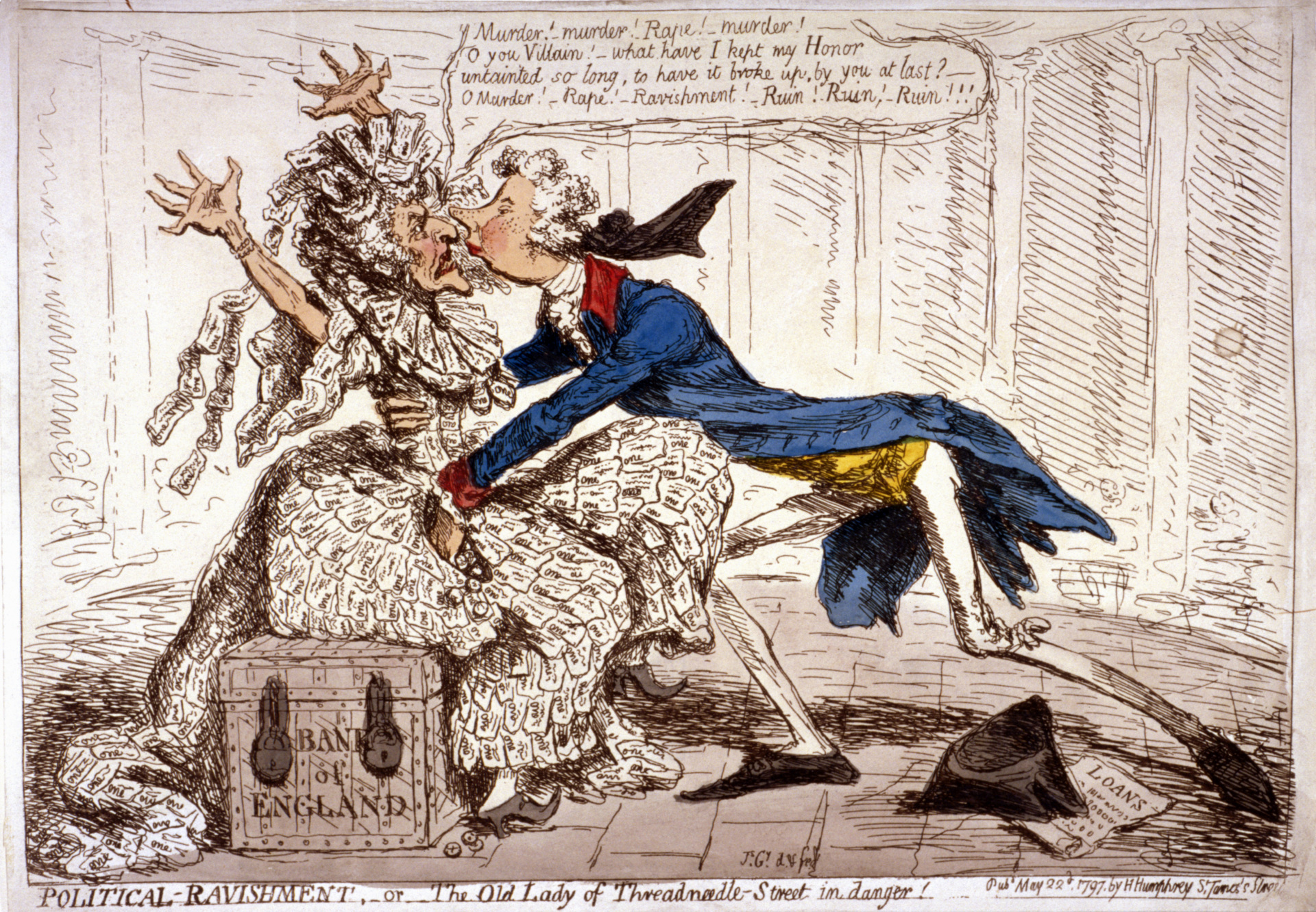
‘Political ravishment, or the Old Lady of Threadneedle-Street in danger!’, 1797; showing a thin old woman dressed in one-pound notes, throwing up her arms in terror as William Pitt embraces her with his right hand and takes guineas from her pocket with his left. The satire is a protest against the introduction of paper money. (Photo by Guildhall Library & Art Gallery/Heritage Images/Getty Images)
The British public wasn’t thrilled about this newfangled paper stuff. Money was supposed to be coins you could bite to test for authenticity, not slips of paper signed by some clerk. Pitt and London’s merchant class had to mount what amounted to a confidence campaign, assuring everyone the notes were “just as good” as gold. It worked, mostly because people didn’t have much choice. But also because you could pay your taxes with the notes, the ultimate anchor for sovereign money. What started as a wartime expedient became a long-term policy. The “Restriction Period” suspending gold convertibility lasted until 1821, well after Napoleon’s defeat.
The pound note stuck around for nearly two centuries, finally replaced by a coin in 1984 after inflation had reduced its average circulation life to just nine months. The authorities decided metal made more sense for such a heavily-used denomination. But that first improvised note in 1797 marked a turning point: the moment Britain’s monetary system shifted from metal to paper, from commodity to promise.
Read the full article here