


The Birth of a New Era in Global Trade
If there were any remaining doubts about the matter, the global trading order that prevailed since at least the turn of the century is dead.
The trade deal Donald Trump announced Sunday with the European Union (EU) is not just the death certificate of the old regime. It is also the birth certificate of a new era in international trade.
The terms of the deal are straightforward enough. The U.S. will apply a 15 percent tariff to most goods exported from the EU, including autos. The EU will invest an additional $600 billion in the U.S. and purchase $750 billion of U.S. energy products and military equipment. There will be no retaliation on the part of Europe for the U.S. tariff hike.
There are many details that remain to be seen and likely will take time to work out. Pharmaceuticals will be initially covered by the 15 percent baseline tariff but may be subject to a higher tariff pending an inquiry by U.S. authorities. The sources of funding for the $600 billion in funding and how it will be deployed remain unclear, with some questioning whether this is a concrete promise or an aspirational goal. Aircraft will be exempt from the tariff and some semiconductor manufacturing equipment may also be exempt, although perhaps not semiconductors themselves. The U.S.’s steel and aluminum tariffs will apparently remain, although there has been hints that there may be a quota under which a lower tariff level would apply.
What About the Non-Tariff Barriers?
It’s not clear how far the EU will go to eliminate the countless non-tariff barriers that stand in the way of U.S. manufactured goods from being exported to would-be customers in Europe. One approach would be for both the U.S. and the EU to accept each other’s safety and regulatory standards. This would allow, for example, any car legal to drive in the U.S. to be sold in the EU and vice versa. Most likely, the EU will hang on to its agricultural protections and hangups about genetically modified foods and chemicals—but that’s something the U.S. can probably accept and may become less important as the U.S. moves toward European-like Make America Healthy Again food standards itself.
At 15 percent, the final U.S. tariff is lower than the 20 percent rate proposed on Liberation Day. We have long argued that the Liberation Day tariffs should be viewed as opening bids that were intended to be reduced so long as trading partners struck reasonable deals with the U.S. Notably, however, the rate is higher than the 10 percent minimum tariff set forth on Liberation Day that many analysts expected the U.S. and the EU to agree to.
One for the History Books and a Vindication
The EU, as a collection of 27 countries, is the largest trading partner of the U.S., which makes this deal the largest bilateral trade deal ever reached and the most important in generations. Combined with the deals with Japan, Indonesia, Vietnam, the U.K., and the Philippines, the Trump administration now has new trade deals in place with countries that, together with the U.S., represent nearly 60 percent of global economic output, 40 percent of global trade in goods, and 18 percent of the world’s population.
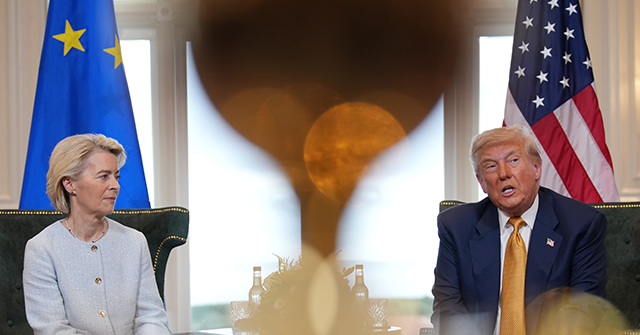
President of the European Commission Ursula von der Leyen shakes hands with U.S. President Donald Trump on July 27, 2025, in Turnberry, Scotland. (Andrew Harnik/Getty Images)
The EU deal—as well as those that preceded it—are a vindication of Trump’s approach to trade negotiations. Instead of multilateral agreements establishing new international bodies like the World Trade Organization, Trump favored bilateral negotiations. He argued that the U.S. could strike more favorable deals one-on-one with trading partners, while his critics predicted he would meet unbending resistance. Trump argued that the U.S. could raise tariffs on trading partners because the U.S. had underpriced access to U.S. markets, while his critics claimed that any tariff hikes would initiate destructive trade wars. He thought we could bring the U.S. economy into better balance and closer integration with our allies, while his critics predicted Trump’s approach would drive others into the arms of China.
On each point, Trump’s view has decisively prevailed.
A Globalist Turns European Nationalist
This victory has stunned the president’s critics, including some of the most influential economists in the world.
We’ll take as our paragon of the beleaguered economists Olivier Blanchard, who is the Robert M. Solow Professor Emeritus of Economics at the Massachusetts Institute of Technology, Professor of Economics at the Paris School of Economics, and the C. Fred Bergsten Senior Fellow at the Peterson Institute for International Economics. After obtaining a PhD in economics from MIT, Blanchard became a professor at Harvard before moving back to MIT. There he chaired the economics department. From 2008 t0 2015, he served as the chief economist for the International Monetary Fund. He is considered one of the leading lights of so-called New Keynesianism, the currently dominant approach to macroeconomics in the U.S. and Europe.
So, how did this most-established of all establishment figures—the “final boss” of economics, as the kids would say—react to the deal? Even before it was announced, Blanchard was weeping into his beret.
And when the deal was announced, Blanchard was beside himself with grief.
One aspect of this should not be overlooked is the partisanship it displays on behalf of Europe. We do not begrudge the Professor Fellow Chairman Chief Emeritus Blanchard his loyalties as a Frenchman. In fact, they’re admirable. He has been described as a globalist but appears to be a sort of European nationalist, if such a thing can be said to exist. Perhaps this moment will also be the beginning in which the world stops looking at pedigreed economists as objective practitioners of a social science but human beings embedded in communal loyalties and practices just like the rest of us.
There’s a new light shining across the globe as the 249th July of our Union comes to a close. The old illusions are fading away, exposed by the gleam of the new Golden Era.
Read the full article here