


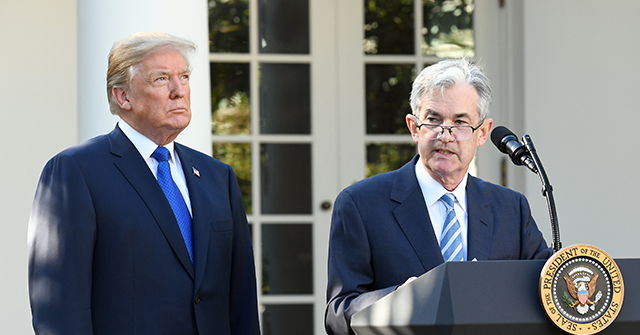
Jerome Powell, Please Go Now!
Welcome back to Friday! This is the Breitbart Business Digest’s weekly foray into the seven-day period now rapidly heading to its expiration. Under no circumstances will the week that was be permitted to become the week pro temporare if next week isn’t confirmed on time.
This week, we saw Jerome Powell insist that he can be Fed chairman forever or at least until his successor is confirmed, whichever comes first, we guess. The Fed also had a meeting and issued a new set of economic projections that were basically ignored by everyone but us. Oil got pricier, and everyone continued to negatively natter about what AI would do to the employment of nabobs.
The Fed Got More Optimistic About Growth
We’ll get to Chairman Jerome Powell’s attempt to cling to control of the central bank in a moment. Before that, however, we wanted to point out something that largely went undetected in the Fed’s quarterly Summary of Economic Projections (SEP): the Fed showed signs of breaking out of its anti-growth mentality.
The median forecast for the longer-run growth rate of the real economy rose in the March SEP from 1.8 percent to 2.0 percent. While that looks like a small change, it’s worth noting because this is the first time the forecast has lifted above 1.8 percent since December 2020. The last time it was as high as two percent was June 2016. Combined with the Fed’s forecast of a two percent inflation rate, this implies a nominal growth rate of four percent.
It might not be immediately obvious why this matters, especially because the Fed’s forecasts are so often wrong. But the way to think about the longer-run expectations is that they are not only forecasts but targets. The longer-run inflation rate, the longer-run unemployment rate, and the longer-run growth rate are not just statements about where the Fed sees the economy going, but about where they think our economic potential is and where their policy will try to steer the economy. When the Fed was saying it the longer-run growth rate was 1.8 percent, it was also saying that it would view more growth than that as at least potentially indicating an overheating economy.
While the difference between growth 1.8 percent a year and two percent might not seem like a big deal, it compounds over time. A two percent a year economy is around two percent larger in 10 years than a 1.8 percent economy. After 50 years, it is 10.5 percent larger. On a 100-year horizon, the economy is nearly 22 percent larger than it would have been.
Perhaps not surprisingly, the Fed’s view of the longer-run federal funds rate also moved up, going from 3.0 percent in December to 3.1 percent in March. We noted some time ago that this began to climb in 2023, after being more-or-less pinned at 2.5 percent since 2019, and has been bumpily moving up ever since. When the Fed was raising it while keeping the GDP forecast at 1.8, the effect was to say that we needed higher interest rates to contain inflation. That’s a tightening of monetary policy: higher nominal rates relative to real GDP growth.
In March, however, the Fed raised the growth forecast by more than the interest rate forecast. That’s a loosening of policy over the long run.
Jerome Powell’s Forever Fed War
At this point, we should be immune to being floored by statements coming from Jerome Powell. Yet he managed to shock us again by claiming at his presser this week that if Kevin Warsh is not confirmed by May 15, Powell will become chairman pro tem of the Fed. What’s more, he characterized this as what the law and past practice expect. As we explained at length yesterday, that’s so wrong that it is borderline nuts.
It’s extraordinary that Powell would make this statement without at least consulting the Fed’s Board of Governors and the rest of the Federal Open Market Committee (FOMC). Even Powell cannot think that he can declare himself chair until a successor is confirmed. Can he? We would think that even the most Fed-independent theory of the case would require the Fed’s board to tap Powell to run things during the interregnum. We’re pretty sure the Fed employs a general counsel who must be familiar with succession law. Powell should probably figure out who it is and give him a ring. (Cheat sheet: his name is Mark E. Van Der Weide, and he’s been the GC since 2017.)
Here’s a nuance that we didn’t mention in yesterday’s newsletter. While the president will get to pick the interim chair of the Fed board if Warsh is not confirmed by May 15, the Federal Open Market Committee can elect any of its members to be its chairman. In the past, they’ve always elected the board chair to run the committee, but they could depart from that convention if they objected to Trump’s choice. That’s unlikely, however, because Trump has to choose one of their fellow governors as chair. It would be extraordinarily uncollegial to reject that choice and go with a different board member as committee chair.
What’s more, under today’s arrangements, the Fed board actually controls monetary policy. That’s because the board sets the rate for interest on reserves, which is now the effective policy rate. The FOMC controls the fed funds rate, which is largely symbolic in an era of super-abundant reserves. The chairman of the board also runs the institutional aspects of the Fed, including the staff and the regulatory apparatus. So, even if the FOMC had a different chairman, it’s not clear how much of a difference that would make.
Our Fate Is in Our Petroleum
Oil prices continued their climb this week, closing in on $110 a barrel. To put that in context, oil was slipping below $60 a barrel at the end of last year. It began to climb earlier this year as markets started to price in the possibility of a U.S. attack on Iran, reaching around $70 a barrel at the end of February.
That means we’re now well past the $95 three-year high. Economist James Hamilton’s research found that passing the three-year high often signaled a looming recession. Above $100 a barrel, it’s very likely that we’ll see demand destruction in the rest of the economy as consumers find it necessary to cut back in other areas to afford to fill their tanks. And businesses will slow output if they see their profits squeezed by a temporary price shock.
But that’s only if we stay at these levels for a considerable period of time. Unfortunately, that seems very possible. While we try to stay optimistic about the war, there’s no sign of it ending imminently or the Strait of Hormuz being opened soon. (Incidentally, why isn’t it called the Crook of Hormuz? Strait doesn’t describe this elbow bend in the Persian Gulf very well.)
As far as we can tell, there’s no easy policy fix for this. Releasing oil from the strategic petroleum reserves tends to only have short-lived and slight effects on global prices. Suspending the Jones Act, which prohibits foreign ships from moving cargo between U.S. ports, will probably do nothing at all, particularly because the suspension is limited to 60 days. No one is moving their oil tankers around the world for a 60-day Jones Act time out.
Also, people are starting to get pretty upset about gas prices.
AI as the New Cotton Gin
The sky is falling on the labor market thanks to artificial intelligence. That’s a view shared by both the techno-optimists and the techno-pessimists. If there’s a big debate happening around AI’s effect on the labor market, it is mostly about how fast AI will destroy jobs and which jobs it will eliminate.
We’re congenitally allergic to that level of consensus. So, let’s run through a very different scenario. When the cotton gin was invented by Eli Whitney, the almost universal expectation was that it would reduce the demand for slave labor. But because it made slave labor vastly more efficient and cotton growing vastly more profitable across the South, the demand for labor increased, and the acreage used for cotton production grew explosively.
There are already hints of this now. We’re seeing an unexpected rise in labor productivity in the U.S. economy, at least part of which appears to be related to nascent AI adoption. If AI makes labor more productive, the demand for human work is likely to increase rather than diminish. We might not be able to say exactly what this looks like, but the assumption that labor-saving technology destroys labor demand is not borne out by history.
Going Dutch
On March 20, 1602, the Dutch Republic’s States-General chartered the Vereenigde Oostindische Compagnie, known to us English speakers as the Dutch East India Company. This was an act of economic nationalism. Statesman Johan van Oldenbarnevelt drove the consolidation of the two major trading firms whose merger created the company, warning that disunity would let Spain and the new English East India Company dominate.
The Dutch East India Company got a 21-year monopoly on trade east of the Cape of Good Hope, starting with 6.4 million guilders in capital. It was the world’s first publicly traded multinational—a true joint-stock company. Any Dutch citizen could buy shares, freely traded on the emerging Amsterdam Stock Exchange. Governance came via a board of 17 directors, balanced across provinces.
A photograph of the world’s first and oldest known share certificate, which was issued in Enkhuizen, the Netherlands, on September 9, 1606, by the former Dutch East India Company (Verenigde Oostindische Compagnie or VOC). (Michel Porro/Getty Images)
Its powers were staggering. The charter let it wage war, sign treaties, build forts, field armies, and mint coins. The Dutch state had outsourced empire-building to a private firm. At its 1670 peak, the Dutch East India Company was the richest company on earth, employing around 50,000 people and monopolizing the lucrative spice trade. It delivered average annual dividends of around 18 percent for nearly two centuries.
But hubris and mismanagement caught up, as they annoyingly tend to do throughout history. Smuggling, corruption, soaring costs, and stubborn dividend payouts amid falling profits piled up debt. By the 1790s, the Dutch East India Company was insolvent.
Read the full article here