


It All Comes Out in the Warsh
Welcome back to Friday. This is Breitbart Business Digest’s weekly wrap, where we compose odes to the economics news of the expiring seven-day period.
This week culminated in the nomination of a former Bush White House economic official to succeed Jerome Powell as Fed chair. We had trade data that the legacy media tried to describe as showing that tariffs are bad, even though the report showed significantly lower trade deficits. And we’re approaching the anniversary of an important event in the history of Fed independence.
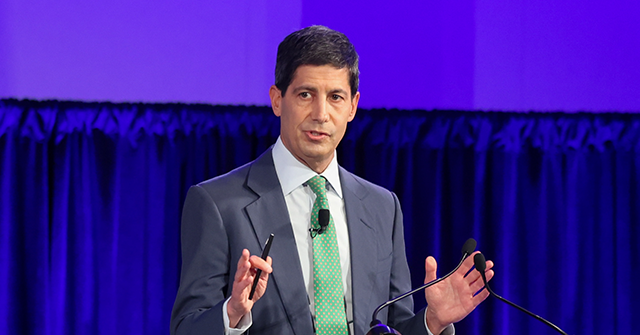
Former Federal Reserve Governor Kevin Warsh speaks during the International Monetary Fund (IMF) and World Bank Spring meetings at the IMF headquarters in Washington, DC, on April 25, 2025. (Tierney L. Cross/Bloomberg via Getty Images)
Kevin Warsh: The Comeback Kid
President Trump’s long-awaited nomination for the next head of the Federal Reserve arrived Friday morning. The nod has gone to Kevin Warsh, a former Fed governor whom the president described as “straight out of central casting.”
Warsh served as a Fed governor from 2006 through 2011 after being elevated to the central bank by George Bush. During the financial crisis, he gained a reputation as being a hawk on inflation and interest rates and a critic of the Fed’s asset buying program known as quantitative easing or QE. He did, however, promote the idea of targeted emergency lending facilities that he thought could provide liquidity to troubled sectors without the “blunt” instrument of lowering rates.
He was one of the final candidates under consideration for the Fed’s top job during Trump’s first term. At the time, Trump was reportedly concerned that Warsh came off as too young for the position. Trump ultimately went with then-Secretary of the Treasury Steven Mnuchin’s pick, Jerome Powell.
In recent years, Warsh has been critical of “mission creep” at the central bank, warning that its own view of its remit had expanded too far from its core mission of fighting inflation, sustaining maximum employment, and preserving bank stability. He’s also a supporter of the Trump administration’s plans to deregulate the banking industry and “re-privatize” the U.S. economy. And while he has remained a hawk on the Fed’s balance sheet, he has seemingly become sympathetic to the idea that rates could be lowered, arguing that the Fed should look through any temporary price increases caused by tariffs. Privately, some in the Trump administration have said he is likely to embrace the view that rising productivity gives the Fed more room to cut without triggering inflation.
There are concerns, however, that Warsh may be too hawkish to support President Trump’s economic policies. In the past, Warsh warned against inflation even in periods of economic slack, a view that has rankled market economists who see him as out of step with Trump’s pro-growth posture. Renaissance Macro’s Neil Dutta, one of the Wall Street economists who has frequently backed the president’s critical view of recent Fed policy, was disappointed with the pick:
We see that everyone’s least favorite candidate, Kevin Warsh, is poised to lead the Fed.
Part of President Trump’s appeal to many voters is his moderation on economic issues and willingness to buck the traditional Republican positions on trade, immigration, social insurance. He is supposed to be the “greatest jobs President that God ever created.” That’s why the nomination of Warsh is so perplexing. Because Kevin Warsh is a threat to working people everywhere.
Someone that sees inflation as a material threat (as he did during the GFC) with unemployment rising to ten percent alongside tightening financial conditions lacks the mental acuity and compassion to work at the Fed.
He’s known on Wall Street for three things. First, no one knew who the hell he was when Bush first named him to be a Governor. Second, he was relentlessly hawkish on inflation as unemployment spiked throughout the GFC. Third, all he has done since his time at the Fed is critique QE, the Fed itself while making a bunch of bad economic calls along the way. No one has cared what he thinks.
A member of the MAGA movement he is not. Warsh is a free trader that comes from a traditional cookie cutter Republican think tank named for a President that presided over the Great Depression. This is the best the President could do? With Tillis slowing down the nomination process due to an open investigation, there is time for serious pushback from the President’s populist base. It’s time to do to Kevin Warsh what was done to Harriet Miers. The stakes are too high.
Another concern among supporters of the president is that Warsh may lack the credibility within the Fed to bring about the deeper reforms many think are needed for the central bank to be successful going forward. “They don’t respect him enough for him to drive institutional change,” said one administration official who spoke on the condition of anonymity. “This could be a lost opportunity.”
Meanwhile, Warsh’s nomination was quickly embraced by critics of Trump’s policies, including Sen. Thom Tillis (R-NC), Harvard economists and former adviser to Obama Jason Furman, and Canadian Prime Minister Mark Carney. Tillis has said, however, that he will attempt to block Warsh’s nomination until the Justice Department drops its investigation of current Fed chair Jerome Powell.
Let’s Just Pardon Powell
While Tillis’s insistence that the Justice Department back off rubs many Trump supporters the wrong way, he is performing the role the Constitution and the Federal Reserve Act assign to senators. At its heart, the independence of the Fed depends not on the judiciary branch policing the president’s removal power but on the Senate using its ability to hold back nominees to the central bank if it sees the president as overreaching.
For his part, Trump has always said he is not trying to gain control of the Fed or interfere with its independence. The funniest—and also most effective—way to satisfy Tillis’ demand would not be to interfere with Justice’s investigation directly but just to short-circuit it by preemptively pardoning Powell. Trump could make it clear that he thinks Fed independence is worth the cost of perhaps letting Powell get away with whatever wrongdoing Justice might suspect.
Warsh himself once composed an ode to Fed independence and has been a stalwart defender of keeping the central bank out of politics and politics out of the central bank. “There is no such thing as being a little bit independent or a little bit credible,” Warsh wrote in 2010. Perhaps this will placate the fears to lawmakers worried about what the media keeps describing as a Trumpian coup attempt over the Fed.
The Trade Deficit Is Falling
The November trade data showed a dramatic month-to-month deterioration, with the total U.S. trade deficit nearly doubling from $28.91 billion to $56.83 billion. But as trade analyst Alan Tonelson points out, looking at the broader picture since Trump’s “Liberation Day” tariffs were announced in April, the overall trade deficit has fallen 25 percent compared to the same period in 2024. For Trump’s full term so far, the deficit is running 7.6 percent lower than during the comparable period under Biden.
The data challenges conventional economic predictions about tariffs. Tonelson notes that these improving results are coming “in an economy growing only slightly more slowly than in 2024,” with growth around 2.5 percent, defying the typical pattern where trade gaps only narrow during significant slowdowns. U.S. exports are growing faster (6.27 percent year-to-date) than in pre-tariff 2024, which Tonelson argues belies “widespread predictions that the Trump 2.0 tariffs would provoke widespread foreign retaliation” and vindicates “the president’s claims that the United States holds the most powerful cards by far in global trade diplomacy.”
The manufacturing trade deficit is down nine percent since Liberation Day, and the goods deficit with China has plummeted 45 percent in the post-tariff period. While some countries like Canada, the EU, and Germany saw deficit increases in November, Tonelson concludes: “It’s still legitimate to argue that trade deficit reduction doesn’t matter…What keeps becoming a lot less legitimate is challenging the claim that, under Trump 2.0, U.S. trade flows are being brought into balance, and that tariffs are a big reason why.”
When Truman Summoned the FOMC to the White House
On the last day of January 1951, President Harry Truman summoned the entire Federal Open Market Committee (FOMC) to the White House for what would become one of the most consequential confrontations in the history of American monetary policy. The meeting came at a critical juncture: inflation had reached an annualized rate of 21 percent by February 1951 as the Korean War intensified, yet the Truman administration was insisting that the Federal Reserve continue pegging interest rates on government bonds at low levels to facilitate Treasury borrowing.
Portrait of President Harry S.Truman, February 27, 1951. (Bettmann/Getty Images)
The Roosevelt and Truman administrations had long pressured the Fed to maintain fixed low interest rates on government securities, a policy that dated back to World War II financing needs. But as the Korean War escalated and threatened to require substantial new government debt issuance, Fed officials found the arrangement increasingly untenable. They faced the prospect of having to monetize massive amounts of new debt, which would have placed even greater upward pressure on already soaring prices. The FOMC believed maintaining the peg would fuel an inflationary spiral that could destabilize the entire economy.
After the White House meeting, Truman issued a statement claiming the FOMC had “pledged its support to President Truman to maintain the stability of Government securities as long as the emergency lasts.” But the FOMC had made no such pledge. The conflicting accounts of what transpired created a public spectacle, with dueling narratives appearing in the press about whether the nation’s central bank had capitulated to presidential pressure. Fed Chairman Marriner Eccles, acting without consulting the rest of the committee, decided to release the FOMC’s own account of the meeting to set the record straight, a dramatic breach of protocol that underscored just how high the stakes had become.
The standoff culminated on March 4, 1951, with the Treasury-Fed Accord, a compromise negotiated largely by Assistant Treasury Secretary William McChesney Martin Jr. while Treasury Secretary John Snyder was in the hospital for cataract surgery. The Accord freed the Federal Reserve from its obligation to peg government bond prices, though it agreed to provide short-term support during the transition. The agreement is seen a crucial step in restoring the Fed’s independence to conduct monetary policy aimed at price stability rather than Treasury financing convenience.
Read the full article here