


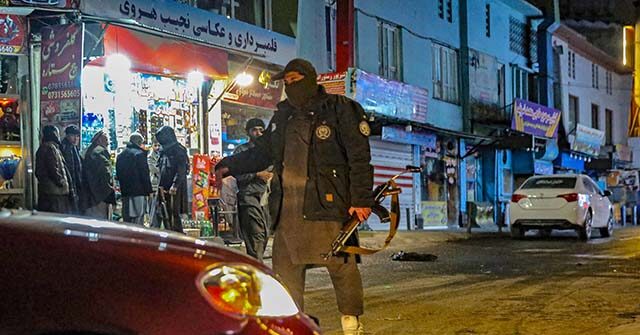
A bomb detonated in downtown Kabul, Afghanistan, on Monday, killing at least 7 people and severely injuring 20 others. The Chinese embassy in Afghanistan said on Tuesday that one of the dead was a Chinese national, as were five of the injured.
Chinese state media quoted a spokesperson for the Taliban’s Interior Ministry saying, “The explosion occurred near a Chinese restaurant, and an explosive device was found at the scene.”
The Taliban Interior Ministry said the restaurant was run by a Chinese Muslim man named Abdul Majid, his wife, and an Afghan partner named Abdul Jabbar Mahmood.
Local police said they immediately “secured the site for cleanup and evidence collection,” but the Chinese embassy did not seem entirely satisfied with the response, urging the Taliban junta to “conduct a prompt investigation while assisting the injured Chinese nationals in receiving medical treatment.”
“China has made urgent representations with the Afghan side, demanding that the Afghan side spare no effort to treat the injured, further take effective measures to protect the safety of Chinese citizen,” Chinese Foreign Ministry spokesman Guo Jiakun said on Tuesday.
The Islamic State posted a statement on its Amaq “news agency” on Monday night claiming responsibility for the attack. ISIS said the restaurant was targeted with a suicide bomber wearing an explosive vest because Chinese nationals were known to patronize the establishment.
ISIS said the attack was in retaliation for “growing crimes by the Chinese government against Uyghurs,” and said more deadly attacks against Chinese nationals in Afghanistan would be forthcoming.
The Uyghurs are a predominantly Muslim ethnic group concentrated in East Turkistan – what China refers to as the Xinjiang Uyghur Autonomous Region (XUAR), a territory Communist China seized by force in 1955.
China has indeed perpetrated massive crimes against the Uyghurs, including brainwashing, torture, mass incarceration in concentration camps, mass surveillance, forced labor, forced abortions, and forced relocation to disperse the Uyghur population and destroy their culture. The U.S. State Department classified China’s abuse of the Uyghurs as genocide in January 2021.
Beijing covets Afghanistan’s mineral resources, and was quick to form business relations with the Taliban regime after President Joe Biden’s disastrous withdrawal from Afghanistan in August 2021. China became the first country to exchange ambassadors with the Taliban regime in 2023.
China also has security concerns in Afghanistan, which borders on the XUAR. The Chinese have long been worried that the Taliban could either negligently, or deliberately, allow Uyghur extremists and other Islamist terrorist groups to take shelter in Afghanistan while plotting attacks on targets in China.
China’s most immediate concern is that terrorist threats against Chinese business interests and personnel in Afghanistan, a pattern Monday’s attack fits into. Beijing wants to fold Afghanistan into its Belt and Road Initiative (BRI) infrastructure project, an ambition that gives terrorist groups in Afghanistan plenty of targets to attack.
China occasionally expresses frustration with the Taliban’s inability to provide security for Chinese workers and managers, mixed with fulsome praise for the Taliban regime when it makes public commitments to better protect China’s interests.
Iftikhar Firdous, executive director of a research group called Khorasan Diary, told the leftist publication New York Times (NYT) on Tuesday that ISIS “sees the Taliban-China relationship as one of the biggest betrayals of a jihadist group.”
Firdous described the Islamic State as “the primary benefactor” of a “growing anti-Chinese jihadist nexus in the region.”
The Taliban regime insisted on Tuesday that the cause of the explosion at the Chinese Noodle restaurant in Kabul was “unknown so far, and is being investigated.”
Read the full article here