


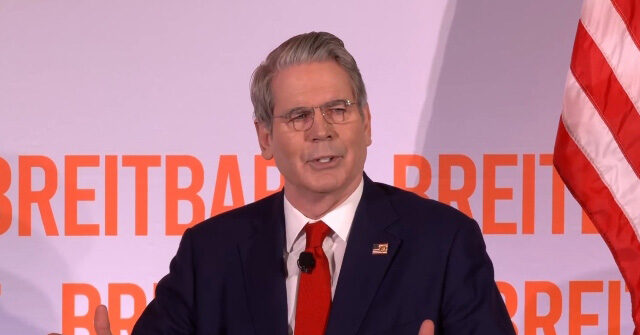
Treasury Secretary Scott Bessent said Wednesday that Iran’s regime has been reduced to “cornered animals” as the United States combines military force, a naval blockade, and an unprecedented financial offensive designed to cut off Tehran’s “financial oxygen,” predicting that under the mounting pressure, “they’re going to yell uncle.”
“The world has never seen anything like this, and it’s because of sequencing,” Bessent told Fox News’s Bret Baier on Special Report.
Bessent laid out that sequence plainly: “We had six weeks of kinetic activity. We have the blockade, and now we have an effort never seen before in terms of constricting and cutting off the financial oxygen to them.”
“They’re cornered animals,” he said.
“I don’t know whether it’s going to be a week, a month, or two months, but they’re going to yell uncle,” Bessent added.
The Treasury secretary’s assessment came as the Trump administration escalates Operation Economic Outcast even as Washington and Tehran have reopened negotiations on the sidelines of the United Nations General Assembly, with Bessent pointing to sharply curtailed Iranian air travel and rising oil flows through the Strait of Hormuz as evidence of the campaign’s impact.
“In terms of Operation Economic Outcast, we are squeezing the Iranians like they’ve never seen,” Bessent said.
Bessent said between 80 and 90 percent of Iran’s external flights had been shut down Wednesday as Washington threatened foreign companies servicing Iranian carriers with secondary sanctions.
“I’m not sure how the Iranian representatives at the U.N. are going to get home,” he said.
Bessent had warned earlier this week that companies providing Iranian airlines with fuel, landing services, ticketing, and other support could face exclusion from the U.S. dollar system.
He issued a similar warning Wednesday to the broader network of financial institutions and businesses still supporting Tehran.
“We have made it very clear around the world, whether it’s the financiers, the people who are doing business, the people who are supplying the Iranians: We know who you are. You know who you are,” Bessent said, warning that Washington would continue targeting their companies and bank accounts “every day and every week.”
The escalating financial offensive is operating alongside a U.S. blockade that is simultaneously choking off Iranian exports while American forces work to keep non-Iranian oil moving through the Strait of Hormuz.
Bessent said between ten million and 17 million barrels of oil are now moving through the waterway each day despite continued Iranian attempts to strike commercial shipping.
“The tankers, they may get hit. Many of them just sail on,” he said. “The Iranians may launch three, four, five, six drones after them. Our great Navy is blocking them, but we are getting between 10, 15, sometimes 17 million barrels a day out.”
Before the war, roughly 20 million barrels moved through the strait each day, Bessent said, while another approximately three million barrels are now moving through alternate routes.
“So that gets us back to somewhere between 13 and 20, which is the reason we have seen oil come down from the spring highs,” he said.
President Donald Trump similarly highlighted the recovery in Hormuz traffic during his address to the U.N. General Assembly Tuesday while calling on other countries to join what he described as the “complete economic isolation” of Iran.
U.S. Central Command announced another measure of the blockade’s expansion Wednesday, saying American forces have now redirected 115 commercial vessels to maintain strict enforcement of what it calls America’s “steel wall blockade.”
The figure is up from 110 vessels just days earlier and 92 when Bessent described the blockade and sanctions earlier this month as “one of the most powerful one-two punches in the history of economic isolation.”
At the time, Bessent told Breitbart News that the administration was increasingly targeting the remaining international lifelines into Tehran, announcing new action against an Iranian airline and warning financial facilitators that Washington would “come for you.”
“The Iranian snake, the leadership, they don’t know they’re dead yet, but they are,” Bessent said during Breitbart News’s State of the Economy policy event earlier this month.
Wednesday’s assessment marked the latest stage of a campaign Bessent has described as the “greatest economic isolation operation in the history of the world.”
“We are going to asphyxiate this regime,” he said earlier this month.
Yet the escalating pressure is now unfolding alongside renewed diplomacy.
Trump said Tuesday that U.S. representatives held an approximately three-hour round of talks involving Iran and regional mediators on the sidelines of the General Assembly, calling the discussions “very good” and saying there was “a lot of momentum” toward an agreement.
Special Envoy Steve Witkoff said mediators shuttled between the two sides during the broader round of negotiations, while Iranian state media separately confirmed that Foreign Minister Abbas Araghchi met with Witkoff.
Secretary of State Marco Rubio said Wednesday that reaching an agreement would require “hard work over a period of time,” while reiterating that the United States would continue to defend and keep the Strait of Hormuz open and that Trump retains military options.
Bessent said the administration sees three possible outcomes from the mounting pressure: the regime turning on itself, an uprising by the Iranian people, or Tehran reaching an agreement — and adhering to it.
“We gave the MOU [Memorandum of Understanding] a try on June 3, and then the Iranians, a few weeks later, began firing on ships in the Strait and being very aggressive,” he said.
“And this time, if there is a deal, I guarantee you they’re going to stick with it.”
Joshua Klein is a reporter for Breitbart News. Email him at [email protected]. Follow him on Twitter @JoshuaKlein.
Read the full article here