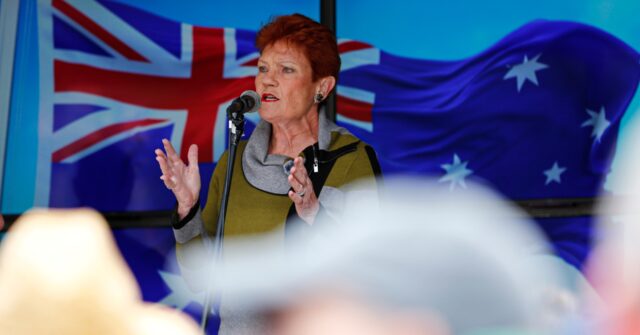
The economic damage of migration is pushing many more Australians to support the nation’s leading anti-migration politician, Pauline Hanson, and her political party, One Nation.
But the cause-and-effect process is being denied by the New York Times, which used a February 26 article to downplay migration’s damage to Australians’ living, local culture, housing market, and workplace productivity.
Instead, the newspaper uses the first quote in the article to portray One Nation as a party of emotional “resentment” that is devoid of logic or decency.
“For politicians like Hanson, who have built up their repertoire capitalizing on politics of resentment, this is the perfect storm,” said Anna Broinowski, a documentary filmmaker and author who has followed Ms. Hanson’s career.
Instead, the article credits the party’s rise to the recent jihadi attack by two Muslims that killed 15 Jews on the nation’s most famous beach. The article’s headline says “After Bondi Beach Massacre, an Anti-Immigration Party Surges.”
Yet the editors also downplayed the weirdness of importing Muslims into Australia’s Christian society, saying:
in December, two gunmen — who the police say were an immigrant from India and his Australian-born son, and who were inspired by the Islamic State — attacked a Jewish celebration and killed 15 people.
Hanson, however, told the newspaper that Australians were opposed to migration even before their bloody jihad attack:
“Even when the people have been screaming, ‘Pull it back, stop it, we don’t need this many,’ the government disregarded them and just kept bringing in more and more people,” Ms. Hanson said in an interview.
The Bondi Beach shooting, she said, had pushed people to voice concerns about immigration they had been previously reluctant to express. “People have been worried about this for a long time, but they didn’t know where to go or what to do or how to say it or speak up,” she said. “Bondi has given them the opportunity to say how they feel about it, what’s happened to our country.”
A new show that the One Nation party has overtaken the pro-business Liberal Party and almost matches the left-wing Labor Party:

The article does admit that Australia’s housing costs are rising and that wages are falling amid the massive migration — but insists that the cause-and-effect link is merely a coincidence:
Public attitudes toward immigration in Australia have soured in recent years, as the country saw an influx of foreigners after the end of pandemic-era restrictions, coinciding with a spike in the cost of living and an acute housing crisis.
This refusal to follow the money in migration is a common feature in the New York Times and many other establishment outlets. In February, for example, the New York Times explained how Spanish pro-migration lobbies hide migration’s pocketbook damage by playing up migration’s benefits for companies and tax collectors, and by hiding the migrant inflow:
More immigration would grow their economies, increase tax revenues and supplement shrinking workforces. But there are few topics more politically charged than immigration, and accepting large numbers of migrants risks provoking voter backlash and creating political instability.
…
the key [to political success] was not persuading the public to be more tolerant of immigration, but structuring immigration in a way that didn’t trigger their fears.
The New York Times‘ problem, however, is that citizens keep noticing the economic damage of migration. For example, deep in the New York Times article, the reporter quotes Australians saying:
But when a nationwide housing crisis seemed to engulf even his small Western Australia town of Manjimup, where he said prices went “through the roof,” [Kester Wilson] found himself thinking she had been “on the right track” about immigration … Jill Sheppard, a political scientist [said] … “Business wants more migration, voters don’t, and the [establishment] parties find themselves caught in between.”
Follow the Money
There is vast and growing economic data from many countries showing that government encouragement of mass migration does catastrophic economic damage to citizens: Wages stall, housing spikes, productivity investment shrinks, marriage declines, and birth rates slide amid the civic and economic chaos.
For more than 200 years, most economies have grown as citizens become more productive via investment in new technology and techniques. But just like in Canada and many other countries, Australia’s productivity growth has dropped below 1 percent because immigration diverts business investment towards real estate and consumer-economy services.
Migration also spikes real estate costs, forcing young people to spend more on rents and housing. That money, in turn, enriches their parents and older investors:
Australia is on the cusp of a property divide like never before ….[Economist Angus Moore] noted that if prices continued to grow at the same rate as the past five years, buyers would pay about 61 per cent more in Sydney, 68 per cent more in Brisbane and 75 per cent more in Adelaide by 2030. Melbourne prices would be 17 per cent higher, Perth prices would go up by 66 per cent and in Hobart and Canberra the rise would be about 40 per cent.
Migration also forces wages down. In 2025, for example, inflation-adjusted wages fell in Australia. In 2025, Australia’s ABC News reported :
The ‘real’ value of workers’ wages (the purchasing power of wages when inflation is taken into account) increased by just 2.6 per cent over the entire decade [2012-2022]. By contrast, in the two decades before that, from 1991 to 2011, real wages grew by 16 per cent in both decades.
Unsurprisingly, birth rates are declining in Australia as impoverished young couples delay marriage, homeownership, and births. In 2024, ABC.net.com reported “The Total Fertility Rate, or TFR, over the past 30 years has slowly dropped from 1.86 in 1993 to 1.5 in 2023.”
Hanson’s political pitch is built on these economic trends, despite the New York Times‘ “resentment” jibe.
The trends match the United States, where median wages for young Americans grew by just 25 percent in the 45 years after Congress dramatically expanded migration in 1965 and 1990.
Similarly, the wealth shifts from migration helped the Australian stock market double in value between 2014 and 2026.
In the same high-migration period, the U.S. Dow Jones index almost tripled in value.
Now, Trump’s deportation mandate is shifting wealth back to ordinary Americans. Their wages are up, and their housing costs are down. Inflation is declining, transport costs are shrinking, crime is dropping, and corporations are spending heavily to help Americans become more productive. The resulting prosperity will likely help to raise the birthrate as husbands gain higher wages and wives gain greater confidence in the future. Trump is also trying to sketch out a prosperity strategy built on productivity instead of Wall Street’s Extraction Migration.
Trump’s crackdown on crime and pro-diversity mandates is also helping to reduce the diversity chaos that is imposed by migration advocates. The same chaos is evident in Australia amid a severe excess of diversity and tribalism that is fracturing and flooding its formerly equal, coherent, generous, and free-speaking society.
Why Won’t The New York Times Follow the Money in Migration?
Ideology and ethnic politics help to explain the refusal by The New York Times‘ managers, editors, and reporters to admit the obvious economics of migration.
Some of the newspaper’s editors and staff seem willing to recognize the economic damage of migration and the inverse relationship between migration and productivity. But most are eager to hide the damage because they view migration as beneficial for non-European migrants and ethnic groups. The newspaper has rarely mentioned migration and productivity in the same article, although some op-ed writers try to dismiss the dilemma.
For example, the newspaper’s white-collar editors chose to portray white-collar opposition to the job-selling H-1B migration program as identity-politics racism — despite the massive evidence that the program used to discard white-collar Americans of all colors. The February 16 article was titled: “How the Visa Debate for Foreign Workers Fuels Racism Against South Asians.” The article was written by “Amy Qin [who] writes about Asian American communities for The Times.”
Migration advocate Jia Lynn Yang served as national editor from 2021 until 2025, where she could help hire and promote reporters and editors who share her views. She is the child of Chinese immigrants and the progressive author of a 2020 pro-migration book, titled “One Mighty and Irresistible Tide.”
She used the book to argue that progressives should use immigration policy to sever America from its cultural roots in Europe:
For those Americans who want ethnic pluralism to be a foundation value of their nation, there is unfinished work. The current generation of [non-European] immigrants and children of immigrants — like those who came before us — must articulate a new vision for the current era, one that embraces rather than [downplays] how far America has drifted from its European roots. If [immigrants] do not, their opponents can simply point out to the America of the last fifty years as a demographic aberration, and they would not be wrong.
For Yang, the new migrants can redeem the many sins of European-origin Americans:
The image of the Statue of Liberty, the Emma Lazarus poem at the statue’s base, the notion of America as an eternal “nation of immigrants,” — these make up an intoxicating part of this country’s mythology. Set against all the sins of America’s past — from slavery to the removal and genocide of American Indians — the arrival of open-hearted [non-European] immigrants, grateful for a chance at a new life on our shores serves as a constant renewal of hope in the American project. If there is salvation for this country, it very well may lie in the underlying gratitude of a refugee whose life has been saved by the granting of a visa.
She repeated these ethnic-politics themes in a February 6 article, titled “Trump’s Immigration Policy Is 100 Years Old”:
the Trump administration, led by the president’s most influential policy adviser, Stephen Miller, is in pursuit of a radical vision for America. They want the country’s immigration policy blasted back in time — and not just to before the Biden era.
They are channeling an immigration regime instituted in 1924, when strict racial quotas — driven by fears of foreigners and a rise in eugenic thinking — led to a bottoming-out of foreign-born Americans that lasted for decades. The quotas signed into law in 1924 were not about securing the border as we understand it today, but about protecting a white, Christian character for the country.
That 1924 to 1965 slowdown in migration created the nation’s middle class because the tight labor market, where ordinary Americans and investors were forced to cooperate as they raised productivity to generate more wages and profits. This national labor market lifted a nation of whites and blacks into middle-class prosperity, “middlebrow” culture, and respectable citizenship.
But economic and cultural elites revolted, and invented a narrative that claimed — as described by Yang — that migrants “made this country American in the first place.” Their elite coalition persuaded Congress to end the 1924 migration pause in 1965, and then doubled the inflow in 1990.
The subsequent and gradual replacement of America’s population by migrants was deliberate, Yang admits:
Today many act as if America’s identity as a nation of immigrants was written into the Constitution itself. In reality, it was the product of a political effort less than a century ago — one that was so successful at creating a new national story that it birthed the sheer ethnic diversity in this country that the Trump administration is now determined to undo.
Yang’s 2025 replacement as national editor is Nestor Ramos, who seems to share her view of migration policy as ethnic politics. In 2018, he wrote while living in Boston:
the Trump administration’s transparently ethnocentric culture-war approach to immigration to make large numbers of decent, compassionate Americans take notice, but that’s what happened. If you doubt that the crackdown on border crossings is rooted in cultural and racial animus, try imagining cages full of white, English-speaking children at the border.
Since January 2025, Trump and his deputies have begun the huge task of reversing the “Mighty and Irresistible” tide of migration and are now pushing millions of foreigners back home.
Australia’s version of MAGA, One Nation, is following the Americans’ footsteps as it tries to escape the civic destruction caused by pro-migration lobbies and their media cheerleaders.
Read the full article here