


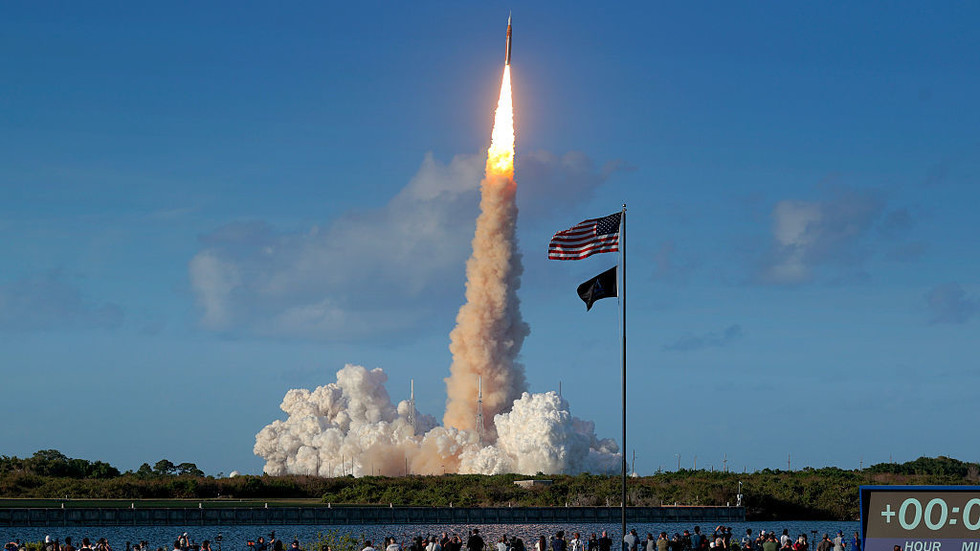
NASA launched its first crewed lunar flight in more than 50 years on Wednesday, as the Artemis II mission began with liftoff from the Kennedy Space Center in Florida. The mission comes at the dawning of a new age of competition in space.
What is Artemis II?
Artemis II is the second mission in NASA’s Artemis program, which aims to land humans on the surface of the Moon in 2028, and establish a permanent base on the lunar surface in the 2030s. Artemis II is the first crewed mission in the program, and takes place four years after Artemis I – an uncrewed mission which tested the Lockheed Martin-built Orion capsule.
Who is flying Artemis II?
Artemis II will see American astronauts Reid Wiseman, Victor Glover, and Christina Koch, along with Canada’s Jeremy Hansen, orbit the Earth, circle the moon, and then return to Earth at a record re-entry speed of 40,000 km/h (25,000 miles). At one point in the mission, the crew will be further from Earth than humans have ever been, surpassing the record of 400,171 km (248,655 miles) set by Apollo 13 in 1970.
Was the Artemis II launch successful?
A NASA Space Launch System (SLS) rocket roared into motion at 6:35pm on Wednesday, accelerating the Orion craft to around 27,360 km/h (17,000 mph) within eight minutes of flight. A technical error with the rocket’s Flight Termination System (FTS) threatened to delay the launch, but NASA technicians were able to resolve the problem with an hour to spare.
The FTS system allows flight engineers to trigger the rocket’s self-destruction in the event that it veers off course and threatens lives on the ground.
When will Artemis II reach the Moon?
The spacecraft will spend 24 hours in high-Earth orbit – around 74,000km (46,000 miles) above the planet’s surface – conducting systems tests before Orion’s own engines will fire on Thursday evening, setting the craft on a trajectory for the Moon.
Orion will enter the Moon’s gravitational sphere on Monday, and will begin its lunar flyby later that day. During this phase of the mission, the Artemis II crew will become the first humans to lay eyes on the far side of the Moon, which always faces away from Earth. The Moon’s gravity will then sling Orion directly back toward Earth, and after reentry, the crew capsule will separate from the spacecraft for a parachute-assisted splashdown in the Pacific Ocean on Friday, April 10.
Why is NASA returning to the Moon now?
Artemis II is NASA’s first crewed lunar mission since Apollo 17, in which astronauts Gene Cernan and Harrison Schmitt walked on the surface of the Moon. The Apollo missions took place at the height of the Cold War, with the US spending 4% of its federal budget on NASA during the 1960s in a bid to land on the Moon before the USSR. After the first successful lunar landing in 1969, however, the agency’s budget contracted amid waning public interest and economic turmoil.
What disasters have befallen NASA’s space program?
Following the 1969 Moon landing, a series of tragedies further curtailed the US space program. NASA’s space shuttle Challenger disintegrated less than two minutes into its tenth flight in January 1986, killing all seven crew members on board. The disaster was broadcast live on CNN: images of the craft exploding in a mid-air fireball and silence from mission control witnessed by millions of Americans.
An inquest found that faulty rubber O-rings caused Challenger’s rocket booster to leak hot gases, which ignited the booster’s remaining propellant.
Tragedy struck again in 2003 when another space shuttle, the Columbia, disintegrated during re-entry to the Earth’s atmosphere, killing all seven astronauts on board. Columbia’s fate was decided during launch, when a piece of insulating foam broke loose and punctured heat-shielding tiles on the craft’s wing. This damage caused the wing to break apart during re-entry.
Who restarted the US lunar mission program?
President Donald Trump reignited the US lunar ambitions in 2017 when he signed Space Policy Directive 1. This established the Artemis program and declared that “the United States will lead the return of humans to the Moon for long-term exploration and utilization.” President Joe Biden kept the Artemis program intact, and upon his return to the White House last year, Trump unveiled a slew of new space goals, including the creation of a space-based missile defense system, the replacement of the International Space Station, and building nuclear reactors on the Moon.
An executive order signed by Trump last December declared that “superiority in space is a measure of national vision and willpower.” Trump echoed this language following the successful launch of Artemis II, writing on social media that “we are winning in space, on Earth, and wherever possible – economically, militarily, and now beyond the stars.”
Was the Artemis program delayed?
The Artemis program has been plagued by delays and cost overruns. The Artemis I mission – before it was named as such by Trump – was initially set to take place in 2016, before the date was pushed back to 2021, and then 2022. When Trump unveiled plans to send humans back to the Moon, he originally set a landing date of 2024, which has since slipped back to 2028.
Combined, the SLS rocket and Orion spacecraft have cost more than $44 billion to develop. As of last year, the SLS project was six years behind schedule and $6 billion over initial cost estimates, while Orion has cost $3.2 billion more than originally projected. A 2021 report by the Government Accountability Office placed the entire cost of the Artemis program at $93 billion up to fiscal year 2025, and the cost of a single SLS/Orion launch at $4.1 billion.
Who is competing with the US in the space race?
NASA is competing with Russia’s Roscosmos and the China National Space Administration (CNSA), which are working on establishing a joint lunar base by 2035.

China has already retrieved samples from the lunar surface, and last August tested the landing craft that Beijing hopes will put the first Chinese astronauts on the Moon by 2030.
Furthermore, the US and China have both created space-focused branches of their militaries – the US Space Force and PLA Aerospace Force. Both have tested anti-satellite missiles, both have declared space a warfighting domain, and both are developing space-based missile interceptors and the means to overcome them.
As was the case during the Cold War, competition between Washington and Beijing has split the world into rival blocs. Some 61 countries have signed the Artemis Accords, a set of non-binding rules governing the exploration and commercial exploitation of the Moon and Mars. Russia and China have both condemned the accords, with Moscow describing them as a “blatant attempt to create international space law that favors the United States.”
Along with Russia and China, 11 other countries including Serbia and South Africa, are taking part in the development of the ILRS.
Can the Moon be mined for resources?
In November 2015, the US Congress passed a bill allowing American companies to own and sell materials they extract from the Moon or other celestial bodies. The Artemis Accords explicitly permit the “safe and sustainable” extraction of resources from the Moon.
The Moon contains substantial deposits of rare-earth elements and Helium-3, an isotope with the potential to power future fusion reactors. These deposits have piqued the interest of commercial space exploration firms. Astrolab and Interlune plan to jointly extract Helium-3 from the Moon by 2029, and have already signed contracts with the US Department of Energy to sell the gas.
According to a research paper published last year, 6,500 craters on the Moon’s surface could contain platinum, palladium, and rhodium worth more than a trillion dollars.
Read the full article here