


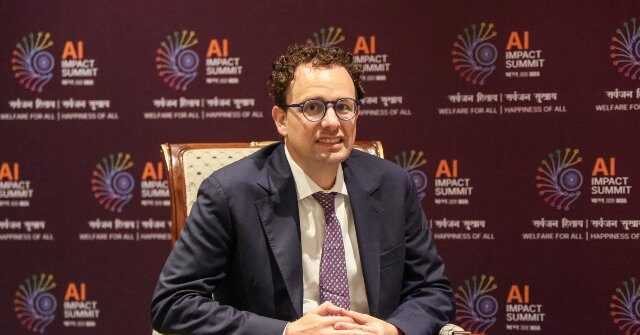
Dario Amodei’s Anthropic, which has spent the last week pushing a campaign of fear about AI advancement, has revealed it built a “wet lab” to conduct AI-driven biology experiments.
Reuters reports that Dario Amodei’s Anthropic has confirmed that it operates a wet biology laboratory in the Bay Area where the company uses its AI models to conduct physical experiments. A wet lab is a facility that specifically deals with hazardous liquids or biological samples.
The revelation comes at an interesting time, as Amodei has led a campaign of AI doomers calling for a slowdown on AI technology accross the board. Critics like the Big Short’s Steve Eisman argue that Amodei’s goal is to create a moat around his business to protect it from competition.
Eric Kauderer-Abrams, Anthropic’s head of life sciences, explained the company’s approach to biological research. “We believe that to do biology, the final test is still, and will be for a while, in real lab work,” Kauderer-Abrams told Reuters. “We absolutely are doing that today.” He described the laboratory’s operations as similar to typical biotech facilities, with Anthropic conducting some research internally while also collaborating with external partners.
In April, the company acquired Coefficient Bio, a stealth AI biotech startup, signaling its intentions to expand into biological research. The company indicated that its primary focus is fundamental biology rather than drug discovery. This positioning appears strategic, as Anthropic maintains numerous relationships with major pharmaceutical companies as both customers and partners. The company recently announced a collaboration with Novo Nordisk focused on joint drug discovery efforts.
Last weekend, Anthropic CEO Dario Amodei shocked the AI community with a call to slow down AI development in the same of safety:
Amodei’s essay lays out a three-step plan meant to temper the AI industry’s development pace without stopping it outright. “To be clear, pacing does not mean halting model training or technical progress, but ensuring companies take adequate time to align and safeguard their models, and for third party evaluators to confirm this,” he wrote.
Anthropic claims it has already taken the first step itself. The company has “unilaterally” committed to giving third-party evaluators employee-level access so they can verify its safety practices and report incidents, a move Amodei said comes without “sacrificing commercial advantage or the United States’ lead in AI.” The second step calls on leading AI companies in democratic countries to coordinate around common safety standards. The third, and most ambitious, asks for coordination between democratic and authoritarian governments.
The contrast between these stark warnings and the establishment of a wet biology laboratory has not escaped notice within the technology sector. Investor and AI coding startup founder Chamath Palihapitiya commented on the situation through social media platform X, posting with apparent irony: “The group behind such hits as: ‘We’re All Going To Die’ and ‘Regulate Me Now’ are building a wet lab in SF. I do not recommend this.”
Breitbart News social media director Wynton Hall recently unmasked the leftist “effective altruism” philosophy that guides both AI kingpins and the supposed nonprofits would would contribute to AI regulation. Hall has written his New York Times bestseller Code Red: The Left, the Right, China, and the Race to Control AI to serve as the definitive guide on how the MAGA movement can create positions on AI that benefit humanity without handing control of our nation to the leftists of Silicon Valley or allowing the Chinese to take over the world.
Read more at Reuters here.
Lucas Nolan is a reporter for Breitbart News covering issues of AI, free speech, and online censorship.
Read the full article here