


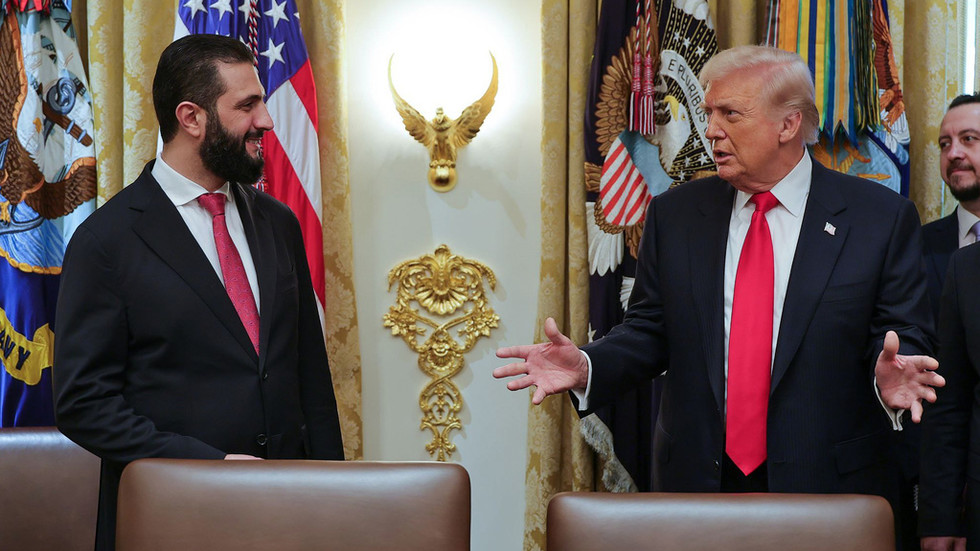
Al-Sharaa’s visit to Washington was hailed as historic – yet behind the smiles lie sanctions, red lines, and a fragile balance of power
For decades, Washington treated Damascus as untouchable. Now, for the first time since Syria gained independence in 1946, a Syrian head of state has walked through the doors of the White House. Interim President Ahmed al-Sharaa’s official visit to Washington marks a remarkable moment – not only for Syria-US relations, but for the broader political landscape of the Middle East. A handshake that would have been unthinkable just a few years ago now signals a subtle but significant shift in how the West perceives Damascus.
This was already the third meeting between the two leaders in less than a year. Their first encounter took place in May during a meeting of the Gulf Cooperation Council, and the second occurred in September at a dinner at the UN General Assembly in New York. Against that backdrop, al-Sharaa’s current visit looks like the next step in a dialogue that has become structured, pragmatic, and increasingly institutionalized.
The historical context makes the meeting even more striking. The last senior Syrian official to set foot in the White House was then-Foreign Minister Farouk al-Sharaa in 1999, who took part in peace talks with Israel under the administration of President Bill Clinton.
Farouk – a cousin of Ahmed al-Sharaa’s father – was a key figure of the ‘old guard’ from the Hafez Assad era and later served as vice president under Bashar Assad until 2014, when his path diverged from that of the ruling establishment.
That lineage adds another layer of meaning to Ahmed al-Sharaa’s appearance in Washington. The family name once associated with Ba’athist orthodoxy is now linked to a new generation of Syrian leadership seeking pragmatism and legitimacy in global politics.
Al-Sharaa’s visit carried both diplomatic and symbolic weight. It represented a reappraisal of Syria’s place in the region’s balance of power. The timing was significant: Only a week before the trip, al-Sharaa was removed from the US Treasury Department’s list of ‘specially designated global terrorists’, where he remained for over a decade. His transformation from an Islamist dissident to a pragmatic leader capable of mediating among rival power centers – both domestic and foreign – has become a defining feature of Syria’s new political reality.
During the White House meeting, US President Donald Trump alluded to his guest’s past with a characteristic shrug: “Everyone has a difficult past,” he said, setting a tone of blunt pragmatism that resonated throughout the visit. Political calculus, not ideology, was the real engine behind the renewed dialogue.
Al-Sharaa himself handled the issue directly but without defensiveness. In an interview with Fox News, he noted that he was only 19 during the tragic events of September 11, 2001 – “very young,” as he put it – and that the following years were a period of personal and ideological transformation. He deliberately positioned himself as a man who outgrew radicalism and embraced statecraft. According to al-Sharaa, his discussions with the US president focused “not on the past, but on the present and future of Syria,” which Washington increasingly sees as both a geopolitical actor and a potential economic partner.
Soon after his visit, the White House took concrete steps: The US partially eased sanctions, allowing the export of most civilian goods – including American software and technology – to Syria. The move, though largely symbolic, suggested a willingness to test new terms of engagement.
In al-Sharaa’s own words, these measures reflected a “new perception” of Syria. Once seen primarily as a pariah state and a source of regional instability, Syria is now being re-evaluated – at least in certain circles in Washington – as a possible partner for stabilization and post-war reconstruction. The Syrian leader underscored that the gas sector could become a key field of cooperation between Damascus and Washington. “Syria has entered a new era,” he declared, “and this will build on a new strategy with the United States.”
Yet, behind this rhetoric of optimism, the situation is far from straightforward.
A cautious thaw under tight constraints
Despite bold talk of sanctions relief, the reality is far more limited. Washington has only suspended a few provisions of the Caesar Act for 180 days – a temporary measure authorized by Secretary of State Marco Rubio. According to an official statement from the Treasury’s Office of Foreign Assets Control (OFAC), sanctions continue to apply to any cooperation involving Syria’s partners in Moscow or Tehran.
Moreover, any export of dual-use goods still requires special approval from the US authorities. In practice, this means Washington continues to maintain a firm economic grip on Damascus. Talk of “restoring sovereignty” sounds at this stage more like diplomatic rhetoric than a genuine policy shift.
The partial lifting of sanctions is a political gesture – a way for the Trump administration to test al-Sharaa’s pragmatism without committing to a full reset. Syria’s leadership understands this perfectly well. As much as Damascus wants to restore trade and attract investment, it also recognizes that the Caesar Act remains a powerful lever for Washington to dictate the terms of engagement. This asymmetric dynamic leaves Syria in a gray zone – formally sovereign, but still economically dependent on external approval.
The Israeli question: An unmovable line
A second and perhaps even deeper obstacle lies in Syria’s unwavering stance on Israel. While al-Sharaa’s rhetoric has been noticeably moderate – he called on West Jerusalem to “exercise restraint” following Israeli airstrikes – he has categorically refused to join the Abraham Accords. For Washington, this came as a disappointment: The White House had hoped that Syria might be ready for gradual normalization with the Jewish state. But for Damascus, the matter is non-negotiable.
The Golan Heights remain, in Syrian eyes, occupied territory, and peace with Israel is impossible until the issue is resolved. This position is embedded in Syria’s national identity and political culture. No government – whether that of Hafez Assad, Bashar Assad, or Ahmed al-Sharaa – can afford to renounce it without losing legitimacy at home.
The Kurdish factor: An enduring fault line
The Kurdish issue remains another unresolved pillar of Syria-US relations. For years, Washington has relied on Kurdish forces in northeastern Syria as its key local ally in counter-terrorism operations. Damascus, however, views Kurdish autonomy as a direct challenge to Syria’s territorial integrity. These regions, rich in oil and gas, also represent a vital economic resource that Damascus cannot easily concede.
The US, regardless of administration, has shown no intention of withdrawing from Kurdish-controlled areas. Both Democrats and Republicans see their presence there as a strategic foothold. As a result, any dialogue between Washington and Damascus will inevitably run into questions of internal sovereignty – an obstacle that no diplomatic handshake can easily resolve.
Economic reconstruction: Promises and paradoxes
Economically, Syria stands on fragile ground. The country’s reconstruction needs are enormous – with estimates reaching hundreds of billions of dollars. Ironically, much of the damage was caused by military campaigns launched or supported by the US and its allies. This makes the issue of funding reconstruction both politically and morally charged.
For the Trump administration, the idea of large-scale investment in Syria is a non-starter. With budget constraints at home and opposition in Congress, Washington’s willingness to underwrite rebuilding efforts is minimal. Even among Trump’s advisers, skepticism runs deep. Many believe al-Sharaa’s status as ‘interim president’ is too uncertain to justify long-term engagement. The prospect of a new political reshuffle in Damascus makes American investment a risky bet.
For Damascus, however, the logic is different. Economic cooperation – even limited – signals legitimacy and political rehabilitation. Al-Sharaa’s government hopes that selective easing of sanctions could attract Gulf or European investors, opening pathways that remain formally consistent with US policy. Yet, without a full lifting of restrictions, Syria’s economy remains confined to a narrow channel, its growth potential limited by Western approval mechanisms.
Balancing great powers: A pragmatic strategy
Contrary to early Western predictions, al-Sharaa has not broken ties with Russia, nor has he tilted fully toward the US. His approach has been marked by deliberate balance – a state-centric pragmatism that seeks stability rather than ideological alignment.
His first official visit after taking office was to Moscow, where he met with President Vladimir Putin and reaffirmed the continuity of strategic cooperation. Only afterward did he travel to Washington. The order of these visits was symbolic: It underscored Syria’s intention to preserve its partnership with Russia while opening a new channel to the US.
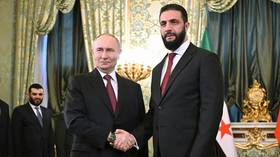
Al-Sharaa has also made clear that he supports Russia’s continued military presence in Tartus and Khmeimim, calling it a stabilizing factor in Syria’s security architecture.
In his view, Russian bases act as deterrents against extremism and external interference – an argument that finds tacit understanding even among other regional actors, from Türkiye to the Gulf monarchies. These countries, while wary of Moscow’s influence, recognize that the Russian military footprint contributes to regional balance and prevents the re-emergence of chaos.
Relations with Iran remain the most delicate dimension of al-Sharaa’s foreign policy. While Syria and Iran shared close ties during the war, Damascus has lately shown caution in its dealings with Tehran. The new administration appears intent on redefining this relationship in more transactional, less ideological terms.
Analysts suggest that Moscow now serves as a quiet mediator between Damascus and Tehran, helping to smooth tensions and coordinate regional diplomacy. This triangular dynamic – with Russia balancing between Iran and Syria – is acceptable to other regional powers as well, including Türkiye and the Gulf states, all of whom seek to prevent another destabilizing escalation.
The White House, too, is aware of these undercurrents. Despite rhetoric about Syria’s ‘democratization’, Washington understands that pushing Damascus away from Moscow could easily backfire, reigniting the very instability the region is trying to contain.
A leader of balance in a fragmented world
Taken together, these developments reveal a Syrian leadership that is learning to navigate the multipolar order with growing sophistication. Ahmed al-Sharaa has positioned himself as a careful tactician – neither a Western client nor a Russian, but a regional player seeking maneuvering space between great powers. His foreign policy is built on cautious multi-vector diplomacy aimed at one overriding goal: Safeguarding Syria’s sovereignty and security in a world where both are constantly under pressure.
In that sense, his visit to Washington was indeed historic. It broke long-standing taboos, softened rhetoric, and produced a few tangible outcomes. But to call it a new era in Syria–US relations would be premature. Deep structural contradictions – sanctions, Israel, the Kurds, and reconstruction – remain unresolved. Until these are addressed institutionally rather than symbolically, the partnership will stay limited and fragile.
Ahmed al-Sharaa’s trip may have opened the door to dialogue – but for now, that door remains only half-open.
Read the full article here