


ALBANY, New York — President Donald Trump’s long-term bromance with New York City Mayor Zohran Mamdani has scrambled Republicans’ collective effort to make the democratic socialist the boogeyman of the midterm elections.
GOP candidates across the country have sought to tie their opponents to the 34-year-old mayor, his anti-Israel views and his brand of socialism — a bet that American voters will reject the Democratic Party’s leftward tilt.
The effort began in earnest last year when the House Republicans’ campaign arm wasted little time launching ads in 49 swing seats nationwide, tying the then-mayor elect to Democratic candidates and warning that a “radical-left earthquake just hit America.” In the race for a hotly contested suburban New York City district held by Rep. Mike Lawler, a House GOP super PAC launched an ad linking his Democratic challenger Cait Conley to the mayor. On Long Island, Republican Mike LiPetri has slammed Mamdani’s “socialist wish list.”
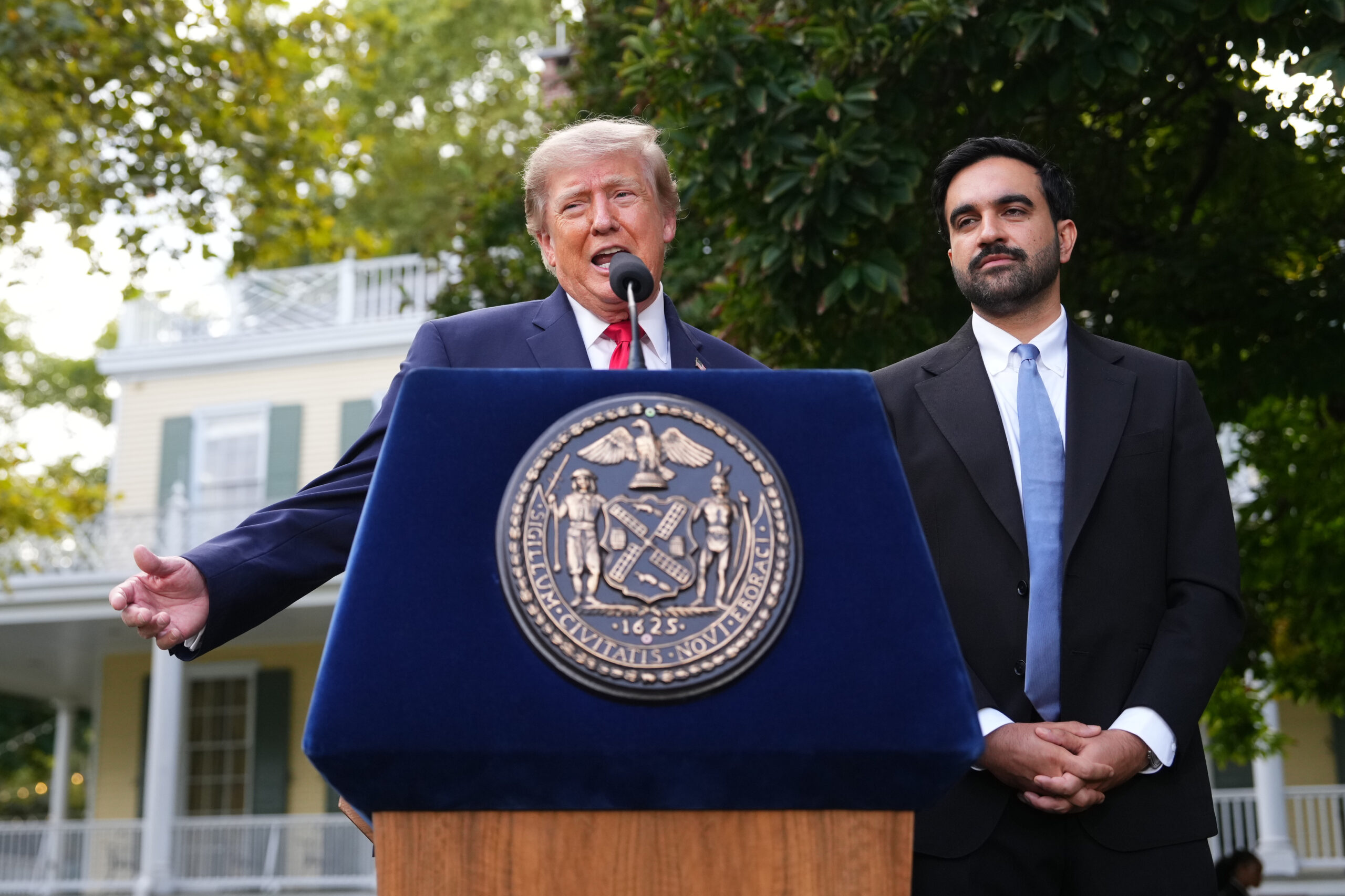
Such attacks are significantly harder to make after Trump, who retains tremendous sway over the Republican base, stood beside Mamdani at Gracie Mansion on Monday and said the mayor has “great potential” and that he’s rooting for his success. The plaudits from the president could not have come at a worse time for a GOP struggling to maintain control of Congress.
“Mamdani is one of the most popular politicians on planet earth right now,” said Chapin Fay, a GOP operative working for a super PAC allied with New York Republican gubernatorial candidate Bruce Blakeman. “Everything that comes out of his mouth I stand against, but he’s good looking, he knows how to operate the media, he’s an incredibly dangerous threat. But you need a good villain to run against in politics, and he’s just not a good villain.”
Still, Republicans aren’t making adjustments. GOP campaigns don’t necessarily expect voters to be turned off by Mamdani specifically, but by a broader concern over the perception that the far left is surging after a string of primary victories by candidates backed by the Democratic Socialists of America. Running against a rising socialist tide is viewed as much easier than competing against the New York City mayor himself.
“That dynamic hasn’t changed,” said one New York Republican operative who was granted anonymity to discuss strategy. “It’s still a very salient issue in the New York City suburbs.”
In a statement, a White House spokesperson touted Trump’s economic record, including tax cuts and addressing prescription drug costs.
“The President’s top priority is always improving the lives of Americans everywhere,” White House spokesperson Allison Schuster said.
The jarring union between two deeply polarizing politicians is an unwelcome splitscreen for Republicans in tough races trying to yoke their moderate opponents to Mamdani’s hard-left image. And their bond has effectively neutralized what could have been a potent weapon for Republicans in a midterm election that increasingly appears dire for the GOP. Polls are showing tightening races in deep red states, while swing seat Republicans need every bit of political ammunition they can muster to counter Democratic attacks over affordability.
The conundrum is particularly complicated for Republicans in deep blue New York, home to several swing districts where the upcoming electoral outcomes stand to determine which party controls the House and the direction of the president’s final two years in office.
It’s an especially thorny challenge for Blakeman, who’s running an uphill campaign against Democratic Gov. Kathy Hochul and has tried to paint the incumbent as a Mamdani fellow traveler. Blakeman’s campaign has released artificial intelligence-generated videos of Blakeman and Mamdani walking side by side, accusing them both of enabling New York City’s destruction. He’s admonished the governor for helping bolster the city’s finances — enabling the mayor’s agenda as a result.
Losing Mamdani as an effective foil, GOP strategists warn, undermines Blakeman’s ability to make that argument against the Democratic governor, who’s leading in the polls.
“It’s very bad for him,” said a Republican operative granted anonymity to speak frankly about the dynamic. “He’s supposed to be the Trump guy and here’s Trump praising Mamdani as a guy with a lot of potential. It seems to have really shocked people all over the state. It really deflates his entire campaign basis.”
Blakeman shrugged off the Gracie Mansion lovefest, insisting to reporters a day later that it had no impact on the race — or his effort to paint Hochul as a far-left radical aligned with the mayor.
“The president is a government official. He’s the highest government official in the United States,” Blakeman said. “And the mayor’s a government official, so I expect that the two of them would talk.”
It’s not the first time a Trump-Mamdani sitdown sapped a Republican’s effort to inject the New York City mayor into their campaign. Rep. Elise Stefanik’s short-lived gubernatorial campaign was short-circuited in part by the lovefest, when the president declined to repeat her claim that Mamdani is “a jihadist.”
For many of those who’ve been in Trump’s orbit, the relationship is a broad reminder that the president continues to harbor a fixation with his hometown where for decades he was a larger-than-life real estate developer.
“One thing you can always count on is that Donald Trump, in spite of everything, loves New York City,” said Michael Caputo, a former Trump administration official and Republican strategist. “I don’t think he’d ever give up on [New York City]. If that makes it a little difficult for some people in their races, I’m sorry, but that was baked into this presidency 50 years ago.”
Trump, who had toyed with running for mayor and governor during his days as a Manhattan developer, has tried to influence New York City’s fate throughout much of his life. He endorsed Mamdani’s main foe in last year’s mayoral election, Andrew Cuomo, warning voters in the financial capital of the world to not elect a socialist. His administration tried unsuccessfully to halt a Manhattan toll plan meant to reduce traffic. And the federal government’s push to redevelop the catacomb-like Penn Station may end up with the president’s name on it.
His meetings with Mamdani have reflected back that intense interest in the five boroughs.
The Trump-Mamdani rapport was forged months ago during their first Oval Office meeting in November. There, the president and the incoming Gotham mayor posed in front of Franklin Roosevelt’s portrait. At their second meeting in February, Mamdani gifted Trump a fake tabloid front page with the headline “Trump to City: Let’s Build” and discussed how to change New York City’s byzantine zoning laws to enable development.
During their most recent meeting the two men discussed building thousands of housing units on top of a Queens rail yard.
“He may not be one of the city’s most popular residents, but he’s never going to quit on New York City,” Caputo said. “It’s never going to matter who the mayor is.”
For similar reasons Mamdani has faced little political downside from the solicitous meetings with a president who most Democrats view with toxicity. The mayor entered office with scant executive experience and has been under pressure to prove he can govern. Trump’s federal government can provide money to help deliver wins for him in City Hall. Much like the president, Mamdani maintains support from an enthusiastic base.
“There’s no danger — his base gives him a complete pass for this,” Democratic strategist Trip Yang said. “There’s no progressive organization that would criticize Mamdani for this. He’s been able to demonstrate some early progress and some potential with Trump.”
Interest has already started to wane in leveraging Mamdani as a villain in Republican campaigns. For suburban New York City voters concerned about public safety and antisemitism, the mayor remains a divisive figure. While a recent Siena Research Institute poll found he has a 60% favorable rating in New York City, only 43% of voters in the suburbs feel the same way.
And some Republicans believe the meetings with Mamdani may have the effect of sanding down some of Trump’s rougher edges — weakening Democratic efforts to demonize the president in the process.
“It works both ways,” former GOP Rep. John Sweeney said. “If one guy is a boogeyman, the other guy is a boogeyman on the other side.”
Read the full article here