


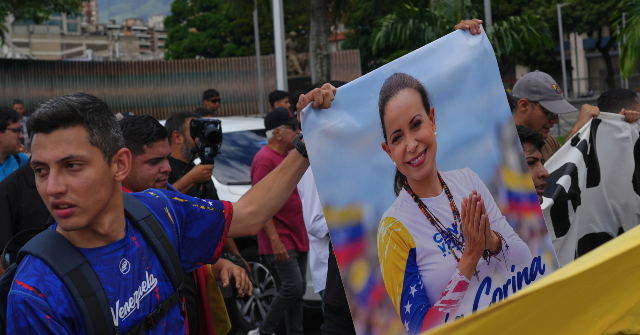
A group of Venezuelan citizens on Thursday peacefully protested in Caracas to demand that the nation’s socialist regime sets a date for a new presidential election in the country.
The protesters also demanded that the Venezuelan regime allow the safe return to the country of anti-socialist opposition leader María Corina Machado — a demand that comes hours after reports published by international outlets indicated Machado was “blocked” from returning to Venezuela three times this week.
Noticias Venevision reported that the peaceful protesters gathered near Caracas’ Plaza Venezuela where a branch of the National Electoral Center (CNE) is located. Like all other Venezuelan state institutions, CNE, the nation’s top electoral authority, has long since been under the control of the ruling socialist regime and has played a key role in the numerous sham elections held by the regime during the rule of deposed dictator Nicolás Maduro.
Protesters demanded that CNE set a clear date for a new presidential election, affirming that they are ready to participate in the process and defend their vote. Additionally, participants called for the restoration of all institutional guarantees in the country and the safe return of all exiled politicians and dissidents, including María Corina Machado.
Footage published by Venezuelan journalists on social media show the protesters chanting “Elections Now” and “Out with Delcy [Rodríguez],” who has been in charge of the Venezuelan socialist regime since Maduro was arrested by U.S. forces in January. Other protesters chanted in favor of Machado, demanding her safe return to Venezuela. Hours after the protest, the Colombian news channel NTN24 reported that it had obtained access to a document from the Venezuelan regime’s SAIME Migration Service indicating that the entry ban imposed on Machado has been recently lifted. Machado, nor any member of her center-right party Vente Venezuela, has publicly commented on NTN24’s report at press time.
Thursday’s protest outside the CNE offices in Plaza Venezuela occurred just hours after “Acting President” Delcy Rodríguez affirmed before the United Nations General Assembly in New York that Venezuela is undergoing a “democratic transition process that includes new elections.”
“I wish to say the following loud and clear at this General Assembly, in Venezuela, there will be elections,” Rodríguez said. However, she did not announce a date for the election and instead claimed that it will be up to the “Venezuelan people, with its age-old wisdom” to determine the “correct” time for the electoral process.
No CNE official has publicly commented on Rodríguez’s announcement at press time.
The legitimacy of Delcy Rodríguez as “acting president” of Venezuela remains a controversial subject in the South American nation since she served as Maduro’s vice president while the dictator was illegitimately clinging to power by holding a sham election in 2024. The Venezuelan Supreme Court — also controlled in its entirety by the ruling socialists — appointed Rodríguez as “acting president” in the immediate hours after Maduro was arrested.
The appointment, according to multiple outlets, was of a temporary nature and with a maximum duration of 180 days as per Venezuelan law, after which new elections must take place when the “absolute absence” of a president has been declared. While the 180-day deadline expired on July 3, 2026, international outlets have pointed out that Venezuela is currently in an unprecedented constitutional scenario — particularly after the socialist-controlled Supreme Court defined Maduro’s arrest as a “forced absence” and not as an “absolute” absence as defined by Venezuela’s current constitution, which was also drastically changed by the ruling socialists in 1999.
Rodríguez met with President Donald Trump on the sidelines of the U.N. General Assembly earlier this week. Hours after the encounter, the U.S State Department’s Spanish-Language Spokesperson Natalia Morano clarified to EFE that Trump’s meeting with Rodríguez does not grant legitimacy to the “acting president” or her interim administration. The spokesperson reiterated that a future free election is part of the U.S. government’s three-phase plan towards restoring democracy in Venezuela.
“The purpose is not to give her legitimacy. We know that she has not been elected by the Venezuelan people,” Morano said, and added, “It doesn’t matter that there was a meeting. The strategy remains in place.”
The subject of free and fair elections in Venezuela following Maduro’s downfall has also been brought up by other regional leaders throughout the ongoing 81st session of the U.N. General Assembly. On Wednesday, Paraguay’s conservative President Santiago Peña called for his Latin American neighbors to concentrate efforts so that can Venezuela can hold free elections and fully return to democracy after nearly three decades of socialist rule — extending similar calls for Cuba, Nicaragua, and Haiti.
Speaking with Martí Noticias on Thursday, Bolivian President Paz called for authorities to set a date for elections in Venezuela. Paz used his debut speech at the U.N. General Assembly that day to aggressively condemn socialism which ruined his country for two whole decades and plunged it into abject poverty and a dire economic situation that his administration is continuously working to overturn.
“The election dates must be clearly set, and that sends a positive message both internally in Venezuela and externally to the world; second, there must be free participation,” President Paz told Martí Noticias. “If Ms. Corina [Machado] launches a movement and establishes a framework to propose an alternative for Venezuela, she has every right to do so alongside other candidates, but the important thing is to establish guidelines.”
“I think that in Venezuela they’re now focusing on local elections, but we need to determine when the national elections will take place and under what terms,” he continued.
Similarly, Ecuadorian President Daniel Noboa made calls for an election date to be set in Venezuela in remarks shared with Martí Noticias while also expressing his support for democratic change in Cuba.
“But of course, there should be free elections, and I think a date should be set — perhaps not in the very near future, but a date for elections should be set in Venezuela and also in Cuba,” Noboa said.
Read the full article here