


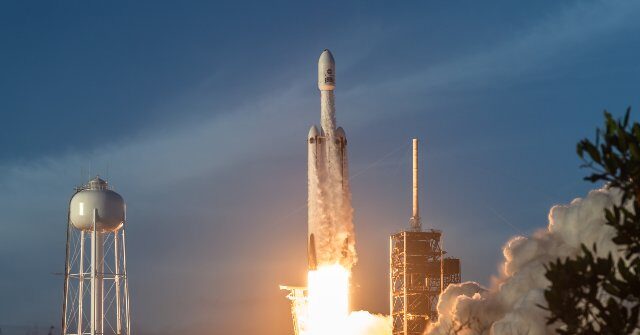
Google is preparing to launch a satellite carrying its AI chips into orbit, part of an early test of whether space could someday host AI data centers.
The New York Times reports that Google’s launch is part of “Project Suncatcher,” the company’s experimental effort to explore putting AI infrastructure in orbit. The satellite is fitted with Google’s Tensor Processing Units and is scheduled to launch October 1 on a SpaceX Falcon 9 rocket. It will circle Earth in low orbit, drawing power from the sun.
Google says the point of the flight is to see how the chips hold up, and whether the hardware can, in the company’s words, “handle the physical stress of spaceflight and the radiation and thermal extremes of space.” As Google put it, “some things can only be tested in space.”
Ground testing has already turned up encouraging signs: Google found its TPUs can tolerate substantial g-forces and radiation exposure. Heat is a tougher problem. It’s harder to simulate on the ground, and it may be the biggest hurdle for the whole project. With this launch, Google will also try out a cooling system built around heat pipes and radiators, run while the chips are actually in orbit.
Travis Beals, Project Suncatcher’s senior director of product management, told the Times that “the chips can only run for about 15 minutes before they’ll need to be turned off to cool down.” Fifteen minutes is a tight window for anything resembling sustained computing, which is why Google is treating this launch as a first step rather than a finished system.
Beals framed the mission in those terms in Google’s own announcement. “Exploring space as a viable location for scalable AI compute won’t happen all at once,” he wrote. “It takes methodical engineering, starting with proving our hardware can handle the physical and unpredictable realities of operating in orbit. This first launch is about seeing what works, identifying points of failure, and applying those findings to future missions.”
Google’s ambitions extend beyond a single satellite. The company envisions eventually launching a constellation of chip-carrying satellites, and it has already committed to putting two more into orbit next year.
Google isn’t alone in this. Elon Musk, Jeff Bezos and former Google CEO Eric Schmidt have all floated space-based data centers as an alternative to Earth-bound ones, which need large amounts of land, power and cooling to run.
AI data centers and the integration of this technology is changing the political landscape. Space could be an ideal location for the data centers of the future, as opposed to America’s heartland and suburban neighborhoods throughout the country. Breitbart News social media director Wynton Hall has written his New York Times bestseller Code Red: The Left, the Right, China, and the Race to Control AI to serve as the definitive guide on how the MAGA movement can create positions on AI that benefit humanity without handing control of our nation to the leftists of Silicon Valley or allowing the Chinese to take over the world.
Read more at the New York Times here.
Lucas Nolan is a reporter for Breitbart News covering issues of AI, free speech, and online censorship.
Read the full article here