


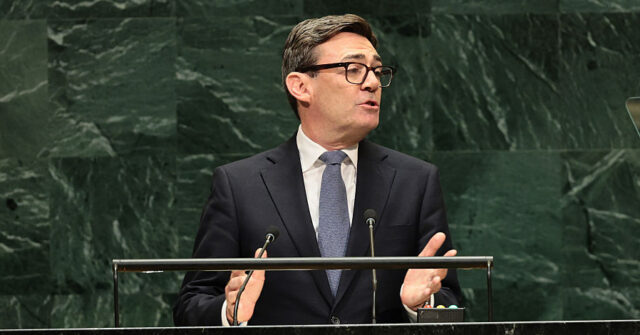
The belief that the United Kingdom is experiencing decline, the view that there are negative elements to modern life, and the feeling of unrest after terror attacks are among “far-right narratives” pushed by Russian intelligence that bear “no resemblance to reality,” Prime Minister Andy Burnham declared as he announced plans for a new National Centre for Information Defence.
The UK has more experience than most Western countries in being attacked with information warfare and will establish a new government body to disrupt “hostile state information attacks”, Andy Burnham said during his address to the United Nations General Assembly on Tuesday, while tipping that this model could be exported to other countries to protect them from unwelcome information as well.
Though the wide-ranging speech touched on a series of issues, the lion’s share of the new British Prime Minister’s speaking time was spent explaining how narratives contrary to his view of modern Britain not only bear “no resemblance to reality”, but are engineered by foreign powers to undermine national security.
The country’s deeper experience in this sort of warfare goes back ten years, Burnham said — not naming the defeat of progressive sentiment in the Brexit referendum ten years ago in 2016, but tacitly implying this was the first battle in this shadow war against information — stating British elections had also been targeted by Russia.
Because there is “no national security” without a cohesive society to build it on, Burnham said the level of threat he intended to fight justified extraordinary reach for this new information control body, stating:
The Kremlin spends about £1.3 billion each year on manipulating information. We’re talking about an insidious campaign that reaches into people’s homes and twists what they feel about their own country and community, creating a narrative of decline, stoking division, and sowing despair… we are going to help our people to strengthen their resilience, because faced with their information warfare, security starts in every home.
The variety of opinions being forced on unsuspecting Britons by Russia was, the Prime Minister said, considerable, and conveniently aligns reasonably neatly with practically everything his Labour Party stands against.
This “industrial-scale assault by hostile actors on the information environment in the UK” by “Russian agencies” includes spreading disinformation to prey on ordinary people’s fears, he said, and amplifying “far-right narratives” by stoking “tensions and unrest in the wake of horrific events”, terror attacks.
The “narrative of decline” and any feeling of “despair” about the state of modern Britain is a “corrosive narrative about life in Britain which bears no resemblance to reality”, the Prime Minister said, announcing:
… we will put in place the architecture to stem this poisonous tide. Today, I am asking our security chiefs in the UK to begin work on a new National Centre for Information Defence. To detect, attribute, and disrupt these kinds of hostile state information attacks. To support and defend democracy. I know this is a shared challenge, so we are going to use our experience in the UK, and the fact we have already been through this shock, starting ten years ago, to help other countries.
… as more elections approach across Europe more nations are grappling with these issues, some for the first time. So we are ready to share our understanding of how these actors work, and how we can respond, because this is a vital task for our collective security and resilience. To overcome division and instability, we must also find new ways to bring countries together. We know we are at our strongest when we unite with others, when we reach across borders to solve shared problems.
Britain, like most Western nations, already has a range of information-control organisations, and expanded that arsenal during the Coronavirus era. As noted by the Free Speech Union, which called the Prime Minister’s initiative perhaps “the most censorious thing a modern British government has done:
We already have NSOIT, the Government Communication Service, the Media Monitoring Unit, RICU, the Defending Democracy Taskforce, the Joint Election Security and Preparedness Unit, the FCDO’s Information Threats and Influence Directorate, 77th Brigade, NCSC/GCHQ, the National Cyber Force and the Social Cohesion Taskforce. Is that not enough? How do we know this new body won’t be weaponised to silence dissent and chill free speech? Will it reprimand the Government itself?
… We should remember that more than 62,000 people have reportedly been arrested for “speech offences” in Britain over the past five years — including social media posts… The Government needs to explain exactly what powers this new Centre will have, who decides what constitutes an “untrue narrative”, and what safeguards will prevent it from becoming a tool for policing lawful dissent. 2026 Britain is turning more into 1984 by the day. We literally now have a Ministry of Truth.
Brexit’s Nigel Farage also responded to the Labour plan to clamp down on information, acknowledging there are indeed bots from “Russia, India and elsewhere” that try to influence elections, but warning the left-wing government would inevitably try to control Britons.
He said: “You know what will happen with this government. Already he’s said it will be to stop ‘far right tropes’, etcetera. This will be like George Orwell’s ‘Ministry of Information’. This will be used to clamp down on free speech, and the one lesson I’m learning as time goes on, whether it’s funding of parties, whether it’s cancelling elections, is never, ever trust this authoritarian government.”
Indeed, references to George Orwell’s 1984 — which, among other things, is a long-established and universally understood warning against the Stalinist impulse of government to control truth — abounded in response to Burnham’s speech, prompting government ministers to go on the defensive on Wednesday morning. Intemperate Burnham ally Wes Streeting, recently elevated to defence minister, told broadcaster GB News that Britain has a democracy, whereas Russia does not.
He said: “Russia is just one of a number of malign state and non-state actors that seek to threaten and disrupt our democracy, including through misinformation and disinformation… We’re not interested in policing domestic political dissent.”
He further told the BBC Today Programme: “What we need to do is not just better co-ordination at the centre of government, but the better mobilisation of the whole of society. And that’s supporting the public to separate fact from fiction”.
Read the full article here