


The Breitbart Business Digest Weekly Wrap: Warsh Hiked Two Interest Rates
Welcome back to Friday!
This was Fed week. As just about everyone expected, the Federal Open Markets Committee (FOMC) raised the fed funds rate by one-quarter of a percentage point. The Fed also released the Summary of Economic Projections showing that Fed officials are becoming more confident about real economic growth and the labor market. The media desperately await a freak-out from Trump that never arrived. Maybe the president actually likes growth, even if it comes with a rates running a bit higher.
Let’s go.
Kevin Warsh Lowered Long Term Rates
The Federal Reserve raised interest rates this week. Or did they? The Fed definitely raised two interest rates: the overnight federal funds rate it targets and the interest on reserves rate it sets. But the 10-year Treasury yield that serves as a benchmark for mortgages and corporate debt barely moved. It closed on Thursday at 4.9470 percent, down from the previous Friday’s close of 4.9750 percent. On Friday afternoon, as we prepared this newsletter for you before heading off for our weekly retreat into the woods, the 10-year yield was up to just five percent, slightly below where it was on the day the FOMC announced the hike.
The yield on the 30-year Treasury that everyone was weirdly obsessing about a week or two ago has dipped from last Friday’s close of 5.354 percent to 5.328 percent. In other words, longer term rates fell.
Higher for Longer
Arguably the most important thing to come out of the Fed meeting was a part of the Summary of Economic Projections (SEP) that hardly anyone looks at. Namely, the Fed’s longer-run estimate of fed funds rate. We know Fed chair Kevin Warsh does not really like the SEP and wants everyone to pay less attention, but we hope he’ll forgive us for continuing to watch it for a bit longer. If Fed officials are going to keep putting dots on the plot, we’re going to look.
The estimate of the longer run rate was in a pretty consistent decline for several years after the Fed started publishing it in 2012. This was the period of “secular stagnation” and “savings glut.” Economic big shots of various stripes, including almost everyone at the Fed, were convinced that the natural rate of interest, or the rate consistent with full employment and price stability, was in decline. Starting at 4.3 percent in 2012, it fell all the way to 2.5 percent by 2019.
After that, it got kind of stuck. This was interesting. It suggested that the Fed thought the fed funds rate should be just a half point above the inflation target. And, if you looked at where they were forecasting GDP growth, it was about 70 basis points above the economy’s growth rate. This did not change through the pandemic or the highly inflationary period afterward, which might explain some of the Fed’s slowness in reacting to the super high inflation of the Biden era. They didn’t think low rates could be causing much inflation because in their view rates just weren’t all that low even when they were near zero.
The estimate for the longer-run rate moved up to three percent in 2024 and then remained there until this summer. It climbed to 3.1 percent in March and to 3.2 percent at the last meeting
At the same time, the median forecast for the unemployment rate for this year and the next two years was revised down and growth revised up. Core PCE inflation was revised up by 0.1 percentage point for 2026, unchanged for 2027, and up 0.1 percentage point in 2028. The longer term inflation estimate was unchanged at 2.0 percent of course. Which means the Fed now thinks the fed funds rate should be 1.2 percentage points higher than the inflation target. That’s more than double what it was from 2019 until 2024. This is the story of the forecast for the real economy strengthening and real rates moving higher. The PCE inflation forecast is not meaningfully higher.
More Growth, Less Unemployment
The SEP also showed that Fed officials now expect more economic growth and lower unemployment.
When the Fed first started including the median forecast for GDP growth in the summer of 2015, it had the longer-run tendency at two percent. In September of the following year, they dropped this down to 1.8 percent. And it stayed there, more or less, until March of this year, around nine a half years later, when it moved up to 2.0 percent. That might seem like a small change, but if you compound that over a decade, you are talking about a major difference in the size of the U.S. economy.
This is all the more important because Fed officials know that changes in our immigration policy and the retiring baby boomers will mean that labor force growth is likely to be low or even negative in the years ahead. Many economists criticized President Trump’s immigration restrictions on the grounds that it would reduce economic growth. Instead, Fed officials now expect more growth. That means they think growth will come from improved productivity growth. It also means the per capita growth picture is even better than it was when Fed officials were likely assuming immigration-driven population growth.
The near-term projections also improved. In June, the Fed was projecting 2.2 percent real growth this year and 2.3 percent next year. Now they see the economy growing 2.3 percent this year and 2.4 percent next year. Even in 2028 and 2029, they see the economy growing above the long-term estimate of two percent. We wouldn’t be surprised if that longer-run estimate starts to climb again.
Finally, no Fed officials in the SEP see downside risk to their growth projections. The only risk to growth projections recorded is upside risk. That’s the first time this has ever happened.
Warsh Breaks the Phillips Curve
Warsh’s discussion of the economy at the press conference made it very clear that he does not view business investment, capital expenditures, AI boom, or low unemployment as inflationary. The inflation discussion was separate from the growth discussion. This is an extremely important sign that he does not believe in the Phillips Curve, the theory that too much growth or too much employment causes prices to rise.
And it isn’t just Warsh. The median inflation projection for next year shows a big decline with only one more hike and no increase in the unemployment rate and accelerating growth. Non-inflationary growth is back, baby.
Trump Refuses to Follow the Liberal Media’s Script
President Trump wants interest rates to be lower. So when it became apparent that the Fed was likely to raise the fed fund rate, the legacy media began salivating for what they thought would be an inevitable attack from the president on his newly appointed Fed chair.
This was a trap. If Trump followed the script and attacked Warsh for agreeing to the hike, the media would have portrayed him as having not understood who he was appointing as chair. And the president would have been accused once again of endangering Fed independence, price stability, and the laws of gravity and thermodynamics by saying something mean about the chairman.
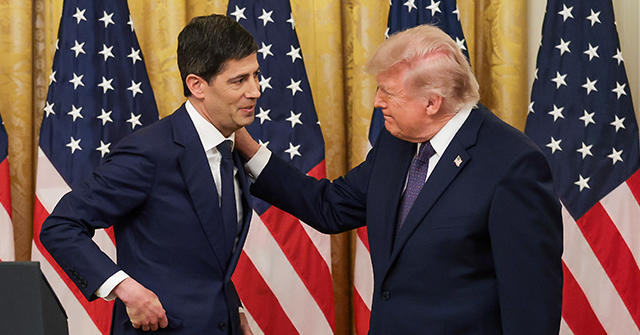
Wonderfully, Trump did not take the bait. Instead, he expressed confidence in Warsh. If you listened closely, you could almost hear the weeping of the financial press as they were forced to rewrite their stories depicting a fight between Trump and Warsh.
Breitbart Business History: The Stock Market Is Cooked
On September 18, 1873, Jay Cooke & Company closed its doors. The Wall Street firm that had helped finance the Union’s victory in the Civil War had exhausted its resources financing the Northern Pacific Railway.
Cooke had prospered by selling government bonds to Americans. Railroad bonds proved a harder sell. Construction required sums long before the tracks could carry customers, and Cooke’s firm had committed heavily to the project. Financial trouble in Europe prompted investors to sell American securities, making railroad financing difficult.
Cooke’s failure panicked investors, creditors, and depositors throughout the banking system. If the financier of the Union could go under, other bankers’ promises offered little comfort. Investors dumped securities, depositors demanded cash, and banks struggled to meet withdrawals.
A newspaper illustration depicts the scene on Wall Street outside the office of Jay Cooke & Company during the Panic of 1873. (Universal History Archive/Universal Images Group via Getty Images)
On September 20, the New York Stock Exchange shut down. Trading remained suspended for ten days. The panic spread across the country, and at least 100 banks failed.
Even the 10-day suspension was not enough to calm the panic. The damage continued after trading resumed. Railroad bankruptcies multiplied, businesses closed, and workers lost their jobs. Within two years, 18,000 businesses had failed. The railroad boom had added 35,000 miles of track between 1866 and 1873. The resulting depression outlasted the immediate banking emergency and continued to trouble the country through the remainder of Grant’s presidency.
Read the full article here