


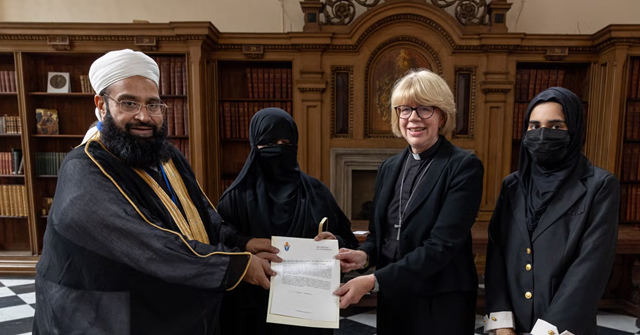
The Archbishop of Canterbury has rescinded an award handed over on the 25th anniversary of 9/11 to a Muslim cleric who praised Osama Bin Laden.
The head of the worldwide Anglican communion has been forced into an embarrassing climb-down after handing a prominent Church of England award to Pakistani Imam Hafiz Muhammad Tahir Mehmood Ashrafi. Given to the cleric last Friday, September 11th, the Hubert Walter Award was given for “reconciliation and interfaith cooperation” relating to “Imam Ashrafi’s longstanding support for religious minorities in Pakistan”.
Yet as critics quickly noted after an image of the newly installed Archbishop of Canterbury, Dame Sarah Mullally — the first female Archbishop in history — standing beside the Imam and his heavily veiled wife and daughter that even the most cursory due diligence check would have raised questions.
In 2007, Imam Ashrafi had said he would give 9/11 terrorist mastermind Osama bin Laden the honorific title ‘Saifullah’, which may be translated to mean “the sword of God” for his jihad against the infidel.
A spokesman for the Imam insists these comments are taken out of context, but even when considered so they are hardly flattering to the Islamic scholar. As noted by a report in The Independent, Imam Ashrafi had been the chairman of the Pakistan Ulema Council in 2007 when those remarks were made during protests across the Muslim world against Britain awarding a knighthood to Salman Rushdie.
Such was Imam Ashrafi’s upset with Britain honouring Rushdie — who remains under an Iranian fatwa for his Satanic Verses bestseller — he was apparently motivated to blast: “If a blasphemer can be given the title ‘Sir’ by the West despite the fact he’s hurt the feelings of Muslims, then a mujahid who has been fighting for Islam against the Russians, Americans and British must be given the lofty title of Islam, Saifullah”.
The Pakistan Ulema Council which Imam Ashrafi led has something of a chequered past as well. While it is today lauded by some for inferfaith dialogue in Pakistan, and now decries fatwas and jihad, this was not by any means always the case. The Action On Armed Violence NGO says of the organisation in their global counter-improvised explosive device [IED] project that the Council “has been criticised in the past for its support of some IED attacks”.
On the upside, that 2016 bulletin on the Council went on to observe “However, in recent years the Ulema have become more critical and raised their voice to condemn IED attacks, more and more often”, and that it had called groups including the Taliban, Al-Qaeda, and ISIS “ignorant and un-Islamic” in 2015. The following year, it issued its own fatwa against terrorism.
Criticism of the Church of England and the leader of the global Anglican communion, the Archbishop of Canterbury, went beyond simply the failure to have properly thought through the award, to observing the ever-accelerating decline of the institution itself. Brexit pioneer and Reform UK leader Nigel Farage lamented “Why, oh why, is the Archbishop of Canterbury giving an award to a man who praised Osama Bin Laden just a few years after the twin towers?” while his party colleague Robert Jenrick called the award a “catastrophic error”.
He said: “It must prompt a total rethinking of how the Church of England operates. They should prioritise Christian worshippers and stop kowtowing to Islamists.”
Top Reform thinker Danny Kruger, who is tasked with doing the behind-the-scenes work to make the party ready for government noted the Church of England is “out of touch with the country and with its own mission”.
The church exists to “defend and promote the Protestant Reformed religion, part of the universal Christian church. I’m not sure where giving awards to radical Muslim clerics fits in that”, he added.
National Secular Society spokesperson Alejandro Sanchez said: “It is obscene, and almost beyond parody, that the archbishop of Canterbury has awarded an Osama Bin Laden apologist an interfaith award on the anniversary of 9/11.
“This demonstrates appallingly poor judgement and is an insult to the victims of 9/11 and their families. Interfaith engagement must not mean overlooking support for extremism.”
A statement announcing the reward had been withdrawn on Thursday night included no apology by Lambeth Palace, the official seat in London of the Archbishop, but reflected only that “However, previous comments made by Imam Ashrafi have come to light that have led Lambeth Palace to reconsider this award and we can now confirm today that the award has been withdrawn”.
Read the full article here