


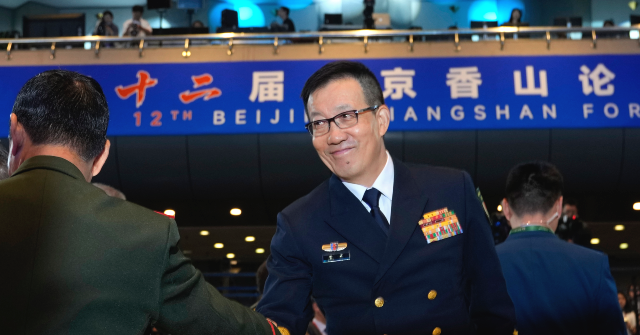
China’s premier annual defense conference, the Beijing Xiangshan Forum, was held from Tuesday to Thursday this week. A major topic of discussion among the roughly 2,000 attendees was the security risk posed by artificial intelligence (AI) technology.
China touts the forum, now into its 13th year, as an opportunity for “small and medium-sized countries” to weigh in on defense issues. It was launched in 2006 as an answer to the International Institute for Strategic Studies’ famous Shangri-La Dialogue, and there is considerable overlap in the guest lists for the two events.
Most of the attendees at the Beijing Xiangshan Forum are from Asian nations, but other parts of the world are represented. This year’s event included a spat between representatives from Saudi Arabia and Iran over the latter country’s wanton attacks on its Middle Eastern neighbors.
The U.S. had a delegation at the Xiangshan Forum, led by Brig. Gen. Stacy Kihara, a senior defense official with the U.S. embassy in Beijing.
Chinese Defense Minister Dong Jun issued a call for all nations to “avoid provocative acts” and curb “latent manifestations of hegemony, militarism, and historical revisionism,” but he was not talking to the Iranians — he was taking a thinly veiled shot at Japan. China has been hysterically fearmongering about resurgent Japanese militarism ever since Prime Minister Takaichi Sanae said Japan might respond to a Chinese attack on Taiwan.
With these regional theatrics out of the way, many attendees at the forum said they were worried about tech issues like drone warfare and artificial intelligence. A commonly-expressed concern was that AI and drone technology is making warfare move more quickly, thus reducing the window for human decision-making and increasing the risk of escalation.
“Artificial Intelligence accelerates decisions while disinformation and misinformation can fracture public trust before governments are even able to respond effectively,” cautioned Pakistani Defense Secretary Muhammad Ali.
“As weapon systems become increasingly autonomous, the need to preserve human judgment and control over the use of force becomes more pressing,” said International Committee of the Red Cross Vice President Jurg Lauber.
“The technology race is heating up, be it in artificial intelligence, space, or robotics,” said Singapore’s defense minister Chan Chun Sing, noting that major advances are now made in “days, not years.”
“The true test of statecraft is this: How do we strengthen our own security without weakening the security of others, or without aggravating the insecurity of others?” he said.
Attendees at the Chinese forum were curious about whether or not bilateral progress on military tech issues would be made when Chinese dictator Xi Jinping visits the U.S. for meetings with President Donald Trump on September 24.
In his speech to the forum, Dong said the nations of the world should “actively engage in security dialogue in areas including artificial intelligence, outer space, and the deep sea.”
Dong and other Chinese officials, including Vice President Han Zheng, said they wanted global governance rules for emerging tech domains like artificial intelligence. The U.S. recently accused China of stealing AI tech from American companies on a massive scale, an accusation China has denied.
Read the full article here