


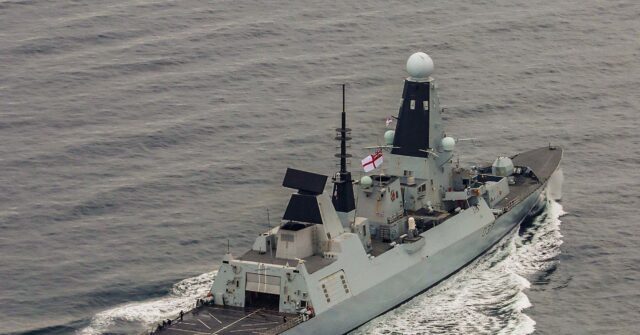
Controlling the sea is “existential” to Britain and the country needs “a new Atlantic fleet” to be in with a hope of surviving the strategic challenges of this century, one of the country’s most senior military officers said.
General Sir Gwyn Jenkins, a top Royal Marines officer who is Britain’s First Sea Lord — the professional head of the Royal Navy — has said Britain needs to urgently get back to being a major naval power, as it can’t possibly hope to survive in the world without control of the sea.
While such appeals from the head of the naval service are, to some extent, to be expected as military chiefs jostle to get a slice of severely limited funding, the comments also come as Britain’s navy dwindles to a size not seen in generations, and depending on definition, in centuries.
The “prosperity, security, and influence” of Britain have for centuries depended on its ability to exert maritime power, Jenkins said, stating “The sea is not peripheral to Britain – it is existential”. In a speech in London marking the Battle of the Atlantic in the Second World War, the top officer noted sea power enabled Britain to hold on and keep fighting through the conflict even as Germany dominated continental Europe.
Leaders like Winston Churchill intimately understood the degree to which Britain is reliant on the sea, Jenkins said, adding: “Lose the war at sea and you lose the war. That was the warning of Admiral Pound, the First Sea Lord of the day – and it remains true now… If we are to prevail in the Atlantic again, we must strengthen our warfighting readiness and rediscover what it means to be a maritime nation”.
Making clear he sees Russia as a major opponent in the north and high Atlantic, the First Sea Lord reminded Britain that most of its food, as well as its imports of raw materials and finished goods come by sea, and the data which enables the digital economy is transmitted on submarine cables on the sea floor. All of this would be threatened by a competent enemy to gain leverage over Britain, he said.
Jenkins said war is not inevitable — “this is not the 1930s” — but said Britain was unnecessarily opening itself up to risk by shedding control of the domain which s the primary guarantee of its safety. He told the London meeting:
…the greatest threat to our security today is Russia. That threat is felt most acutely in the maritime domain – in the North Atlantic, in the High North. Russia retains advanced submarines that are increasingly difficult to track, long-range precision weapons, and specialist systems designed to operate deep underwater.
It is increasingly active in our domain, and we are spending increasing amounts of time and resource monitoring Russian vessels and the shadow fleet. On average, two Royal Navy warships are now being deployed every week for this purpose. Russia is probing, testing, and mapping. It seeks advantage in the grey zone, particularly around the critical undersea infrastructure on which modern societies rely.
Part of the General’s critique is one common to the discourse coming from many Western security leaders in recent years that, after a period of comparative peace, the wider public have come to see defence as something done by other people to other people, and which has no impact on their lives. When it comes to maritime, because the sea is so far removed from the daily experience of most Britons, they simply don’t consider how it underwrites practically everything they do.
Speaking out on what is called in naval circles ‘sea blindness’, Jenkins went on to say this would have to change, explaining: “The sea, the Atlantic, has arguably never mattered more to Britain. We are certainly much more reliant on it than we were in the 1930s. And yet it has become increasingly invisible in the public’s mind… We have made this huge progress seem effortless. But it was not effortless.”
The First Sea Lord’s speech, with its focus on Britain being unprepared for war and the need to re-engage the public is only the latest in a series of such remarks from British and European defence leaders since the 2022 Russian invasion of Ukraine. Summarising previous reports of these remarks:
Talk of imminent war stalks the discourse in the United Kingdom… Both NATO and Westminster have spent the past two years drumming the idea into the British public that the post-Cold War era is over and the West is now in a 1930s-like pre-war state, if not already in the prelude of ‘Hybrid war’. The leitmotif of these warnings is the coming conflict, be it successfully deterred or not, will be a “whole of society event” and young Britons will be a particularly important part of that.
… the head of the UK Armed Forces Air Chief Marshal Sir Richard Knighton made similar remarks. He added: “Sons and daughters, colleagues, veterans, will all have a role to play. To build, to serve and, if necessary, to fight. And more families will know what sacrifice for our nation means”.
The same day, the head of Britain’s foreign intelligence agency MI6 said it would now be acting like the Second World War SOE agency, which launched sabotage campaigns against enemies in Europe. The Director said: “At an operational level, we will sharpen our edge and impact with audacity, tapping into – if you like – our historical SOE instincts… We will never stoop to the tactics of our opponents. But we must seek to outplay them. In every domain. In every way.”
Read the full article here