


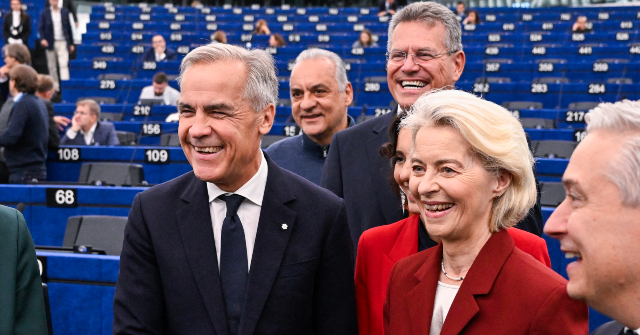
European Commission President Ursula von der Leyen offered Canadian Prime Minister Mark Carney a special “associate member” status in the European Union (EU) on Wednesday as Canada’s rift with the United States widens.
The Wall Street Journal (WSJ) reported on Saturday that Carney was making an “audacious bid” for Canada to take its relationship with the EU to the “next level.” According to this report, Carney began lighting up the phones of leaders across Europe months ago when Canada’s trade dispute with the United States grew more serious:
Carney has instructed his special envoy to Europe to scope out the most ambitious possibilities short of full membership in the EU or its common market, according to people familiar with the matter. The details are still being sketched by technical working groups for what the prime minister has told his aides will be the reorienting of an economy and a society that for half a century has been dominated by the U.S.
To European leaders, Carney has even suggested Canada take on a new title: “Associate Member of the European Union.” The EU, not known for its flexible enforcement of membership rules, is open to the idea, officials from both sides say.
The terms of this “associate membership” were vague, but would ostensibly include “frictionless” movement of Canadian goods, services, and workers into European markets, possibly with visa-free travel and residence for Canadians in Europe.
Another idea was to run undersea data cables from Canada to Europe to establish a network “beyond the reach of American tech giants.” Carney reportedly also suggested building pipelines to redirect gas shipments from U.S. to European buyers, shipping fertilizer to Europe through the Arctic, and building a Canadian-European research network to compete with American universities.
“Wouldn’t it be lovely if Canada was the 28th state of the European Union rather than the 51st state of the United States?” Finnish President Alexander Stubb told the WSJ, alluding to President Donald Trump’s goading about annexing Canada.
Carney responded to the WSJ article on Sunday by saying he sought a closer relationship with the EU, but not membership.
“We’re not looking to become a member of the European Union. What we are looking — and will begin discussions for — is a unique alliance between Canada and the European Union. We share the same values, we have the same priorities, and we have very complementary strengths,” he said to reporters at the Toronto International Film Festival.
Canada’s Globe and Mail reported on Sunday that the talk of “associate membership” was “floated” by officials from the EU, not Canada, and the Canadian government felt it was “premature” to discuss an official upgrade to the Canada-Europe relationship.
The Globe and Mail’s Canadian government source said Canada was not seeking an arrangement like Norway, which chose not to join the EU, but is part of the “European Economic Area,” gaining access to Euro markets with a relatively modest sacrifice of sovereignty.
As the Globe and Mail pointed out, even that modest sacrifice involved accepting thousands of EU laws and regulations and paying fees, without gaining any voting rights in the EU project — a prospect that has made many Canadians nervous about the mating dance between Carney and von der Leyen.
Carney’s denial of seeking associate member status was probably driven by the blowback from Canadians who feared ending up on Europe’s leash after running away from the United States.
“Will European border policies apply in Canada, further overwhelming our immigration system while our youth can’t find homes? Will Canadian waitresses struggling with rent have to pay tax dollars to the bloated EU bureaucracy? Will Canadian small businesses be buried under the red tape of Eurocrats that have never met a Canadian entrepreneur?” asked Canadian Conservative leader Pierre Poilievre on Sunday.
“The Welland welder did not elect a Eurocrat to regulate our steel. The Saskatchewan farmer and the Atlantic fisherman did not choose a Brussels agrifood regulator that has never even seen our prairies or coasts,” he declared.
“Mark Carney could not be more out of touch,” Poilievre said. “With Canadians missing meals and mortgage payments, and days before he addresses the European Parliament (instead of the Canadian Parliament), we learn in a foreign newspaper of secret talks to make Canada an ‘Associate Member’ of the European Union.”
Critics noted that Carney has been struggling to get the entire EU to ratify a trade deal far less dramatic than associate membership in the union, in part because the Europeans are worried about subjecting their farmers to competition from Canadian agriculture.
Von der Leyen might have poured a bit of lemon juice on Carney’s political paper cuts by plowing ahead on Wednesday and making a public offer of an unprecedented limited membership in the European Union.
“I said we must urgently reimagine our partnerships. So, I would like to work with you on opening the door for Canada to be the first associate member of the EU,” she told the European Parliament in Strasbourg on Wednesday, before walking across the stage to physically embrace the visiting Carney.
Von der Leyen said the EU and Canada “see the world with the same eyes: from AI to climate change, from the Arctic to geopolitics. And we have stood together: on Ukraine, on defence, on raw materials, and on supply chains.”
Most importantly of all, she said, “Europe and Canada believe in democracy.”
Interestingly, Carney’s official response welcomed a “far stronger, more ambitious alliance in the future,” but did not mention “associate membership” or anything adjacent to it.
An EU diplomat grumbled to Reuters that “nobody really knows what it means” and worried that von der Leyen was “overpromising and won’t be able to deliver.”
If the whole business was just a theatrical performance by Carney and von der Leyen, a mutual thumbing of their noses at Donald Trump without much in the way of substance, it might backfire — especially against Carney, who is already facing complaints that for all of his bluster, he doesn’t seem to be thinking about the real-world concerns of his constituents enough.
The Carney-von der Leyen performance won a bit of applause from Ukraine, whose foreign ministry said it was “interested” and “examining what it will specifically entail and how close the integration will be.”
On the other hand, Ukraine has long desired closer integration with the European Union beyond just a symbolic associate membership that might mean little in practice.
Writing at Euractiv on Wednesday, Linn Selle of the Europe Center at the German Council of Foreign Relations (DGAP) suggested the Ukrainians might be simultaneously offended by Canada getting an associate membership application before they do, and dismayed if it turns out to be a “half-baked proposition compared to full integration.”
“Because while Ottawa might read opportunity, Kyiv sees a rebuff. Ukraine is not seeking an added-value partnership; it wants credible security guarantees that can finally wrench it away from Russia’s sphere of political influence,” Selle wrote.
“Nothing short of full membership — including full access to the Single Market and credible security guarantees within the EU framework — will suffice. Von der Leyen’s SOTEU [State of the European Union] surprise has only muddied the waters,” Selle concluded.
Read the full article here