


Americans — and Congress — are divided on whether it’s acceptable to fall behind other countries in the race to develop advanced artificial intelligence.
And that fear of international competition is emerging as a key point of tension slowing down any path to AI safety legislation.
Even as almost two thirds of respondents in a new POLITICO poll said there’s a real possibility that AI could destroy humanity, they’re split on whether it’s acceptable to slow down and potentially fall behind other countries like China in an AI arms race.
A plurality, 43%, say it is okay for the U.S. to fall behind if that means developing AI more responsibly and securely, while 37% take the opposite view. Voters who backed Donald Trump in 2024 favor the competition-first position by 50% compared to just 34% of Kamala Harris voters.
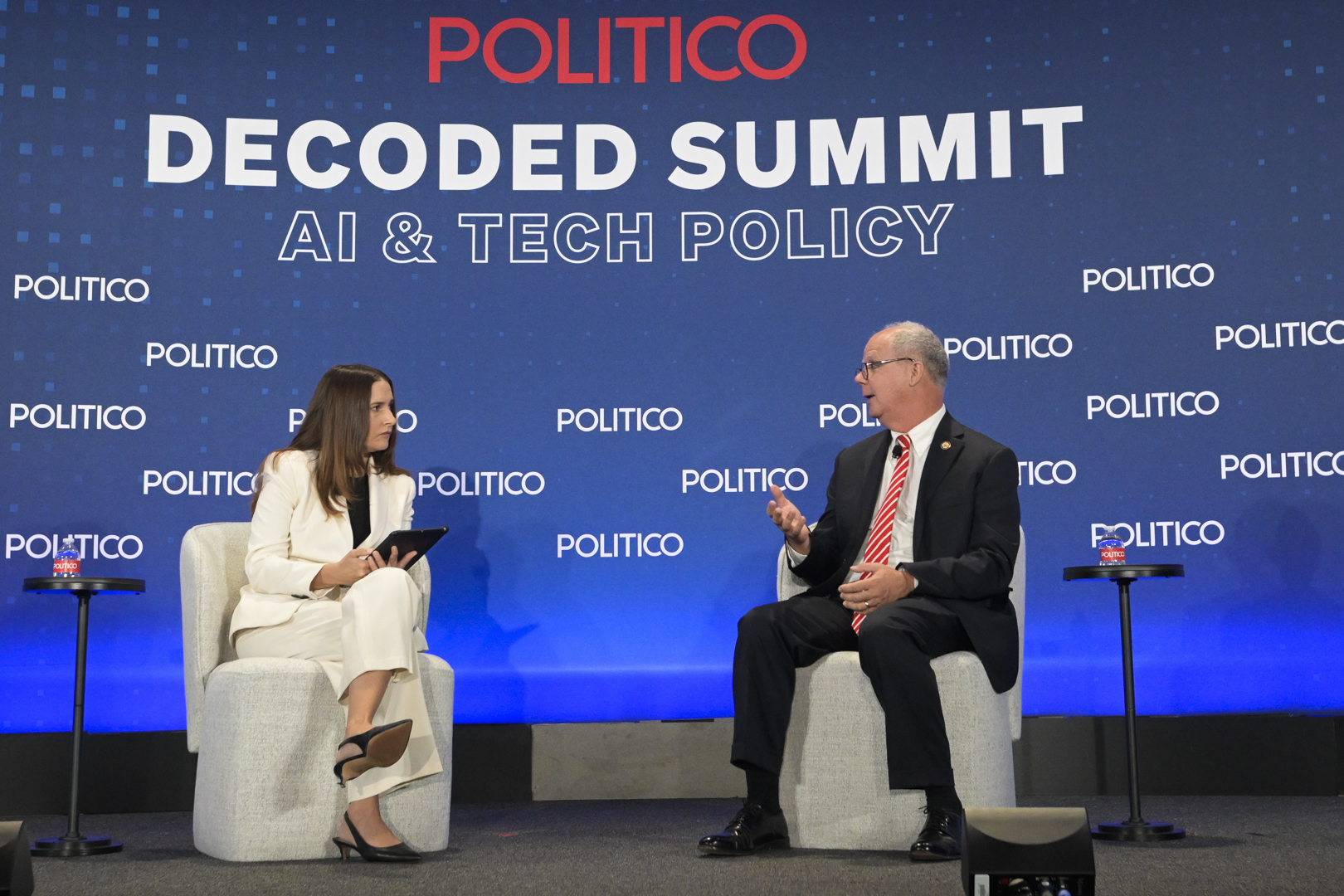
Republican Energy and Commerce Chair Brett Guthrie argued the U.S. cannot risk Chinese AI dominance, and that AI legislation is too complex to rush — even if that means pushing off until next year consideration of a measure by his panel.
“We absolutely can’t surrender,” he said Wednesday at POLITICO’s Decoded Summit.
Meanwhile, the head of the Congressional Progressive Caucus said competition isn’t a reason to avoid guardrails.
“The AI race is not an arms race that you win,” Rep. Greg Casar said at the Decoded Summit.
Other lawmakers from both sides of the aisle are trying to strike a balance. Rep. John Moolenaar, chair of the House Select Committee on the Chinese Communist Party, acknowledged lawmakers “do have a responsibility for public safety” while saying it was also important to “beat China when it comes to the AI race.”
Still, the emerging divisions spotlight a long road ahead for any consensus from Congress.
An attempt to quickly pass a bill requiring companies to build a “kill switch” into their AI models from Republican Sen. John Kennedy was blocked Wednesday by Sen. Rand Paul on the chamber’s floor.
And while Guthrie’s Senate counterpart, Commerce Chair Ted Cruz said Wednesday his hope was still to mark up this month a bipartisan AI safety bill from Majority Leader John Thune and Sen. Amy Klobuchar, lawmakers haven’t reached agreement to finalize the measure. Thune himself said Wednesday he was unsure it would happen before the midterms.
Cracks are also starting to show among the leading AI companies on what role they want Congress to play.
One example: Anthropic’s policy chief Sarah Heck declined at POLITICO’s summit to endorse a proposal for congressionally mandated independent AI monitoring — a day after competitor OpenAI endorsed it. The proposal is a key provision in Reps. Jay Obernolte and Lori Trahan’s bipartisan AI safety measure.
The House’s early dismissal Wednesday only added to time pressure on lawmakers, who will return to a lame duck session with an already full calendar.
What else we’re watching:
— LEE BULLISH ON PERMITTING: Energy and Natural Resources Chair Mike Lee told fellow Republicans during a closed-door lunch Wednesday he is “guardedly optimistic” that negotiators will reach a long-sought deal on a bill to ease permitting approval for energy projects. “We were told today that the Democrats are going to agree to a permitting bill, and it’s going to be drafted and ready for us to vote on,” Kennedy said in an interview. Still, the top negotiators have yet to clinch an agreement, meaning the timeline could slip until after the midterms.
— SPY LAW TIMING UNCLEAR: The Office of the Director of National Intelligence recently warned Congress that if it doesn’t vote on a controversial surveillance law by Nov. 20, the program could go dark, but it’s unclear congressional leadership can meet that deadline. Thune told reporters this week that there is an “interest” in trying to get Section 702 of the Foreign Intelligence Surveillance Act reauthorized, but didn’t commit to getting a vote before the midterms. With the House gone, reauthorization will wait until at least mid-November, regardless.
Riley Rogerson, Mia McCarthy, Anna Wiederkehr, Jordain Carney, John Sakellariadis and Josh Siegel contributed to this report.
Read the full article here